The Keyword Era

Discover how early search engines worked by matching simple keywords, why this system was easily manipulated, and how its failure paved the way for the intelligent search we use today.

12 min read
Foundations
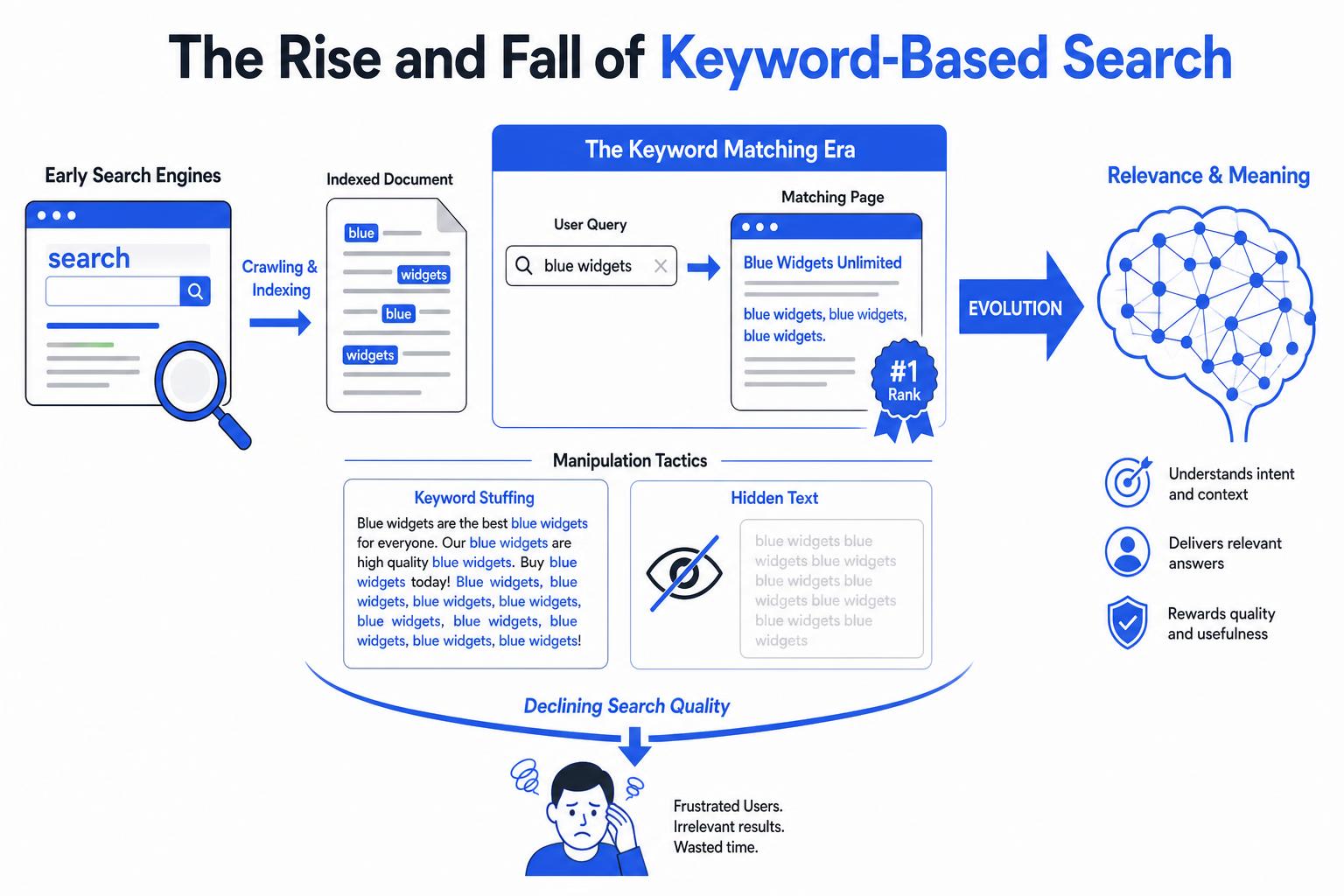
<h3>Learning Objectives</h3> <ul> <li>Define what a 'keyword' meant for early search engines.</li> <li>Explain the concept of 'keyword matching' and 'keyword density.'</li> <li>Identify common manipulation tactics like 'keyword stuffing.'</li> <li>Understand why keyword-focused search led to a poor user experience.</li> <li>Recognize the limitations that prompted search engines to evolve.</li> </ul> <h2>Introduction: Finding a Needle in a Digital Haystack</h2> <p>Imagine a massive, global library with no card catalog and no librarians. Books are being added every second by anyone who wants to contribute. Some books are brilliant, some are nonsense, and some are just advertisements disguised as books. This was the early internet. It was a chaotic, disorganized, and rapidly expanding universe of information. The fundamental problem was simple: <em>how do you find anything?</em></p> <p>This challenge gave rise to the first search engines. Their goal was to bring order to the chaos. To do this, they needed a system, a set of rules to decide which of the millions of documents was the most relevant to your search. The first and most intuitive rule they used was based on one simple thing: the words you typed into the search box. Welcome to the Keyword Era, the foundational period that shaped everything we know about search today.</p> <h2>How Early Search Engines Worked</h2> <p>Before a search engine can show you results, it first needs to know what's out there. Early search engines, like AltaVista, Lycos, and Excite, built their indexes using automated programs called "spiders" or "crawlers."</p> <p>Think of a spider as a tireless digital librarian. It starts on a known webpage, reads its entire content, and follows every link on that page to discover new pages. It then reads <em>those</em> pages, follows <em>their</em> links, and so on. This process, called "crawling," is a never-ending journey to discover and map out the web.</p> <p>As the spider reads each page, it sends the information back to the search engine's massive database, or "index." This index isn't just a list of websites; it's a record of the words found on every page. So, if a page about baking apple pies contained the words "apple," "pie," "cinnamon," and "recipe," the index would associate that page with those words.</p> <h2>The Rise of Keyword Matching</h2> <p>Now, when you wanted to find an apple pie recipe, you'd go to a search engine and type in a query. A <strong>keyword</strong> is simply the word or phrase you type into the search box. In this case, your keyword might be "apple pie recipe."</p> <p>The search engine's job was to perform a deceptively simple task: <strong>keyword matching</strong>. It would look at your keywords and then scan its entire index for pages that contained those exact words. The core logic was this:</p> <ul> <li>If a page contains the words the user searched for, it must be relevant.</li> <li>If a page contains the words the user searched for <em>many times</em>, it must be <em>very</em> relevant.</li> </ul> <p>This led to a simple but powerful ranking principle. The pages that repeated your keywords the most were often ranked the highest. It was a numbers game. More mentions equaled more relevance, which equaled a higher position in the search results.</p> <h2>What Is Keyword Density?</h2> <p>As website creators realized how this system worked, they needed a way to measure their efforts. This led to the concept of <strong>keyword density</strong>.</p> <p>Keyword density is a simple percentage that measures how often a keyword appears on a page relative to the total number of words.</p> <p><strong>The formula is:</strong> (Number of times a keyword appears / Total words on the page) x 100</p> <h3>A Simple Example</h3> <p>Let's say you own a website that sells a fictional product: "atomic laser pointers." You write a 100-word description for your product page. To rank for the keyword "atomic laser pointers," you decide to mention it 5 times.</p> <ul> <li><strong>Keyword:</strong> "atomic laser pointers" (3 words)</li> <li><strong>Number of mentions:</strong> 5</li> <li><strong>Total words on page:</strong> 100</li> </ul> <p>Your keyword density would be 5% (5 / 100 * 100). In the Keyword Era, a webmaster might think, "My competitor has a 4% density. If I can increase mine to 6% or 7%, the search engine will think my page is <em>more about</em> atomic laser pointers and rank me higher!" This thinking was the fuel for a frantic race to manipulate search rankings.</p> <h2>How Rankings Were Manipulated</h2> <p>The fatal flaw of a system based on counting words is that it's incredibly easy to game. If the search engine rewarded pages for simply repeating a word, then why not repeat it as much as possible? The motivation was clear: a #1 ranking meant traffic, attention, and money. The method was simple: add more keywords.</p> <p>This gave birth to a set of manipulative tactics known as "spamming" or, more specifically, <strong>keyword stuffing</strong>.</p> <p>Content creators and early SEOs (Search Engine Optimizers) shifted their focus from creating a good experience for the <em>human user</em> to creating a page that looked perfect for the <em>search engine spider</em>. The user became secondary. The primary audience was the algorithm.</p> <h2>Keyword Stuffing Explained</h2> <p>Keyword stuffing is the practice of loading a webpage with keywords in an attempt to manipulate a site's ranking in search results. It took many forms, from obvious and ugly to sneaky and hidden.</p> <h3>Visible Keyword Stuffing</h3> <p>This was the most blatant approach. The text was written for a robot, not a person, resulting in content that was unnatural and often unreadable.</p> <blockquote> <p><em>"Welcome to our cheap custom widgets shop! We sell the best cheap custom widgets you can buy. If you are looking for cheap custom widgets, look no further. Our cheap custom widgets are made from the highest quality materials. Order your cheap custom widgets today!"</em></p> </blockquote> <p>Reading this is painful. It provides no real information and is clearly just repeating a phrase. Yet, to an early search engine, this page looked incredibly relevant for the query "cheap custom widgets."</p> <p>Another common tactic was to have a list of keywords at the bottom of the page, often listing every city or state they wanted to rank in:</p> <ul> <li><em>We sell widgets in: New York, Boston, Chicago, Los Angeles, San Francisco...</em></li> </ul> <h3>Hidden Keyword Stuffing</h3> <p>As search engines and users became warier of this practice, manipulators got sneakier. The most common method was to include large blocks of keywords but make them invisible to the human eye.</p> <ul> <li><strong>Hidden Text:</strong> The most famous trick was to put keyword-stuffed text on a page and set its color to be the same as the background color (e.g., white text on a white background). A human visitor wouldn't see it, but the simple search engine spider would read it all and count every word.</li> <li><strong>Tiny Text:</strong> Setting the font size to 1 or 0 would make the text invisibly small to the user, but still present in the HTML code for the crawler to find.</li> <li><strong>Meta Keywords Tag:</strong> HTML has a special tag called the <code>meta keywords</code> tag, which was originally intended for authors to tell search engines what the page was about. Predictably, it was abused. People would "stuff" hundreds of keywords into this tag, hoping to rank for all of them.</li> </ul> <h2>Why Search Quality Declined</h2> <p>The result of all this manipulation was a terrible experience for the average user. You would search for something you needed, like "best digital camera reviews," and the top results would be pages like:</p> <ul> <li>A page with dozens of paragraphs of unreadable, repetitive text about "best digital camera reviews."</li> <li>A page with a few sentences and a huge block of invisible white-on-white text listing every camera model ever made.</li> <li>An e-commerce site that listed hundreds of cities at the bottom, hoping to rank for "digital cameras in Dallas."</li> </ul> <p>Finding genuinely helpful, well-written content became a chore. Users lost trust in the search engines. After all, if the top result is garbage, what's the point of using the service? The search engines faced an existential crisis: evolve or become irrelevant.</p> <h2>The Move Towards Relevance</h2> <p>The architects of search, especially at a then-emerging company called Google, realized that counting keywords was a fool's errand. A truly helpful search engine needed to understand not just the words on a page, but also a page's <strong>quality, authority, and actual meaning</strong>.</p> <p>They understood that relevance isn't about how many times a page says "apple pie." A truly relevant page is one that:</p> <ul> <li>Comes from a trusted source (like a well-known cooking website).</li> <li>Is recommended by other trusted sources (i.e., other websites link to it).</li> <li>Contains related concepts like "baking," "oven," "temperature," "flour," and "butter"—words that show a deep understanding of the topic, not just repetition of a single keyword.</li> </ul> <p>This realization marked the end of the Keyword Era as the dominant force in search. It was the beginning of a new, more complex and intelligent chapter—an arms race not of repetition, but of relevance.</p> <h2>Connection To Modern Search</h2> <p>Does this mean keywords are no longer important? Absolutely not. They are still the starting point of nearly every search. However, their role has fundamentally changed. Today, keywords are signals, not commands. They tell modern search engines what topic you are interested in, but the engine then uses sophisticated AI to find the best <em>answer</em>, not just the page with the most matching words. The lessons learned from the failures of the Keyword Era directly shaped the principles of modern SEO, semantic search, AEO, and GEO — disciplines built on relevance, authority, and intent rather than repetition.</p> <h2>Lesson Summary</h2> <p>The Keyword Era was the foundational period of search where ranking was driven by simple word matching and keyword density. While ingenious for its time, the system's simplicity invited widespread manipulation through keyword stuffing, ultimately degrading the user experience and forcing a complete rethink of how search engines determine relevance. Understanding this era is essential because it explains <em>why</em> modern search — and modern AI Visibility — looks the way it does today.</p> <h2>The AI Visibility Perspective</h2> <h3>Why Keyword Matching Isn't Enough</h3> <p>In the Keyword Era, search engines were like simple file clerks. You asked for all documents containing the word "profit," and they'd give you every single one, regardless of context. A document about "company profit," "prophet of doom," or "how to profit from gardening" were all treated similarly based on that one keyword match. This is fundamentally incompatible with how modern AI works.</p> <p>AI-powered search, like voice assistants (Siri, Alexa) and generative engines (ChatGPT, Google's SGE), operates on <strong>semantic understanding</strong>. They don't just match words; they comprehend <em>meaning, intent, and context</em>. When you ask an AI, "What was the company's profit last quarter?" it knows you're asking about financial gain, not a religious figure.</p> <p>This is the core of modern AI Visibility. Repetition, the hallmark of the Keyword Era, is a negative signal for an AI. An AI values conciseness and accuracy. It's looking for the single best answer, not a list of 10 blue links. Stuffing your content with the phrase "company profit last quarter" won't make you the source for the AI's answer. In fact, it does the opposite. The AI's language models will likely perceive this as low-quality, spammy content and ignore it.</p> <p>This is where Answer Engine Optimization (AEO) and Generative Engine Optimization (GEO) diverge sharply from old SEO. Your goal is no longer to just rank for a keyword. Your goal is to be the <strong>definitive source of the answer</strong>. This requires:</p> <ul> <li><strong>Clarity and Structure:</strong> Using clear headings, lists, and direct statements that an AI can easily parse and synthesize.</li> <li><strong>Factual Accuracy:</strong> Providing verifiable data and information that the AI can trust.</li> <li><strong>Topical Authority:</strong> Covering a subject comprehensively, demonstrating expertise through detailed, well-explained content, not by repeating phrases.</li> </ul> <p>The legacy of the Keyword Era teaches us what AI is evolving away from. Visibility in the age of AI isn't about repeating what the user said. It's about deeply understanding the question they're asking and providing the most direct, authoritative, and helpful answer possible.</p> <h2>Reflection Questions</h2> <ol> <li>Why was keyword density initially seen as a logical and fair way to determine a page's relevance?</li> <li>Have you ever landed on a 'keyword stuffed' page, even recently? How did it make you feel as a user and how quickly did you leave?</li> <li>What problems would exist on the internet today if search engines never evolved beyond simple keyword matching?</li> <li>How does the primary goal of a content creator in the Keyword Era differ from the primary goal of a content creator today?</li> <li>Beyond web search engines, can you think of another digital tool you use that still relies on simple keyword matching (e.g., a simple file search on your computer, an old email client)?</li> </ol> <h2>Further Reading</h2> <ul> <li><strong>The Concept of Links as 'Votes'</strong> — Discover how Google's PageRank algorithm revolutionized search by treating links from other sites as endorsements of quality.</li> <li><strong>Understanding User Intent</strong> — Learn the difference between what a user types (their keywords) and what they actually want to achieve (their intent).</li> <li><strong>Algorithms That Penalize Spam</strong> — Explore the major Google updates, like 'Florida' and 'Panda,' that were designed specifically to identify and demote low-quality, keyword-stuffed content.</li> <li><strong>The Shift from Keywords to Topics</strong> — See how search engines began to build 'knowledge graphs' to understand the relationships between concepts, not just words.</li> <li><strong>Prioritizing E-A-T</strong> — An introduction to the principles of Expertise, Authoritativeness, and Trustworthiness, and why they became the gold standard for high-quality content.</li> </ul>

Key takeaways

  • Early search engines indexed the web using automated 'spiders' or 'crawlers'.
  • Keyword matching was the first primary method for ranking pages in search results.
  • A 'keyword' is the specific word or phrase a user types into a search engine.
  • Keyword density—the percentage of times a keyword appears—was used to measure relevance.
  • The belief was that higher keyword density meant a page was more relevant.
  • This simple system was easily manipulated through a tactic called 'keyword stuffing'.
  • Keyword stuffing involves unnaturally repeating keywords, sometimes hidden from the user.
  • Widespread manipulation led to a severe decline in search result quality and user trust.
  • The failure of keyword-based ranking forced search engines to evolve towards understanding true relevance and quality.
  • While stuffing is obsolete, understanding user keywords remains a crucial part of modern content strategy for signaling topics.

The Keyword Era Quiz

Pass at 70%.

1. How did early search engines primarily decide which web pages to show a user?
2. Which phrase describes the practice of measuring the percentage of times a specific word appears on a web page compared to the total word count?
3. What term refers to the spammy technique of repeating a target phrase unnaturally to trick search engines into ranking a page higher?
4. What was the primary result of website creators exploiting early keyword-based search algorithms?
5. If a local bakery claims to sell the best custom cakes and writes a paragraph repeating "best custom cakes" in every single sentence, what practice are they demonstrating?
6. A user searches for "affordable running shoes", but a highly relevant article uses the phrase "cheap jogging sneakers" instead. How would an early keyword-era search engine handle this article?
7. To fix the problems of the keyword era, search engines eventually had to change their algorithms. What new approach did they prioritize?
8. How does an Artificial Intelligence tool reading a web page differ from an early search engine reading that same page?
9. When designing content for modern AI visibility, why is writing purely for exact keyword density a poor strategy?
10. In the context of AI and modern search, what is the best way to view the role of a "keyword"?
Create a free account to save progress and earn a certificate.