Learning Objectives
By the end of this lesson, you will be able to:
- Describe how people found websites before modern search engines.
- Explain the role and structure of early web directories, using Yahoo! as an example.
- Define what a basic, keyword-based search engine was and how it worked.
- Understand the limitations of these early discovery methods.
- Connect the historical challenge of 'getting found' to the modern field of AI Visibility.
The World Before a Search Bar
Imagine you wanted to bake a cake, but there were no cookbooks. Not only that, there wasn't even a library or a bookstore. The only way to get a recipe was if a friend physically handed you a piece of paper with one written on it. This is a close analogy for the World Wide Web in its earliest days, the early 1990s.
It was a collection of digital 'pages' on a system called the internet, but there was no central map, no index, and no easy way to find anything. The web was a digital 'Wild West'—a vast, unorganized frontier. If you didn't already know the exact address (the URL, like http://example.com/page.html) of a website, you were unlikely to find it.
This created a fundamental problem that we still work to solve today: How do you make information visible to the people who need it?
Finding Your Way: The Age of Manual Sharing
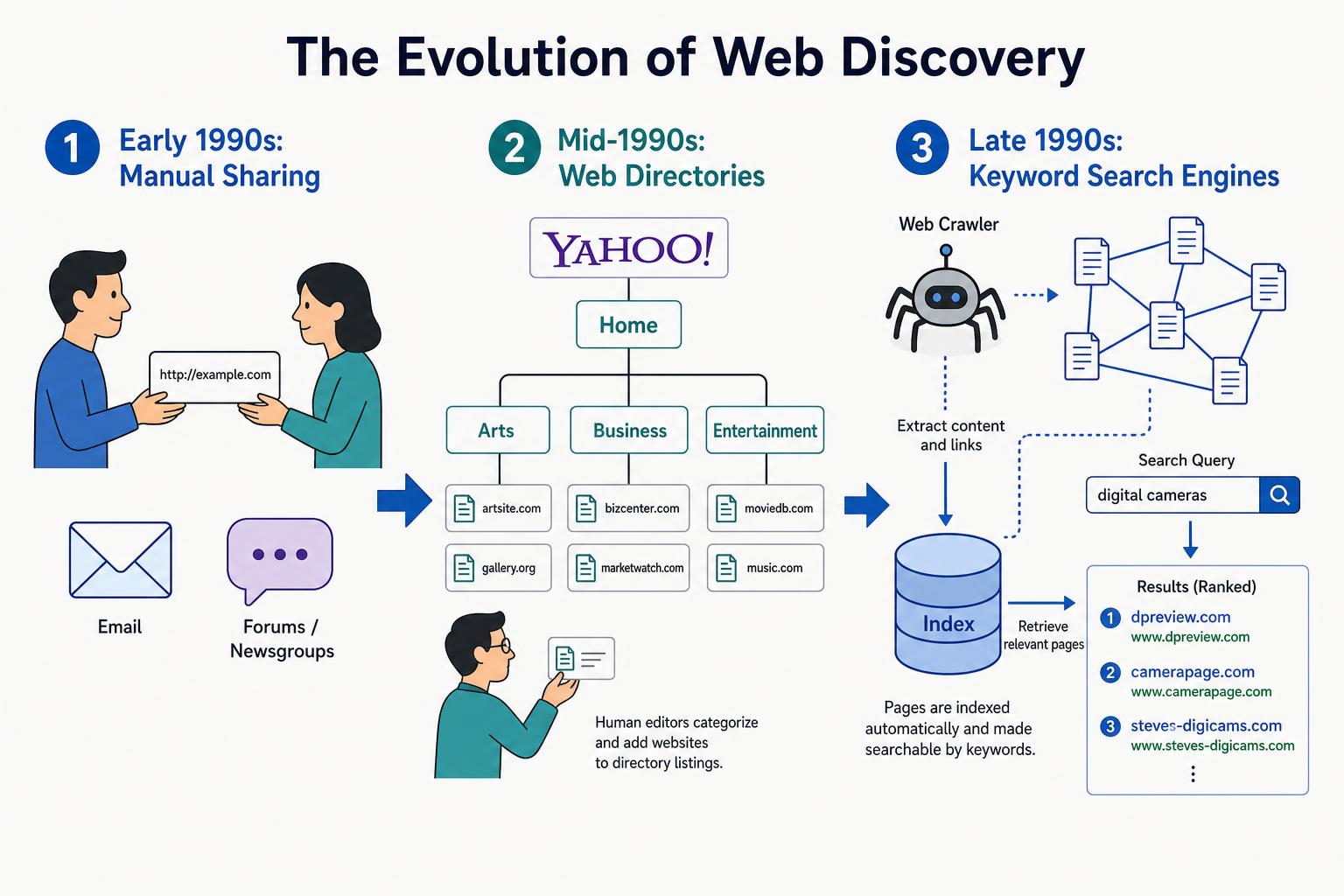
In the beginning, the solution was purely social and manual. People discovered new websites through:
- Word-of-Mouth: Just like in the physical world, someone would tell you about a cool new website they found.
- Email and Email Lists: You might get an email from a colleague with a subject line like "Check this out!" containing a link to a new resource.
- Usenet & Bulletin Board Systems (BBS): These were early online forums where communities gathered to discuss specific topics (e.g., astronomy, movies, programming). In these digital meeting rooms, people would post links to relevant websites they had created or discovered.
This was a slow, person-to-person process. It worked for a small, academic, and technically-savvy community, but it couldn't possibly keep up as the web started to grow exponentially. A new solution was needed to bring some order to the chaos.
Bringing Order to Chaos: The Rise of Web Directories
As the number of websites exploded into the thousands, a more structured approach emerged: the web directory. Think of it as the internet''s first attempt at a library card catalog.
What Was a Web Directory?
A web directory was a website that organized links to other websites into a hierarchical list of categories and subcategories. The most crucial detail is this: these directories were built and maintained by humans.
If you created a new website about vintage cars, you would go to a directory and submit your site. A human editor would review your website. If they approved it, they would manually place a link to it in the appropriate category, perhaps under: Recreation > Automobiles > Classics > Vintage.
This process created a browseable, topic-based 'map' of the web. Instead of needing to know the address beforehand, you could now navigate to a topic you were interested in and discover relevant sites.
Real-World Example: Yahoo!
The most famous and dominant web directory of the 1990s was Yahoo!. Founded in 1994 by Jerry Yang and David Filo, its original name was "Jerry and David's Guide to the World Wide Web." It wasn't a search engine in the way we think of one today; it was a gigantic, hand-curated list.
When you visited the Yahoo! homepage in 1996, you didn't see a prominent search bar. You saw a list of top-level categories, such as:
- Arts & Humanities
- Business & Economy
- Computers & Internet
- Education
- Entertainment
If you were looking for information on the movie Star Wars, you would click Entertainment, then Movies, then Science Fiction, then Star Wars. There, you would find a list of fan sites, official pages, and news articles, all reviewed and placed by a Yahoo! employee.
The Limitations of Directories
For a while, directories were an elegant solution. They provided structure and a quality filter, as human editors would reject low-quality or irrelevant sites. However, the web''s explosive growth soon revealed their fatal flaw: they couldn''t scale.
- Sheer Volume: By the late 1990s, millions of new pages were being created every day. A team of human editors, no matter how large, simply couldn''t keep up with reviewing, categorizing, and adding every new site.
- Maintenance: Websites change or disappear. Keeping the directory''s links fresh and removing dead ones was a monumental, never-ending task.
- Subjectivity & Bias: What one editor deemed important, another might ignore. Placement also depended on how well a site owner wrote their submission description. Furthermore, what category does a site about the philosophy of car design belong in?
PhilosophyorAutomobiles? The rigid structure often failed to capture the complexity of information.
The Next Leap: The First Search Engines
The limitations of human-powered directories created an opportunity for a new, automated approach: the search engine.
From Human Curators to Web Crawlers
Instead of relying on humans to submit and categorize sites, early search engines like AltaVista and Lycos unleashed automated programs onto the web. These programs, known as "bots," "spiders," or "web crawlers," had a simple but powerful job.
- Start with a list of known web pages.
- Visit each page and read its entire text content.
- Store all that text in a massive database, called an index.
- Follow every link on that page to discover new pages, then repeat the process.
Imagine a robot that could read every book in a city-sized library in a single day and create a master index of every word in every book. That''s what a web crawler does for the internet.
Keyword Matching: A Simple but Flawed System
When you used an early search engine like AltaVista, you would type in a query (e.g., "classic car restoration"). The engine would then do something very simple: it would go to its massive index and find all the pages that contained those exact words. It then displayed a list of those pages.
This was revolutionary! For the first time, you could find information on pages you never knew existed, without browsing through categories. The system was fast, comprehensive, and scaled perfectly with the growing web.
However, the results were often chaotic. The primary ranking factor was keyword density—how often your search term appeared on the page. The engine assumed that a page mentioning "classic car restoration" 20 times was more relevant than a page that mentioned it only 3 times. This logic was easily exploited.
The "Spam" Problem: Keyword Stuffing
Cunning website owners quickly figured out how this system worked. To get their site to the top of the results, they started engaging in a practice called keyword stuffing. They would either repeat their target keywords over and over in the visible text, or they would hide them by making the text the same color as the background.
A page for a mechanic might have a paragraph at the bottom that read: "car repair car repair cheap car repair best car repair fast car repair auto shop auto mechanic auto mechanic..." To the simple search engine algorithm, this page looked like the most relevant result in the world. To a human user, it was spammy and unhelpful.
The AI Visibility Perspective
This journey from manual sharing to keyword-stuffed search results may seem like ancient history, but it establishes the fundamental concepts that drive our work today in AI Visibility.
-
The Core Problem is Timeless: The basic challenge—"How do I connect my content with the right audience?"—has existed since the web began. The methods change, but the goal remains the same.
-
The First "SEO": Submitting your site to Yahoo! and writing a compelling description to convince a human editor was the very first form of Search Engine Optimization (SEO). You were optimizing your content for a human-powered search system.
-
Action and Reaction: The rise of keyword stuffing demonstrates a dynamic that continues today. As soon as a system for ranking information is created, people will try to understand and influence it to gain visibility. This forces the search systems to become smarter and more sophisticated to combat manipulation and provide better results.
Understanding the failures of directories and early keyword search is essential. It tells us why Google had to invent a better way (which we''ll cover in the next lesson) and why search engines continue to evolve with complex AI today. The simple desire to find a good cake recipe online set in motion a technological arms race that has led us directly to the world of modern, AI-powered search.
Reflection Questions
- How would your daily work or personal life change if you had to rely on a human-curated directory instead of a modern search engine?
- What are the biggest advantages and disadvantages of a human-curated web versus an algorithm-curated one?
- Can you think of any modern equivalents to the old web directories that you use today (e.g., app stores, podcast directories, ''awesome lists'' on GitHub)?
- Why was the shift from relying on human submissions (directories) to automated crawling (search engines) so revolutionary for the internet?
- Reflecting on keyword stuffing, what does this tell you about the inherent tension between content creators wanting visibility and search systems wanting to provide quality, unbiased results?
Further Reading
- The PageRank Algorithm and the Founding of Google
- The History of SEO: From Keyword Stuffing to E-E-A-T
- The Difference Between the Internet and the World Wide Web
- An Introduction to How Modern Search Engines Crawl and Index Websites
- The Rise of AI Search Engines (e.g., Perplexity, Google AI Overviews)