Introduction
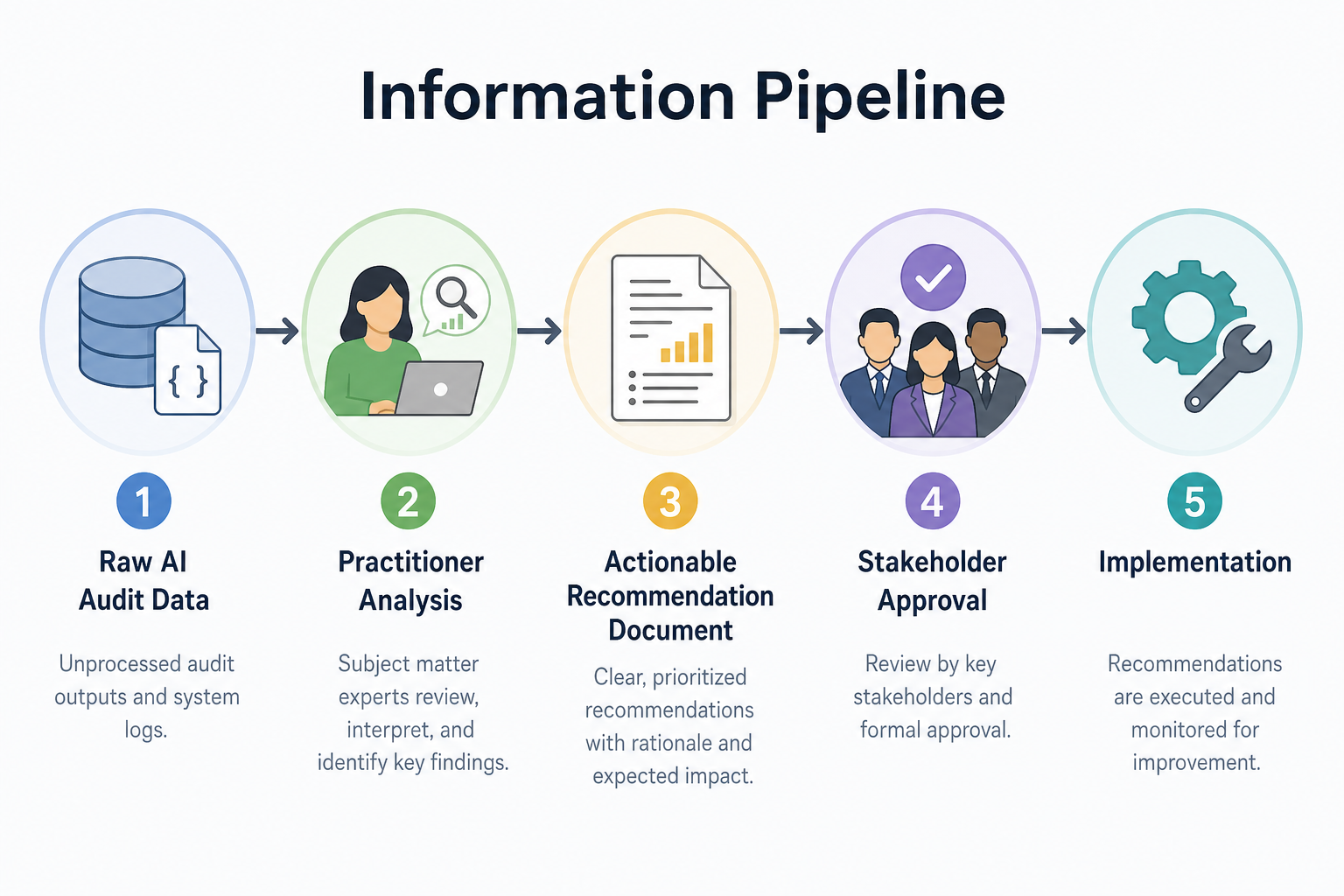
Transitioning from raw technical data to a client-facing recommendations document is the most critical phase for an AI Visibility Practitioner. While your analysis might identify obscure latent semantic gaps or complex citation patterns in Large Language Models (LLMs), these insights are worthless if a busy Marketing Manager or Web Developer cannot understand them. This lesson focuses on the 'Recommendations Document'—the bridge between AI analysis and real-world execution. We will move away from academic theory and focus on building a prioritised, clear, and actionable roadmap that focuses on business outcomes rather than technical vanity metrics.
The Anatomy of an AI Visibility Recommendation
A common mistake is to treat an AI Visibility report like a traditional SEO technical audit. While there are overlaps, AI recommendation documents must address three distinct layers of content consumption: the Stakeholder (Who pays the bills?), the Content Creator (Who writes the copy?), and the Developer (Who builds the structure?).
1. Executive Summary and The 'So What?'
Start with the high-level findings. If your client's brand is missing from Perplexity's 'Best CRM for SMEs' answer, say it clearly. Use a 'Status -> Impact -> Action' framework.
- Status: Brand absent from top 3 AI engines for key commercial queries.
- Impact: Estimated loss of 15% of high-intent top-of-funnel traffic.
- Action: Implement structured data and authoritative third-party earned media campaign.
2. Strategic Prioritisation
Do not provide a list of 50 tasks. Use a 'Power vs. Effort' matrix to pick 5-7 high-impact recommendations. Categories should include Content Logic (what we say), Technical Scaffolding (how we label it), and Credibility Signals (who says it about us).
3. Clear Instruction Sets
Use imperative language. Instead of saying 'Consider adding some schema,' use 'Apply ProductGroup Schema according to the 2024 Google/LLM documentation updates to the following URLs.'
Translating Technical Terms for Non-Specialists
To ensure your document is acted upon, you must translate 'AI Speak' into 'Marketing Speak'.
- Instead of 'Latent Dirichlet Allocation Optimization': Use 'Closing Topical Content Gaps'.
- Instead of 'Improving Cosine Similarity': Use 'Making our content more relevant to the user query'.
- Instead of 'N-Gram Frequency Analysis': Use 'Using the terminology our customers actually use'.
- Instead of 'LLM Citation Probability': Use 'Brand Awareness within AI Search'.
The Worked Example: 'SaaS Flow' Case Study
Imagine you are working for 'SaaS Flow', a project management tool. Your audit shows they are cited for 'free tools' but never for 'enterprise solutions', despite having an enterprise tier.
Recommendation 1: The 'Authority Pivot'
Observation: AI models associate SaaS Flow with 'SME' and 'Free' based on 2021-2022 dataset training. Recommendation: Create five deep-dive whitepapers on 'Enterprise Resource Planning for Global Teams'. Action for Client: Content team to produce these by Q3; Marketing team to pitch these to three specific industry publications (TechCrunch, Forbes, CIO) to trigger new crawls/indexing by AI agents.
Recommendation 2: Dataset Refresh via Structured Data
Observation: LLMs are hallucinating SaaS Flow's pricing. Recommendation: Update PriceSpecification Schema and create a dedicated /pricing-faq/ page with clear, extractable tables. Action for Client: Web developer to deploy JSON-LD to the pricing page. Content team to ensure tables are HTML-based, not images or JavaScript-heavy elements.
Structuring the Document
A professional document should follow this template:
- Project Scope: What we audited (which engines, which queries).
- Current AI Share of Model (SoM): A visual representation of current visibility versus competitors.
- The 'Quick Wins': Metadata and schema fixes that take < 2 hours.
- The Strategic Content Roadmap: Long-term content adjustments to influence model weights.
- Citations & Relationships: A plan for external link-building and mentions on high-authority 'seed' sites.
- Measurement Framework: How we will track success (e.g., mention frequency in monthly Perplexity audits).
Common Pitfalls to Avoid
- Over-promising on 'Tricking' AI: Avoid language that suggests you are 'gaming' the algorithm. Use 'Alignment' and 'Clarity'.
- Vague Instructions: 'Improve content' is not a recommendation. 'Add a 3-sentence summary at the top of the 'How it Works' page to improve snippet extraction' is a recommendation.
- Ignoring Technical Constraints: If the client uses a legacy CMS that doesn't allow Schema edits, don't make it a top priority without suggesting a workaround (like a GTM injection, though less ideal).
- Lack of Visuals: Use screenshots of AI responses. Seeing a competitor's name where theirs should be is a powerful motivator for stakeholders.
Putting it into Practice
To move from theory to delivery, follow these steps for your first client document:
- Draft the 'Action Table' first: Ensure every task has an owner (Dev, Content, or PR).
- Read it as a CEO: Does the executive summary prove ROI?
- Read it as a Dev: Are the technical instructions specific enough to execute without a follow-up meeting?
- Include a 'Jargon Buster': A small appendix defining terms like 'Generative Engine Optimization' or 'Citation Graph' so the client feels educated, not overwhelmed.