Presenting an AI Visibility Audit

Master the art of translating complex LLM data into actionable business insights during client presentations to secure buy-in for AI visibility strategies.

12 min read
Foundations

Introduction

Presenting an AI Visibility Audit is a critical stage in the practitioner's workflow. Unlike a standard SEO audit, which focuses on technical health and keyword rankings, an AI Visibility Audit examines how Large Language Models (LLMs) perceive and recommend a brand. For many clients, this is a new and potentially confusing concept. Your role is to bridge the gap between technical data—such as sentiment analysis, citation frequency, and probabilistic association—and the client’s bottom-line business objectives. This lesson provides a structured framework for delivering these insights with clarity, authority, and commercial focus.

The Psychology of the AI Audit Presentation

When presenting AI visibility findings, you are often dealing with a 'black box' perception. Clients may feel overwhelmed by the lack of direct control over AI responses. Your presentation must reassure them that while LLMs are non-deterministic, they are predictable and influenceable through robust data signals.

Avoid the temptation to lead with technical jargon. Instead of starting with 'latent Dirichlet allocation' or 'vector embeddings,' start with the 'Voice of the Machine.' Show the client exactly what ChatGPT, Claude, and Perplexity are saying about them today. This immediate visual and textual evidence creates a 'hook' that justifies the deeper analytical dive that follows.

Structuring Your Presentation

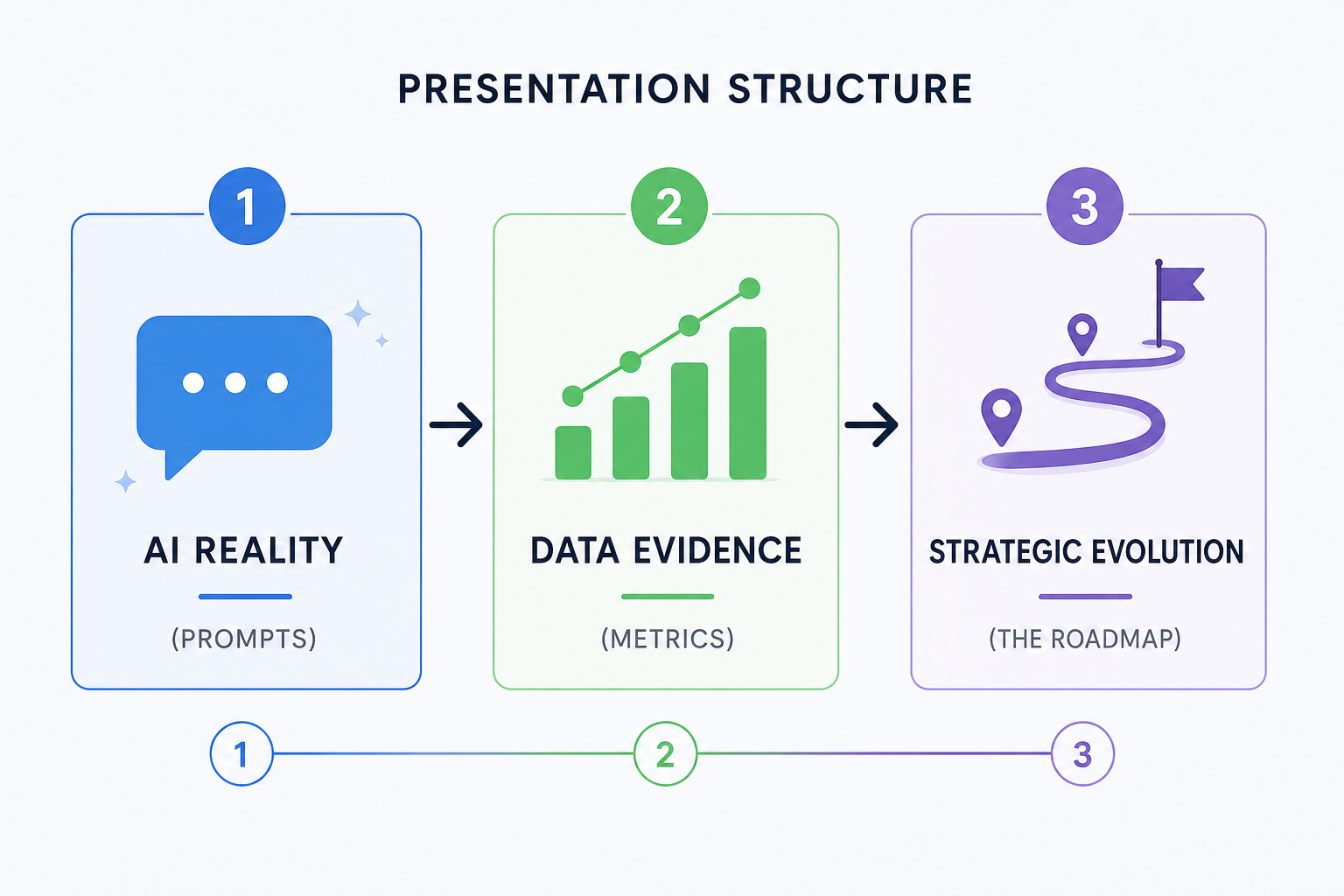
A successful presentation should follow a logical flow from high-level sentiment to granular data and, finally, a strategic roadmap.

1. The Executive Snapshot

Don't save the best for last. Open with a three-slide summary:

  • Current AI Brand Sentiment: Is the brand recommended, ignored, or criticised?
  • Visibility Share: How often does the brand appear in generative answers compared to two primary competitors?
  • The 'Gap' analysis: A single sentence defining the distance between current performance and the desired state.

2. The Narrative Audit (The 'Mirror')

Show screenshots of specific prompts. Use a mix of 'branded,' 'category,' and 'intent' prompts. For example, if you are auditing a fintech client, show the response to 'Which UK bank is best for small business loans?' Contrast this with 'Describe [Brand Name]’s reputation for customer service.' This section acts as a mirror, showing the client how the AI perceives their digital footprint.

3. The Data Deep Dive

Once the narrative is established, introduce your metrics. In the AI Visibility Practitioner framework, we focus on:

  • Citation Frequency: How many sources link back to the client per response?
  • Sentiment Polarity: Is the AI neutral, positive, or defensive?
  • Key Characteristic Mapping: Does the AI associate the brand with the correct USPs (e.g., 'affordable', 'innovative', 'reliable')?

4. Competitor Benchmarking

AI visibility is relative. Present a 'Citation Share' chart. If Perplexity generates 100 responses for a category, and Competitor A is cited in 40 of them while the client is cited in 2, the visual disparity creates immediate urgency for investment.

Worked Example: High-End E-bike Brand

Imagine you are presenting to 'VoltRide,' a premium e-bike manufacturer. Their SEO is strong, but their AI visibility is low because LLMs are hallucinating that their bikes are 'entry-level' due to outdated review data.

Slide A: The Problem. A screenshot of ChatGPT stating: 'VoltRide offers budget-friendly bikes but lacks the durability of brands like Specialized.'

Slide B: The Evidence. Data showing that 80% of the training data the LLM likely ingested came from 2021 reviews before the brand pivoted to premium materials.

Slide C: The Solution. A plan to target high-authority technology publications with updated specs to 'force' a refresh in the machine's knowledge graph.

Outcome: The client immediately understands that this isn't just a 'keyword' problem—it's a 'reputation and data' problem.

Handling Obstacles and Difficult Questions

Clients will inevitably ask, 'How do we know the AI won't change its mind tomorrow?' You must explain the concept of Information Persistence. Explain that while LLMs iterate, their underlying world-view is built on the density of consensus across the web. If 50 high-authority sites say X, the AI is unlikely to say Y. Your strategy is about building that consensus.

If a client asks about 'Direct SEO vs. AI Visibility,' use the 'Source Attribution' argument. Explain that many AI engines (like Perplexity and SearchGPT) provide direct links. Visibility in the AI answer is the new 'Position Zero.'

The Actionable Roadmap (The 'So What?')

Never end a presentation without a 30-60-90 day plan.

  • Days 1-30: Foundational fixes (Schema markup, updating 'About' pages, verifying Google Knowledge Panels).
  • Days 31-60: Content seeding (PR outreach to 'Seed Sites' that LLMs prioritise).
  • Days 61-90: Re-audit and fine-tuning prompts to see if recommendations have shifted.

Putting it into practice

To apply this in your next client session, follow this checklist:

  1. Pre-Presentation Test: Run your key prompts 30 minutes before the call. LLM responses can shift; don't be caught out by a version update mid-presentation.
  2. The 3-Prompt Lead: Select three prompts that perfectly illustrate the client's biggest AI visibility weakness.
  3. Commercial Tie-in: Always link a lack of citations to a loss in 'Share of Search' and potential revenue.
  4. The Comparison Slide: Visualise the client against their biggest rival in a radar chart across five metrics: Authority, Sentiment, Accuracy, Citation Share, and Recommendation Rate.
  5. Leave-behind Document: Provide a simplified PDF of the 'Narrative Audit' that they can share with internal stakeholders who weren't in the meeting.

Visual diagram

[ diagram placeholder ]

A flow chart showing the presentation structure: starting with the 'AI Reality' (prompts), moving to 'Data Evidence' (metrics), and concluding with 'Strategic Evolution' (the roadmap).

Exercise

Select a mid-tier brand in a category you know well. Run three prompts through Perplexity.ai: a branded query, a 'best of' category query, and a competitor comparison. Create three slides: one showing the current 'Voice of the Machine', one identifying a factual gap, and one proposing a 'seed site' the brand should target to fix that gap.

Key takeaways

  • Lead presentations with the 'Voice of the Machine' using real screenshots.
  • Address the 'Executive Snapshot' early to secure top-level engagement.
  • Contrast branded vs. category prompts to show the breadth of AI perception.
  • Use Citation Frequency as a primary metric for measuring visibility share.
  • Explain LLM responses as a reflection of web-wide consensus, not random chance.
  • Use competitor benchmarking to create a sense of strategic urgency.
  • Distinguish between 'Information Persistence' and 'Hallucinations' for the client.
  • Link AI visibility directly to 'Position Zero' and source attribution traffic.
  • Provide a 30-60-90 day roadmap to turn audit findings into concrete actions.
  • Always re-verify prompts immediately before a presentation due to LLM volatility.

Lesson Quiz

Pass at 70%.

1. What is the primary goal of the 'Executive Snapshot' in an AI audit presentation?
2. Why is it recommended to use screenshots of prompts in the presentation?
3. When an LLM provides incorrect data about a brand, what should you explain to the client?
4. What does 'Citation Frequency' measure in the context of an AI audit?
5. How should a practitioner handle 'nondeterministic' (varying) AI responses during a pitch?
6. Which of these is a 'Category Prompt'?
7. What is 'Information Persistence'?
8. In a 30-60-90 day roadmap, what usually happens in the first 30 days?
9. Why compare the client to competitors during the audit presentation?
10. What is the best way to prepare for an AI presentation regarding live tool updates?
Create a free account to save progress and earn a certificate.