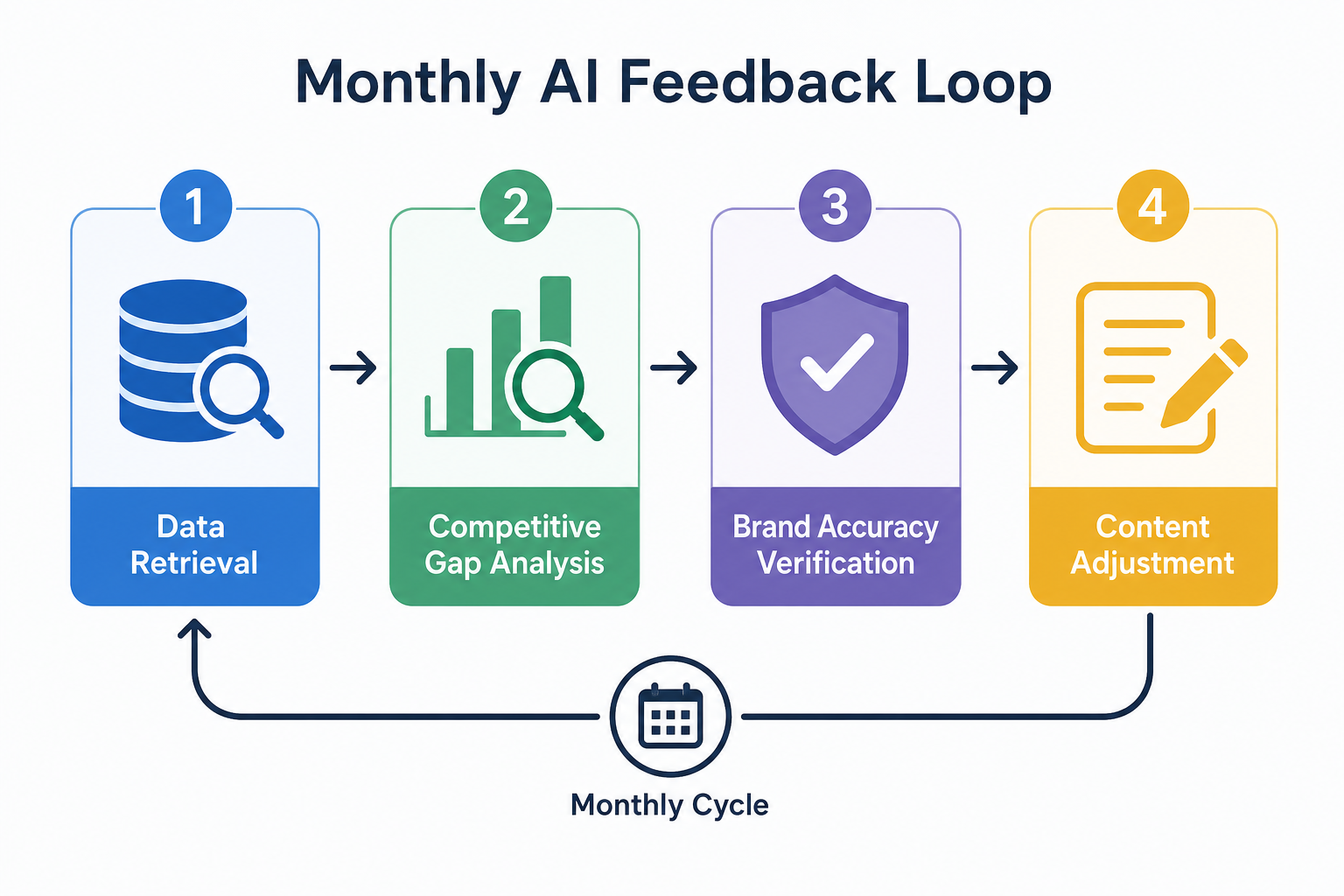
Establishing the Monthly AI Review Cycle
In the rapidly evolving landscape of Generative Engine Optimisation (GEO), monthly reviews are no longer just about tracking keyword rankings. They serve as a critical touchpoint to educate the client, validate your technical approach, and pivot based on the latest LLM (Large Language Model) updates. A successful monthly review bridges the gap between complex AI tracking data and bottom-line business value.
Traditional SEO reports focus on traffic and clicks. However, AI visibility often results in zero-click experiences or direct data sourcing. Your monthly review must shift the narrative from 'How many people visited the site?' to 'How often is our brand the primary source for the user's solution?' This lesson outlines a repeatable framework for these high-stakes engagements.
The Three-Pillar Monthly Framework
A professional AI visibility review should be structured around three main pillars: Performance Verification, Share of Model (SoM) Analysis, and the Strategic Roadmap.
1. Performance Verification
This section deals with the 'What'. You are documenting what happened over the last 30 days. Use APIs or manual tracking tools to report on:
- Citation Rate: How often your brand is cited in responses for target intent clusters.
- Sentiment & Accuracy: Is the AI representing your product features correctly?
- Referral Traffic (Direct): Traffic originating specifically from AI agents like Perplexity or ChatGPT (Pro/Search).
2. Share of Model (SoM) Analysis
SoM is the new Share of Voice. In this part of the review, you compare your presence against 3-5 key competitors within specific LLMs. Provide a snapshot of whose content the AI prefers and why. Is the competitor winning because of more structured data, or better long-form expertise? This provides the 'Why' behind the numbers.
3. The Strategic Roadmap
This is the 'What Next'. AI updates happen weekly. Your monthly review must include a section on reactive adjustments. This prevents the client from feeling like the strategy is static. If OpenAI releases a new search feature, this is where you explain how you are adapting the content pipeline to meet it.
Step-by-Step: Conducting the Review Meeting
Preparation (5 Days Before)
Gather data from your tracking tools (e.g., Perplexity queries, Google Search Console's AI Overviews data). Cross-reference this with lead generation or sales figures. Look for 'Citation Gaps'—keywords where you rank well in traditional search but are absent in AI answers.
The Presentation (45-60 Minutes)
- The Executive Summary (5 mins): Lead with the 'Big Win'. Did you secure a citation for a high-intent query?
- The Visual Deck (20 mins): Use screenshots of AI responses. Clients need to see the brand in the wild. Compare 'Month A' vs 'Month B' responses to show evolution.
- The Insight Deep-Dive (10 mins): Pick one specific topic. Explain why the AI chose a particular snippet of your content.
- Action Items (10 mins): Agreed tasks for the next month.
Worked Example: A B2B SaaS Client
Scenario: A cloud security firm wants visibility for 'Best enterprise firewall for remote teams'.
Month 1 Review:
- Finding: ChatGPT mentions the brand but attributes a feature incorrectly.
- Diagnosis: The product documentation page uses ambiguous phrasing.
- Action Item: Re-write the documentation using clear, entity-based definitions and update the Schema.org markup.
Month 2 Review:
- Result: ChatGPT now cites the brand correctly as the 'leading solution' for the specific feature and provides a direct link to the updated documentation.
- Value Demonstrated: We corrected the brand narrative in the AI's training/retrieval set, leading to higher-quality lead inquiries.
Communicating Technical Nuance to Non-Technical Stakeholders
When reporting on AI visibility, avoid getting bogged down in 'Embeddings' or 'Vector Databases' unless the client is highly technical. Instead, use metaphorical language:
- Instead of 'Vector similarity', use 'Contextual relevance'.
- Instead of 'LLM hallucinations', use 'Response accuracy gaps'.
- Instead of 'RAG (Retrieval-Augmented Generation)', use 'Real-time sourcing'.
By framing the technology in business terms, you maintain authority without causing confusion. Your goal is to be the 'interpreter' of the AI landscape for their business.
Monthly Checklist for Practitioners
- [ ] Export citation data from tracked LLM prompts.
- [ ] Compare current AI snippets against previous month's screenshots.
- [ ] Audit the top 5 'High Value' pages for Schema accuracy.
- [ ] Check Google Search Console for 'AI Overview' traffic signals.
- [ ] Review competitor mentions in AI responses for 'brand stealing' opportunities.
- [ ] Draft 3-5 specific content optimisations based on LLM response gaps.
- [ ] Update the 'Internal Knowledge Base' for the client with new LLM trends.
Putting it Into Practice
To transition from search reporter to AI visibility consultant, start by adding a 'Generative AI Snapshot' page to your current reports. Select five high-priority queries and manually test them in ChatGPT, Claude, and Perplexity. Document whether your client appears, who is winning the citation, and what 'type' of content (listicle, table, or paragraph) is being pulled. Presenting this to a client immediately elevates the conversation from standard SEO to futuristic visibility strategies.