Introduction to QBRs in the AI Era
The Quarterly Business Review (QBR) is the most critical touchpoint in an AI Visibility Practitioner's client relationship. Unlike monthly reports, which often focus on granular data and tactical progress, the QBR is a strategic pivot point. As search evolves from a list of links to generative responses, clients are often anxious about 'traffic loss'. Your role in the QBR is to shift the narrative from volume-based metrics to value-based outcomes, demonstrating how AI visibility influences the buyer journey long before a click occurs.
In this lesson, we will explore how to structure a QBR that connects generative engine presence to business growth, handles common objections regarding 'zero-click' searches, and provides a clear roadmap for the next quarter.
Shifting the Narrative: Presence as a Proxy for Authority
Traditional SEO QBRs focus heavily on Organic Sessions and Keyword Rankings. While these remain relevant, the AI Visibility QBR must introduce the concept of 'Share of Model' (SoM) or 'Generative Share'.
The 'Influenced Revenue' Framework
When traditional traffic dips because a user received their answer directly in a Google Gemini or Perplexity response, you must prove that the brand was the source of that answer. We call this 'Influenced Revenue'.
- Citation Mapping: Show how many times the brand was cited in generative snapshots for high-intent queries.
- Sentiment Alignment: Demonstrate that the AI's summary of the brand aligns with the brand’s actual value proposition.
- Direct Referral Quality: Focus on the fact that while volume may be lower, users clicking through from a generative citation are often further down the funnel and convert at a higher rate.
Structuring the QBR Agenda
A 60-minute visibility QBR should follow a strict structure to avoid getting bogged down in technical minutiae:
- Executive Summary (5 mins): One slide showing top-level growth in visibility and its estimated impact on brand reach.
- The Landscape Shift (10 mins): A brief overview of how the specific generative engines (Perplexity, SGE/AI Overviews, ChatGPT Search) are treating the client's industry.
- Performance vs. Objectives (15 mins): Reviewing the last quarter’s KPIs. Did we increase our citation frequency for 'Best [Category] Solutions'?
- Case Study/Deep Dive (10 mins): A 'Worked Example' of how an optimized piece of content became the primary source for a leading AI engine.
- Looking Ahead (10 mins): The roadmap for content clusters and technical schema updates.
- Q&A and Resource Alignment (10 mins): Discussing budget or inter-departmental needs (e.g., getting help from the PR team for external citations).
Worked Example: B2B SaaS QBR Scenario
Client: 'CloudScale', a B2B cloud monitoring tool. Problem: Organic traffic to their 'What is Cloud Monitoring?' blog post dropped by 30%. The Analysis: Discovery showed that Google AI Overviews are now answering the query 'What is cloud monitoring?' in full. However, CloudScale is cited as the primary source in 45% of these AI Overviews.
The QBR Presentation Strategy:
- The Visual: A side-by-side screenshot showing the AI Overview. Use a red box to highlight CloudScale’s citation.
- The Metric: 'Brand Impression Growth'. Explain that while the visit didn't happen, 15,000 monthly searchers saw CloudScale as the authoritative expert.
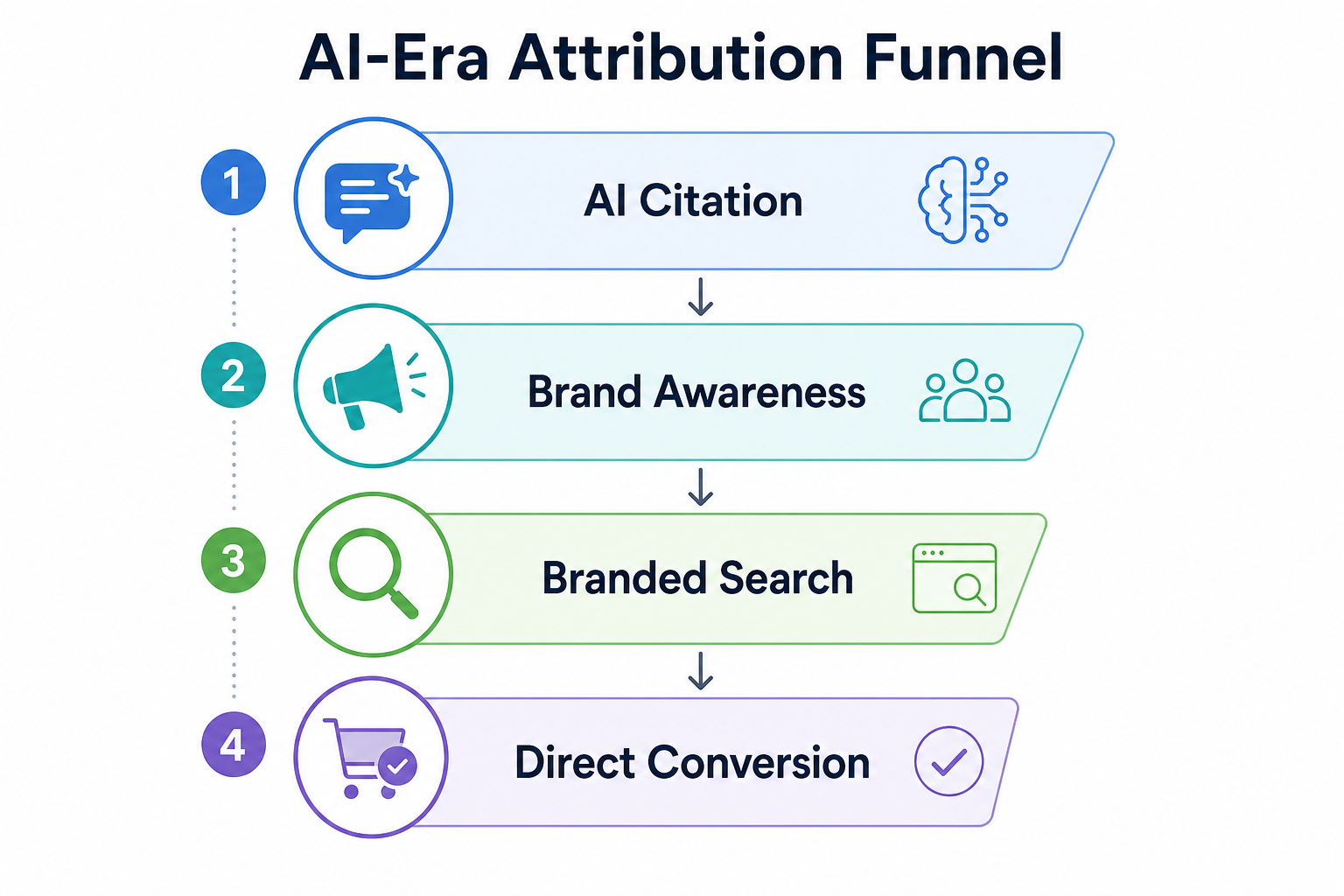
- The Result: Cross-referencing this with Direct traffic and Brand Search volume. Often, a rise in AI citations correlates with a rise in people searching for the brand specifically later that day.
- The Strategy: Instead of trying to 'win back' the 30% traffic for a top-of-funnel definition, we will pivot content to 'Comparison of Cloud Monitoring Tools'—a query where users still need to click through to see detailed tables and pricing.
Handling the 'Zero-Click' Objection
Clients will inevitably ask: "If they don't click, why are we paying for this content?" Your response must be rooted in the 'Path to Purchase'.
- Brand Salience: Remind the client that if their competitor is the one cited in the AI response, the user will never even know the client exists. Being the citation is a defensive necessity.
- Assistant Ecosystems: Explain that ChatGPT and Gemini are personal assistants. If the assistant recommends a brand today, the user is likely to ask that same assistant to "buy it" or "book a demo" tomorrow.
- Data Feed Quality: Explain that technical SEO (Schema, Clean HTML) isn't just for Google; it’s for LLM training data. We are ensuring the 'brain' of the internet knows the client's products accurately.
Putting it into Practice
To apply this in your next client engagement:
- Audit Citations Early: Use tools or manual sampling to track how often the client appears in AI snapshots versus their top three competitors.
- Update Reporting Templates: Replace 'Average Position' with 'Visibility Share in AI Responses' for your top 20 'money' terms.
- Contextualise Traffic Drops: If a page loses traffic, immediately check for a new AI Overview. If the client is cited, report it as a 'Conversion to Visibility' rather than a 'Loss of Traffic'.
- Connect with PR: During the QBR, show the client how mentions in high-authority industry journals led to the brand being cited by AI. This justifies further investment in digital PR.
- Set 'Generative KPIs': Agree on targets for the next quarter, such as 'Increasing citation presence for product comparison queries by 15%'.