Introduction to AI Visibility Resilience
Transitioning from traditional SEO to Generative Engine Optimisation (GEO) brings a new level of volatility. Unlike the relatively stable index of Google Search, AI responses are non-deterministic, meaning the source cited for a query today may disappear tomorrow. This lesson provides the framework for handling difficult conversations when results fluctuate, clients push back on technical requirements, or the scope of work begins to creep beyond the initial agreement.
The Psychology of the AI Pivot
When a client sees their brand removed from a Perplexity 'Source' box or a ChatGPT 'Search' response, their immediate reaction is often one of panic or scepticism. As a practitioner, your role is to shift the conversation from 'failure' to 'iteration'. AI visibility is not a static leaderboard; it is an ongoing competition for relevance within a machine-learning model's probability distribution.
Anticipating Common Objections
-
"The AI isn't citing us anymore, were we penalised?" AI models do not penalise in the traditional manual-action sense. Instead, the model found a source with higher contextual relevance, better structured data, or more citations. Explain this as a competitive displacement rather than a penalty.
-
"Why is this taking longer than standard SEO?" Traditional SEO focuses on keywords; GEO focuses on entity relationships and semantic resonance. The latter requires deeper content engineering and technical validation, which naturally expands the timeline.
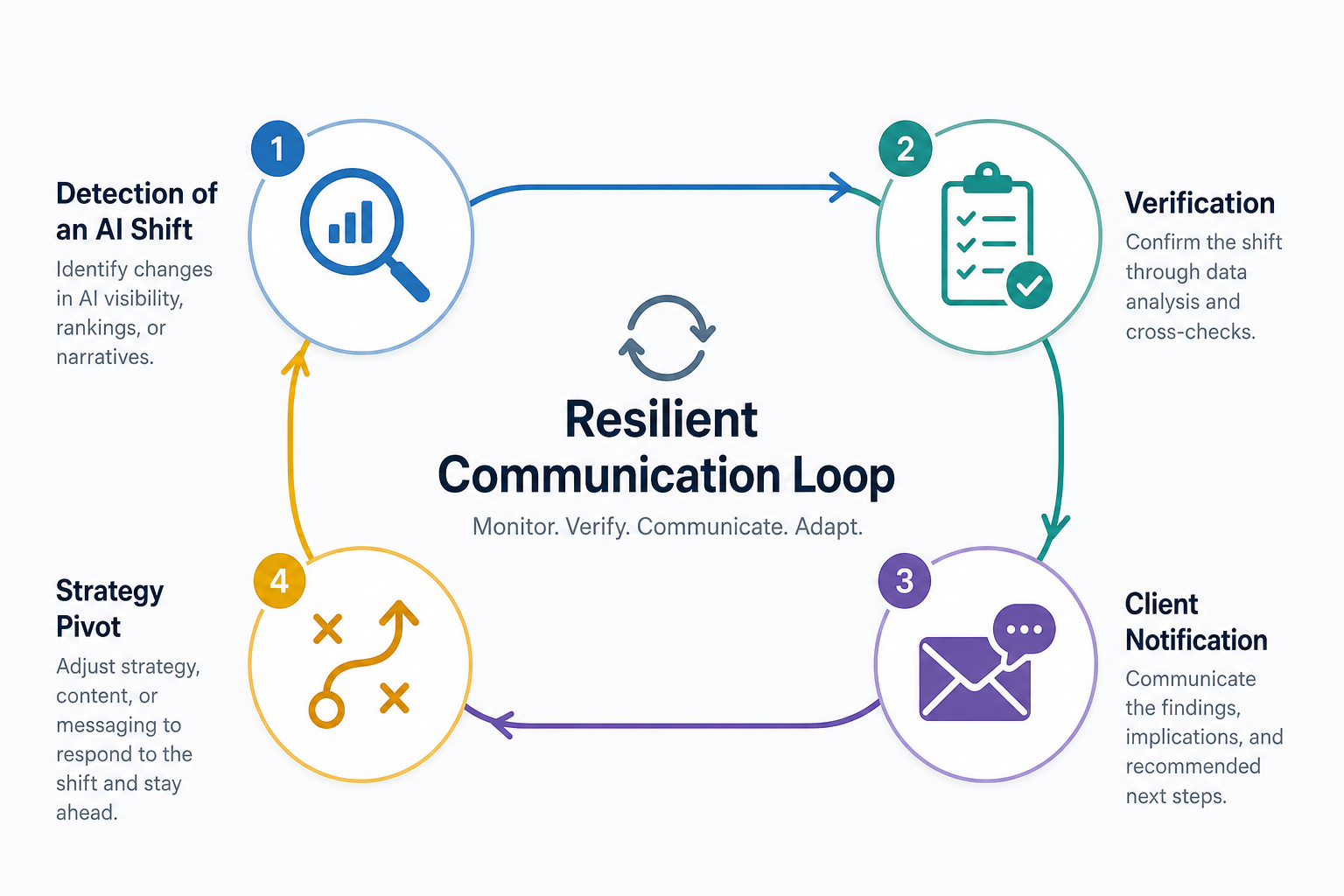
Managing Regressions: The 4-Step Response Framework
When performance drops, use this structured approach to maintain client trust:
1. Data Verification
Before communicating, verify if the regression is a global model update or a site-specific issue. Check if competitors also lost visibility. Use your tracking tools to see if the 'Citational Share of Voice' has dropped across the entire niche or just for specific long-tail queries.
2. Radical Transparency
Don't hide the dip. Reach out to the client before they bring it to you. A proactive message like, "We've observed a shift in how GPT-4o is citing sources in the [Niche] sector following their latest update; here is our analysis," establishes you as a partner, not a vendor.
3. The 'Probabilistic' Explanation
Educate the client on the non-deterministic nature of LLMs. Use the analogy of a courtroom: the AI is the jury, and your content is the evidence. Sometimes the jury prioritises one piece of evidence over another based on the specific way a question was asked. Our job is to make our evidence so compelling it cannot be ignored.
4. The Corrective Roadmap
Never present a problem without a solution. If visibility dropped, present a plan to adjust the 'Brand Authority Signals' or re-engineer the Schema.org patterns that the AI is currently prioritising.
Handling Technical Pushback
GEO often requires changes that may clash with brand guidelines—such as adding 'User Intent' sections, FAQ blocks, or highly technical 'Fact Sheets' to product pages.
Strategy: The 'AI-First' Compliance Argument
Explain that search engines are no longer just indexing text; they are seeking structured truths. If the brand guidelines prevent the use of technical tables or structured lists, use data to show how competitors who do use them are capturing 80% of the AI citations.
Scope Creep in AI Engagements
AI visibility projects frequently expand because the deeper you go into entity mapping, the more gaps you find in the client's digital footprint (e.g., missing LinkedIn data, outdated Wikipedia entries, or fragmented local citations).
Dealing with Expansion
When a project moves from 'On-page GEO' to 'Digital Entity Management', you must document the shift immediately.
- The Delta Document: Create a simple table showing 'Contracted Tasks' vs 'Required Tasks for Success'.
- The Value Link: Explicitly link the new scope to the client's goals. "To rank in the new Google Search Generative Experience for 'Top Consulting Firms', we must now also optimise your executive team's external profiles, which was not in the original scope."
Worked Example: The Mid-Campaign Volatility Conversation
Scenario: A B2B SaaS client was ranking as the #1 citation for "Best Payroll Software for UK SMEs" in Perplexity. Following a model update, they have been replaced by a competitor with a lower DR (Domain Rating) but more reviews on G2.
The Conversation Script:
- The Opening: "I wanted to flag a shift in the Perplexity landscape. While our technical SEO is perfect, the model's 'Trust Weights' have shifted toward third-party validation platforms like G2 and Capterra."
- The Pivot: "This doesn't mean our work isn't working; it means the AI is widening its lens. To regain that spot, we need to pivot 20% of our current resources toward an automated review acquisition strategy to feed the AI's trust signals."
- The Result: The client understands the shift isn't a failure of your strategy, but an evolution of the AI's logic, justifying a change in direction (and potentially budget).
Putting it into Practice
- Draft a 'SLA for AI': Update your Service Level Agreements to include language regarding the non-deterministic nature of AI outputs. Set expectations that cite-rates will fluctuate.
- Conduct a Monthly 'AI Environment Audit': Report not just on rankings, but on how the AI's 'style' of answering is changing. This prepares the client for future shifts.
- Create a Pushback Ledger: Log every time a client rejects a technical recommendation. If visibility drops later, you have a documented trail of why the 'Engine' couldn't fully comprehend the site's data.