Share of AI Voice

Master the methodology for calculating Share of AI Voice (SOAV) to benchmark brand visibility against competitors within generative AI responses and LLM citations.

12 min read
Foundations

Introduction to Share of AI Voice (SOAV)

In traditional search engine optimisation, we have long relied on Share of Voice (SOV) based on keyword rankings and estimated click-through rates. However, as generative search engines like Google Gemini, Search Generative Experience (SGE/AI Overviews), and Perplexity gain traction, the metric must evolve. Share of AI Voice (SOAV) measures the frequency and prominence with which a brand (or a competitor) is cited across a statistically significant set of industry-relevant prompts.

Unlike traditional search, where a rank of #1 is the primary goal, AI visibility is binary: you are either cited as a source or you are not. SOAV allows practitioners to quantify their digital footprint within the 'latent space' of Large Language Models (LLMs) and provide clients with a concrete benchmark of their authority relative to their peers.

The Core Methodology

To calculate SOAV accurately, you cannot rely on a single query. You must define a 'Prompt Set'—a collection of 50 to 200 queries that reflect your target audience’s journey. This methodology comprises four distinct stages: Selection, Extraction, Normalisation, and Calculation.

1. Defining the Prompt Set

Your prompt set should not just be keywords; it should reflect the natural language patterns found in conversational search. Categorise these into:

  • Informational (Top of Funnel): "What are the best sustainable fabrics for sportswear?"
  • Commercial (Middle of Funnel): "Compare recycled polyester vs organic cotton durability."
  • Transactional (Bottom of Funnel): "Where can I buy ethically made gym leggings in the UK?"
  • Brand-Specific: "Is [Brand Name] a sustainable company?"

2. Data Extraction and Citation Mapping

You must run these prompts through target AI engines. For each response, identify the cited domains. In an AI Overview or a Perplexity response, citations are typically indicated by superscript numbers or source cards at the bottom. Record every domain mentioned. If a domain is mentioned three times in one response, it still counts as 'present' for that specific prompt in a binary model, though some advanced practitioners weight by frequency.

3. Normalisation

Clean the data by grouping subdomains (e.g., blog.brand.com and www.brand.com) and identifying 'Inertia Sources'—third-party sites like Wikipedia or Reddit that consistently appear but are not direct competitors. This ensures the SOAV reflects the competitive commercial landscape rather than just general web authority.

Worked Example: High-End Coffee Machines

Imagine we are representing 'BeanMaster', a boutique espresso machine manufacturer. We want to measure our SOAV against 'JavaPro' and 'GrindCo'.

The Setup:

  • Prompt Set: 100 queries covering 'Home espresso maintenance', 'Best prosumer machines 2024', and 'How to dial in espresso'.
  • Engine: Google AI Overviews.

The Findings:

  • Total Prompts: 100
  • BeanMaster cited in: 15 prompts
  • JavaPro cited in: 30 prompts
  • GrindCo cited in: 10 prompts
  • Affiliate Review Sites (e.g., Wirecutter): 45 prompts

The Calculation: To find the SOAV, use the formula: (Brand Mentions / Total Prompts) * 100.

  • BeanMaster SOAV: 15%
  • JavaPro SOAV: 30%
  • GrindCo SOAV: 10%

Analysis: While BeanMaster might have better traditional SEO rankings for 'espresso machines', JavaPro is dominating the AI citations. This suggests JavaPro has better 'LLM-optimised' content—likely structured data, clear entity relationships, and inclusion in the specific review clusters the AI is pulling from. BeanMaster needs to investigate which specific pages JavaPro is winning with and reverse-engineer their citation triggers.

Advanced Metric: Citation Intensity

Beyond basic presence, we can measure 'Citation Intensity'. If a prompt generates a response with five citations and your brand is three of them, your intensity is higher than a brand with one citation. This is a leading indicator of 'Topic Authority'. To calculate this, divide the total number of citations your brand received by the total possible citations across all prompts in the set.

Tools for Tracking

While manual tracking is possible for small sets, scale requires automation. Current practitioners use:

  1. Custom Python Scripts: Using Playwright or Selenium to scrape AI responses (check terms of service before proceeding).
  2. Specialised AI Tracking Tools: Platforms like Authoritas or ZipTie which are building specific modules for SGE and Gemini tracking.
  3. LLM APIs: Querying GPT-4o or Claude via API to see if they cite your brand when asked specifically about your niche (note: this measures training data presence, not real-time search retrieval).

Strategic Deployment of SOAV Data

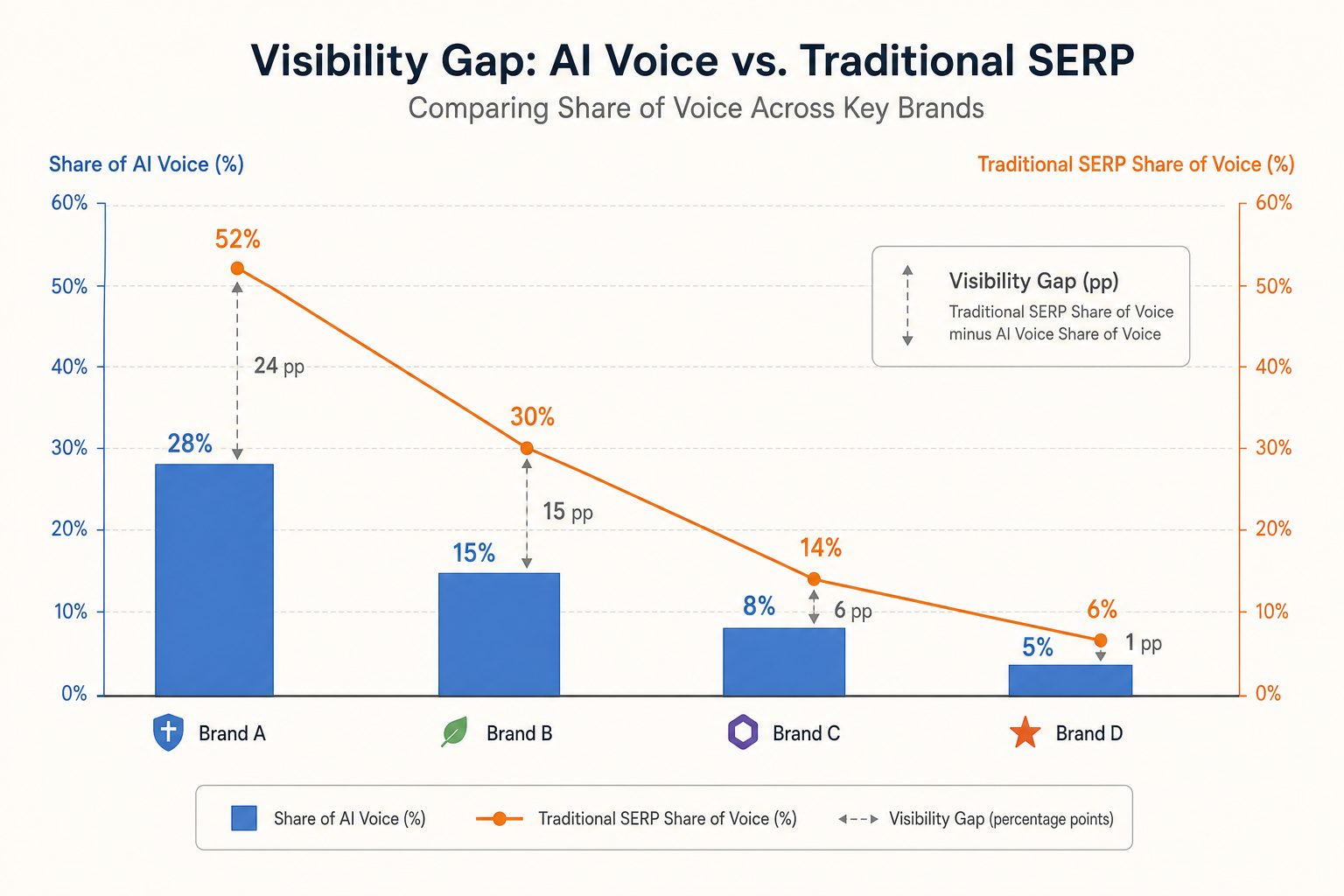
SOAV is a powerful reporting tool for clients. It moves the conversation away from 'Where am I on page 1?' to 'Am I part of the AI-generated answer?'. If your SOAV is lower than your traditional market share, it indicates a 'Visibility Gap'. This gap is often caused by technical barriers (e.g., blocking bots in robots.txt) or content barriers (e.g., lack of clear, factual, and citable statements).

Putting it into Practice

To implement SOAV tracking for your next client report, follow these steps:

  1. Select 50 High-Value Queries: Focus on the 'Problem/Solution' phase of the buyer journey.
  2. Create a Spreadsheet: Columns for 'Prompt', 'Brand Present (Y/N)', 'Competitor A Present (Y/N)', and 'Top Cited Domain'.
  3. Run the Prompts: Using a clean browser profile or an incognito window, trigger the AI response for each prompt.
  4. Calculate the Percentage: Divide the 'Yes' count by 50 for each brand.
  5. Identify the 'Gap': Look for prompts where competitors are cited but you are not. Analyse the 'Source' URL the AI used for the competitor. Is it a product page, a blog post, or a third-party review?
  6. Optimise: Update your corresponding content to match the structure and depth of the winning sources.

By consistently measuring SOAV over a quarter, you can demonstrate the direct impact of your AI Visibility (AEO) efforts, showing a clear upward trend in citation frequency even if traditional rankings remain static.

Visual diagram

[ diagram placeholder ]

A bar chart showing 'Share of AI Voice' percentages for four competing brands, with a secondary line graph overlaying their traditional SERP Share of Voice to highlight the 'Visibility Gap'.

Exercise

Identify 10 core 'how-to' questions for your brand's niche. Use an AI search engine (like Perplexity or Google Gemini) to search for each one, record which domains are cited, and calculate your brand's SOAV for this mini-set.

Key takeaways

  • SOAV measures a brand's presence in AI-generated answers compared to its competitors.
  • Unlike traditional SEO, AI visibility is often binary: you are either a cited source or you are not.
  • A prompt set should be a representative sample of 50-200 conversational queries, not just keywords.
  • Inertia sources like Wikipedia should be identified but separated from direct commercial competitors.
  • The basic SOAV formula is (Brand Mentions / Total Prompts) * 100.
  • Citation Intensity is an advanced metric measuring how many links a brand gets within a single response.
  • A Visibility Gap exists when a brand's SOAV is significantly lower than its traditional search market share.
  • SOAV tracking helps identify which types of content (blogs vs products) the AI prefers to cite.
  • Data extraction can be done manually for small sets or via specialized tracking tools for larger ones.
  • Reporting SOAV provides a modern benchmark for clients moving into the AI-first search era.

Lesson Quiz

Pass at 70%.

1. What does SOAV stand for in the context of AI Visibility?
2. How is a brand's citation usually represented in a generative AI response?
3. Why should you use 50-200 prompts instead of just 5 for SOAV tracking?
4. What is an 'Inertia Source' in SOAV analysis?
5. If your brand is cited in 20 prompts out of a 100-prompt set, what is your SOAV?
6. What does a 'Visibility Gap' indicate?
7. Which of these is a 'Middle of Funnel' commercial prompt?
8. What is 'Citation Intensity'?
9. Why might a brand with high SEO rankings have a low SOAV?
10. What is the first step in a SOAV practice implementation?
Create a free account to save progress and earn a certificate.