Competitor Strength and Weakness Profiles

Develop the skills to audit competitor AI visibility across LLMs by mapping their content depth, technical provenance, and digital footprint strengths against your own performance.

15 min read
Foundations

Introduction

To succeed in the current AI-driven search landscape, monitoring your own performance is only half the battle. To gain a competitive edge, you must understand exactly why specific competitors are being cited by Large Language Models (LLMs) like GPT-4, Claude, and Gemini while others are ignored. Competitor Strength and Weakness Profiles allow you to move beyond 'guesswork' and build a data-backed map of the competitive terrain. This lesson focuses on the practical mechanics of dissecting a competitor's AI footprint, identifying their content 'moats', and spotting the gaps in their strategy that your brand can exploit.

The Three Pillars of Competitor AI Profiling

In generative search, a competitor's strength is not just about their 'Domain Authority' in the traditional SEO sense. Instead, profiling requires an assessment of three distinct pillars: Citability, Narrative Consistency, and Data Structure.

1. Citability (The 'Source' Factor)

LLMs prioritise sources that are perceived as authoritative, primary, and frequently referenced across the web. When profiling a competitor, you must ask:

  • Are they being used as a citation for factual claims?
  • Do LLMs include their brand name in 'suggested further reading' blocks?
  • Does the competitor provide original data, research, or unique insights that cannot be found elsewhere?

2. Narrative Consistency (The 'Identity' Factor)

LLMs are probabilistic; they predict the next token based on training data. If a competitor has a highly consistent message across social media, PR, their website, and third-party reviews, the model develops a 'stronger' association between that brand and specific topics. Weak competitors often have fragmented identities, making them harder for AI to categorise reliably.

3. Data Structure (The 'Accessibility' Factor)

Technical implementation matters. A competitor might have great content, but if it is trapped in non-semantic HTML or lacks structured data (Schema.org), LLMs—and the crawlers feeding them—may struggle to extract the core entities. Profiling their technical competence reveals potential 'easy wins' for your own technical roadmap.

Auditing Competitor Content Depth

To profile a competitor's content strength, perform a 'Topic Coverage Gap Analysis'. Select five core topics within your niche and test how LLMs describe the competitor’s stance on those topics compared to yours.

The 'Expertise' Check

Look for 'Content Clusters'. A strong competitor will have a library of interconnected articles on a singular niche. If you ask an AI, 'What is [Competitor Name]'s view on [Topic]?', and the AI provides a detailed, nuanced summary, the competitor has successfully achieved topical authority. If the AI provides a generic or 'hallucinated' guess, their content depth is a weakness.

The 'Tone and Style' Check

AI models are sensitive to the style of writing. A competitor using academic, high-perplexity language might be favoured for technical B2B queries, while a competitor using simple, accessible language might dominate 'top-of-funnel' informational queries. Identifying these patterns helps you decide whether to compete head-on or pivot to a different segment of the audience.

Identifying Weaknesses in the Digital Footprint

Even the strongest market leaders have 'Blind Spots' in the AI era. Use the following checklist to find weaknesses during your audit:

  1. Outdated Citations: LLMs often rely on training data that may be months or years old. If a competitor has recently pivoted or rebranded but their old profile persists in AI responses, this is a weakness you can exploit by providing more current, relevant data.
  2. Fragmented Reviews: If a competitor has 5 stars on its own site but 2 stars on Reddit or Trustpilot, LLMs often pick up on this dissonance. A lack of sentiment consistency is a major weakness.
  3. Low Entity Connectivity: If a competitor is mentioned often but rarely linked to other 'entities' (e.g., they aren't mentioned in lists of top tools, or their founders aren't cited as experts), their 'Identity Map' is weak.

Worked Example: Premium Project Management Software

Imagine you are auditing a competitor called 'TaskMaster Pro'.

Step 1: The Prompt Test. You ask an LLM: 'Which project management tool is best for Agile software development, and why?'

Step 2: Analysis of the Response. The AI mentions TaskMaster Pro but adds a caveat: 'Some users find their pricing confusing.' This reveals a Sentiment Weakness regarding their pricing transparency.

Step 3: Source Verification. You check the citations. The AI cites a 2022 blog post from TaskMaster Pro. This reveals a Freshness Weakness. They are not producing enough current, high-value updates that the AI can scrape and prioritise.

Step 4: Technical Audit. You run their latest feature page through a Schema Validator. They have no 'Product' or 'FAQ' schema. This is a Structural Weakness.

The Resulting Strategy: You produce a 2024 'Ultimate Guide to Agile Costs' (targeting the pricing weakness), ensure your schema is perfect (targeting the structural weakness), and use a 'Product' schema that explicitly mentions Agile compatibility to force the AI to associate your brand more strongly with that entity.

Building the Profile Document

Your final deliverable for a client should be a 'Competitor AI Matrix'. This is a table with competitors on the Y-axis and these four categories on the X-axis:

  1. AI Visibility Score: (High/Med/Low) based on frequency of mentions in LLM prompts.
  2. Sentiment Pole: (Positive/Neutral/Negative) how the AI describes the brand.
  3. Primary Citation Source: (e.g., Their blog, Wikipedia, Reddit, Industry news).
  4. Recommended Action: (e.g., 'Target their lack of updated case studies' or 'Mimic their use of listicle formatting').

Putting it into Practice

To implement this immediately, follow these four steps:

  1. Select 3 Competitors: Choose one market leader, one direct peer, and one 'disruptor' (a smaller, tech-savvy brand).
  2. Run Comparison Prompts: Use at least three different LLMs (GPT-4o, Claude 3.5 Sonnet, and Perplexity) to ask for comparisons between your brand and these competitors.
  3. Note the 'Hallucinations': If an AI makes a mistake about a competitor, mark it as a 'Clarity Weakness' in their profile. This means their public information is not clear enough for AI to process accurately.
  4. Audit the 'Backlink Gap' for AI: Use an SEO tool to find where competitors are mentioned in 'best of' lists or industry reports. These are the sources AI uses to build its 'knowledge graph' of who is important in your field.

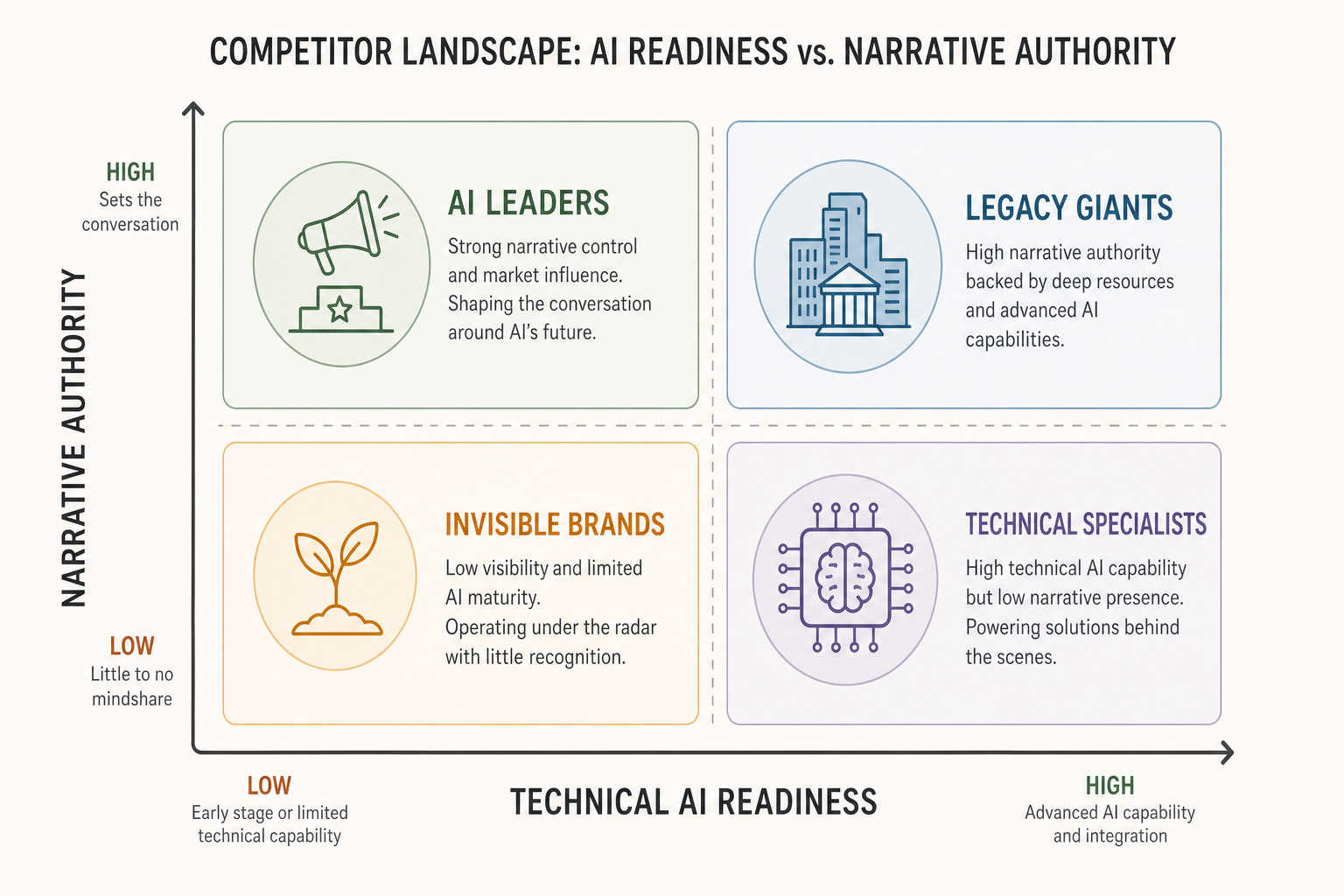
Visual diagram

[ diagram placeholder ]

A 2x2 matrix plotting competitors on 'Technical AI Readiness' (X-axis) vs 'Narrative Authority' (Y-axis), showing 'AI Leaders', 'Legacy Giants', 'Technical Specialists', and 'Invisible Brands'.

Exercise

Take your primary competitor and ask an LLM: 'What are the pros and cons of using [Competitor Name]?'. List the three 'cons' the AI identifies and cross-reference them with the competitor's website to see if they have content addressing these issues. If not, this is a gap for your content strategy.

Key takeaways

  • AI visibility is driven by citability, narrative consistency, and data structure.
  • A competitor's traditional SEO authority does not always translate to AI visibility.
  • Consistent messaging across multiple platforms builds a stronger brand-entity association.
  • Technical weaknesses like missing Schema.org can prevent AI from indexing a competitor's key facts.
  • AI models often rely on outdated training data, creating an opening for brands with current info.
  • Fragmented sentiment across third-party sites is a major vulnerability for established brands.
  • The 'Expertise Check' involves testing if an AI can accurately summarise a competitor's stance.
  • A 'Clarity Weakness' occurs when AI hallucinates or gets facts wrong about a competitor.
  • Competitor AI profiling requires testing across multiple LLMs to see consensus or variance.
  • The final goal is a Competitor AI Matrix that identifies specific 'attack' points for your strategy.

Lesson Quiz

Pass at 70%.

1. What is 'Narrative Consistency' in the context of AI visibility?
2. If an AI model provides a detailed summary of a competitor's stance, they likely have:
3. Which of these is a 'Structural Weakness' in AI profiling?
4. Why is it important to test competitors across different LLMs (e.g., GPT and Claude)?
5. What does an AI 'hallucination' about a competitor usually indicate to an auditor?
6. A 'Legacy Giant' in the AI Matrix typically has:
7. How can you exploit a competitor's 'Outdated Citation' weakness?
8. Which pillar of profiling focuses on whether a brand is used as a factual reference?
9. The 'Sentiment Pole' in a Competitor AI Matrix refers to:
10. What is the primary purpose of a Topic Coverage Gap Analysis?
Create a free account to save progress and earn a certificate.