Turning Competitor Insight Into Action

Transform raw AI visibility data into a strategic roadmap by identifying content gaps, refining brand sentiment, and optimising for specific LLM retrieval patterns.

12 min read
Foundations

Introduction

Analysing competitors in the age of generative engine optimisation (GEO) is only half the battle. The true value lies in the translation phase: converting data about how AI models perceive your rivals into actionable tasks for your own website. Unlike traditional SEO, where you might simply target the same keywords, AI visibility requires a more nuanced approach. You must decide whether to mimic, outmanoeuvre, or bypass competitor strategies based on how LLMs (Large Language Models) synthesise their information.

In this lesson, we will explore how to take the raw outputs from toolsets like Perplexity, Gemini, and SearchGPT and turn them into a high-impact workstream for your marketing team or clients.

Categorising Competitor Insights

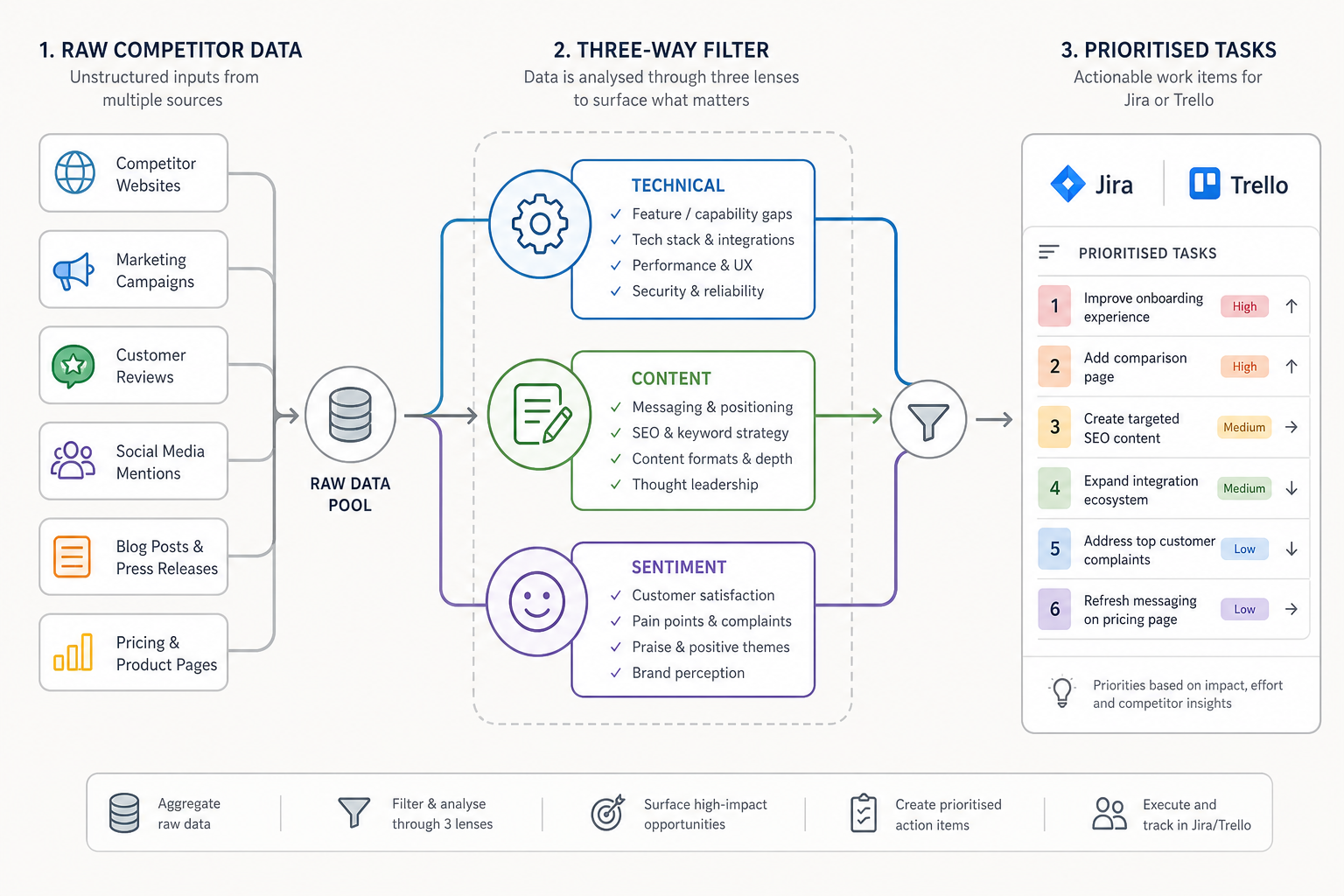
Before you can act, you must categorise your findings into three distinct workstreams: Technical, Content, and Brand Sentiment.

1. The Technical Workstream (The Scaffolding)

If competitors are consistently appearing in 'overviews' or 'citations' while you are absent, the first place to look is your structured data and technical delivery.

  • Action: If a competitor is cited for 'Best Value' in a search for 'Budget CRM software', examine their Schema.org markup. Are they using the Product or AggregateOffer type effectively?
  • Action: Check for 'Retrieval Friction'. Compare your page load speed and DOM structure. If an LLM-based crawler cannot easily parse your pricing table but can parse your competitor’s, you will lose the citation every time.

2. The Content Workstream (The Substance)

AI models thrive on specific, high-intent data. If a competitor is being prioritised, it is often because they provide a 'better' answer according to the model's training data or RAG (Retrieval-Augmented Generation) pipeline.

  • Action: Fill the Information Gap. If a competitor is cited for '24/7 support' and you offer the same but haven't explicitly stated it in a findable way, you must update your service pages.
  • Action: Improve Contextual Density. Models look for relationships between entities. If your competitor is mentioned alongside terms like 'sustainable' and 'eco-friendly' and you are not, you need to infuse your content with these semantic markers.

3. The Sentiment Workstream (The Reputation)

Generative AI often provides summaries containing subjective sentiment. This is pulled from third-party reviews, social media, and forums.

  • Action: If AI describes a competitor as 'the most reliable' but calls your brand 'challenging to set up', this is a directive for your PR and Customer Success teams. You need to drive positive, troubleshooting-focused reviews on platforms like G2, Trustpilot, or niche industry forums.

Worked Example: Premium Coffee Machines

Scenario: You are the SEO lead for 'Caffeinated-UK'. Your main competitor, 'BeanMaster', is consistently appearing as the top recommendation in Gemini when a user asks: "Which espresso machine is best for small kitchens?"

Analysis of BeanMaster performance:

  • Gemini cites BeanMaster because it explicitly states its 'Footprint: 15cm x 20cm'.
  • BeanMaster has 50+ Reddit mentions praising its compact size.
  • BeanMaster uses the size property in its Schema markup.

Action Plan for Caffeinated-UK:

  1. Immediate Content Update: Add a dedicated 'Dimensions & Space Saving' section to the product page. Use a clear H3 tag: 'The Best Espresso Machine for Compact Kitchens'.
  2. Product Attribute Schema: Update the JSON-LD to include depth, width, and height properties specifically.
  3. Strategic Seeding: Launch a campaign to encourage current users with small kitchens to share their 'setup shots' on social media and Reddit, mentioning the brand name and the word 'compact'.
  4. Comparison Content: Create a 'BeanMaster vs. Caffeinated-UK' comparison page that highlights your machine is actually 2cm narrower than theirs. AI models love comparison data to resolve user queries.

Prioritising Your Actions (The Matrix)

Not all insights are worth pursuing immediately. Use the following priority matrix to decide where to allocate resources:

  • High Impact / Low Effort: Updating Schema markup, clarifying existing facts on-page, correcting inaccuracies in AI output via feedback buttons.
  • High Impact / High Effort: Launching a brand sentiment campaign, rewriting entire product categories, getting listed on high-authority industry 'best of' lists.
  • Low Impact / Low Effort: Minor CSS tweaks, updating non-indexed footer links.
  • Low Impact / High Effort: Attempting to manipulate LLM training data through mass-generated low-quality content (Avoid this).

The 'Echo' Strategy: Validating the Action

Once you have implemented a change based on competitor analysis, you must perform 'Echo Testing'. Wait 7-14 days (depending on the tool's refresh rate) and re-prompt the AI with the same queries.

Check for:

  • Citation Shift: Are you now mentioned alongside the competitor?
  • Narrative Change: Has the descriptive language changed from neutral to positive?
  • Feature Parity: If the competitor was cited for a specific feature, are you now also cited for that same feature?

Putting it into Practice

To move from insight to action, follow these steps with your own project today:

  1. Identify the 'Generative Winner': Choose one query where a direct competitor is suggested by an AI, but you are not.
  2. Reverse Engineer the Citation: Look at the source cited. Is it their own site? A third-party review? A Reddit thread?
  3. Isolate the Trigger: Identify the specific word or data point the AI used to justify the recommendation (e.g., "cheapest price", "quickest delivery", "longest warranty").
  4. Implement the Counter-Move: Update your own content to be more explicit about that specific data point. Use clear headings and structured data.
  5. Audit the Result: Re-run the prompt in two weeks and document any changes in the AI's response logic.

Visual diagram

[ diagram placeholder ]

A workflow diagram showing raw competitor data flowing into a three-way filter (Technical, Content, Sentiment) and emerging as a prioritised list of Jira/Trello tasks.

Exercise

Identify a 'Recommended' competitor for your top target keyword in Perplexity. Find one specific adjective the AI uses to describe them (e.g., 'affordable', 'reliable', 'innovative') and update your own landing page content and Schema to explicitly claim that attribute with evidence.

Key takeaways

  • Categorise competitor data into Technical, Content, and Sentiment workstreams for clarity.
  • Prioritise schema updates as they provide structured 'facts' that AI models can easily ingest.
  • Address narrative gaps where AI describes competitors with positive adjectives you lack.
  • Focus on 'Contextual Density' to connect your brand to relevant industry keywords.
  • Use comparison pages to provide AI with structured data on how you outperform rivals.
  • Monitor third-party platforms like Reddit, as these significantly influence AI sentiment.
  • Avoid high-effort, low-impact tasks like mass-generating low-quality content.
  • Perform 'Echo Testing' 7-14 days after implementation to verify changes.
  • Look for 'Retrieval Friction' in your site's technical structure that might hinder AI crawlers.
  • Translate 'Best For' citations into specific content updates on your own product pages.

Lesson Quiz

Pass at 70%.

1. What is the primary goal of turning competitor insights into action in an AI context?
2. Which workstream covers updates to JSON-LD and Schema.org markup?
3. If an AI model calls a competitor 'the most reliable', but doesn't mention your brand's reliability, where should you act?
4. What is 'Retrieval Friction' in the context of AI visibility?
5. In the 'Premium Coffee Machine' example, why did the competitor win the citation?
6. What is the purpose of 'Echo Testing'?
7. Which of these is considered a 'High Impact / Low Effort' action?
8. Why is 'Contextual Density' important for AI visibility?
9. What should you do if an AI model contains an inaccuracy about your brand?
10. Which platform is cited as a major influence on brand sentiment for AI models?
Create a free account to save progress and earn a certificate.