Building a Competitor Set

Learn how to define, categorise, and validate a primary competitor set for AI visibility tracking, distinguishing between traditional organic rivals and new algorithmic competitors.

12 min read
Foundations

Introduction

In traditional Search Engine Optimisation (SEO), your competitors are usually the websites ranking alongside you in the ten blue links. However, in the era of Artificial Intelligence Organisers (AIOs) and Generative Search, the competitive landscape has fragmented. Establishing a 'Competitor Set' for AI Visibility requires a shift in perspective. You are no longer just competing against other brands; you are competing against the large language models (LLMs) themselves, data aggregators, and niche authoritative sources that AI models favour when synthesising answers.

Building an accurate competitor set is the foundation of any visibility strategy. If you track the wrong entities, your benchmarks will be skewed, and your optimisation efforts will be misdirected. This lesson provides a structured methodology for identifying and curating a list of entities to monitor within AI-driven search environments.

The Three Tiers of AI Competitors

To build a robust tracking list, you must categorise your competitors based on their role in the AI ecosystem. We categorise these into three distinct tiers:

1. Direct Vertical Competitors

These are the businesses offering the same product or service as your client. If you sell project management software, your direct competitors are other software providers. In AI responses (like Perplexity or Google’s AI Overviews), these competitors are often cited in 'best of' lists or comparison tables.

2. Informational & Editorial Authorities

AI models rely heavily on trusted intermediaries to validate claims. These include industry journals, review sites (e.g., Trustpilot, G2), and major news outlets. While they don't sell a competing product, they 'compete' for the citation space. If a review site is cited instead of your brand, they are a competitor for visibility.

3. Aggregate & Community Sources

Platforms like Reddit, Quora, and niche forums are increasingly prioritised by AI models seeking 'human-first' perspectives. These sources often provide the 'social proof' that LLMs use to justify recommending a specific brand. Tracking the sentiment on these platforms is essential to understanding why a competitor might be outranking you in AI citations.

Step-by-Step: Curating Your Competitor Set

Step 1: Baseline Seed Discovery

Start with your known SEO competitors but do not stop there. Use a generative engine (like ChatGPT or Claude) to ask: "Which companies are the leaders in [Industry] for [Specific Use Case]?" and "What are the most trusted sources for information regarding [Topic]?"

Step 2: The 'Citations Audit'

Run 20-30 high-intent queries related to your client's core services through an AI search engine (e.g., Perplexity or Bing Chat). Document every website that appears in the footnotes or 'Sources' section.

  • Look for patterns: Are there specific domains that appear across multiple queries even if they aren't direct business rivals?
  • Check for 'Hidden' Competitors: You may find niche blogs or academic sites that the AI views as more authoritative than your brand's commercial blog.

Step 3: Mapping the Correlation

Compare your traditional SEO competitor list with your new AI citation list.

  • High Correlation: Brands performing well in both.
  • AI-Only Winners: Sites with low traditional traffic but high AI citation rates (often due to high technical readability and structured data).
  • Legacy Giants: Traditional SEO leaders who are missing from AI results (often due to paywalls or poor mobile/bot accessibility).

Step 4: Final Selection and Weighting

Narrow your list to 5–10 primary competitors for active tracking. Include:

  • 3 Direct Business Rivals (Market leaders).
  • 2 'Disruptors' (Smaller brands appearing frequently in AI results).
  • 2 Editorial/Review sites (Key gatekeepers).
  • 1 Community source (e.g., a specific subreddit or forum).

Worked Example: Premium Eco-Friendly Paint Brand

Imagine you are an AI Visibility Practitioner for 'Veridian Eco-Paint'.

Traditional SEO Competitors: Dulux, Farrow & Ball, Crown Paints.

AI Search Discovery Phase: When searching "Best non-toxic paint for nurseries" on Perplexity, the results cite:

  1. The Spruce (Editorial Review)
  2. Lick.com (Direct Competitor - High visibility in AI)
  3. A niche blog: 'The Healthy Home Collective' (High authority in this specific niche)
  4. Reddit (r/InteriorDesign thread)

The Resulting AI Competitor Set:

  1. Farrow & Ball (Direct - Benchmark)
  2. Lick.com (Direct - AI Performance Leader)
  3. The Spruce (Informational - To monitor for backlink/citation opportunities)
  4. The Healthy Home Collective (Informational - Influencing the model's 'Trust' score)
  5. Edward Bulmer (Sustainable niche specialist appearing in specific green queries)

Technical Validation of the Set

Once you have your set, you must validate if these competitors are 'AI-friendly'. Check their:

  • Structured Data: Do they use Schema.org more effectively than you?
  • Crawler Accessibility: Are they blocking GPTBot or CCBot? If they are, and you aren't, you have a competitive visibility advantage in future training sets.
  • Sentiment Score: Use a sentiment analysis tool to see how these brands are discussed in the training data (Reddit/Common Crawl). AI models are less likely to cite brands associated with negative sentiment.

Putting it into Practice

  1. Initial Audit: Conduct 10 searches on Perplexity and 10 on Gemini for your core brand terms. Log every source cited.
  2. Filter and Group: Categorise these sources into Direct, Editorial, and Community.
  3. Identify the 'Gap': Find three sources that appear consistently for your keywords but are not on your current marketing radar.
  4. Baseline Metrics: Record the current 'Share of Model' (how often they are mentioned) for these competitors compared to your brand.
  5. Quarterly Review: AI models update their weights and fine-tuning regularly. Re-validate your competitor set every 90 days to capture new entrants in the generative space.

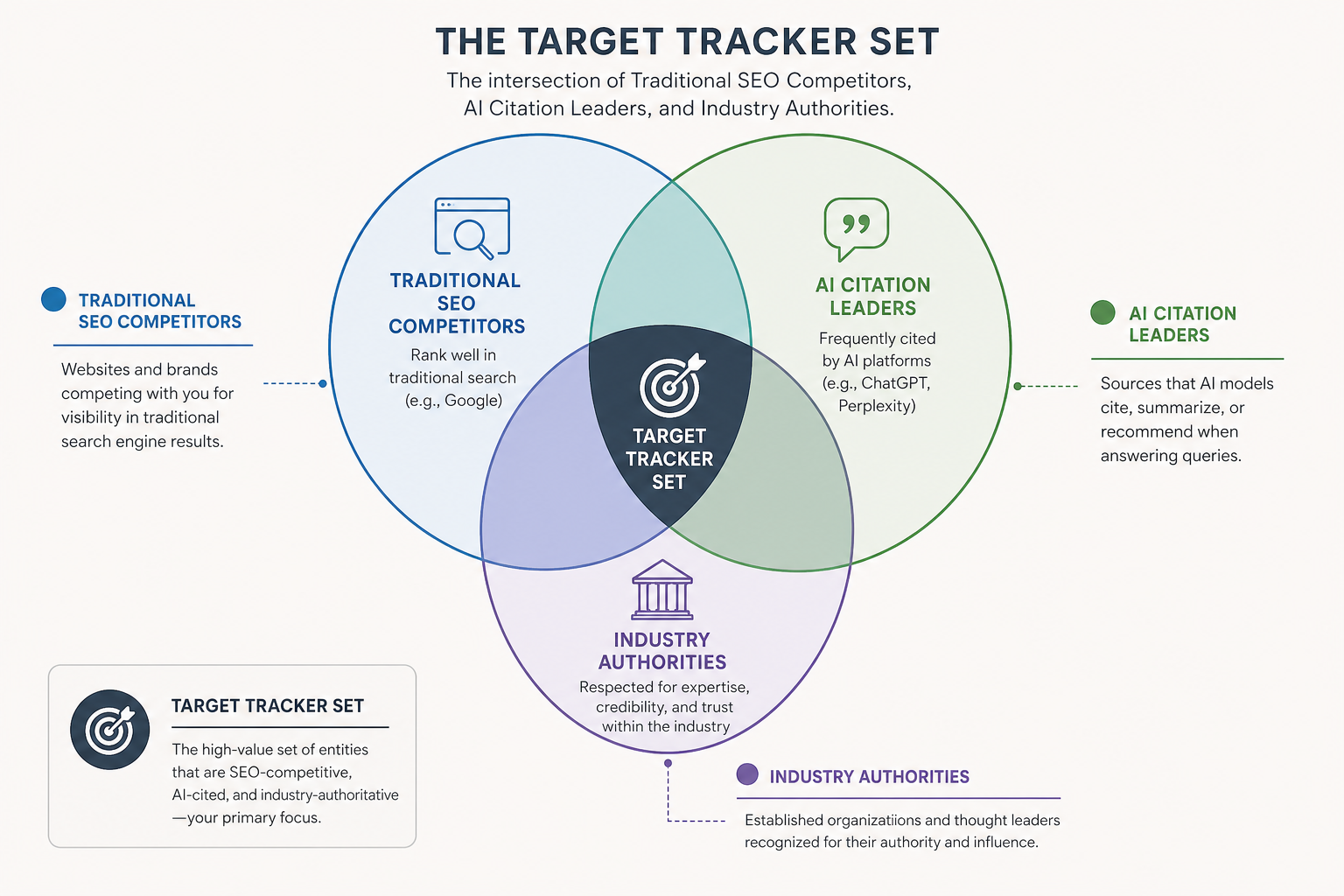
Visual diagram

[ diagram placeholder ]

A Venn diagram showing the overlap between Traditional SEO Competitors, AI Citation Leaders, and Industry Authorities, with the 'Target Tracker Set' in the centre intersect.

Exercise

Identify a core product or service you manage. Run five specific 'Comparison' queries (e.g., 'X vs Y for [Use Case]') through an AI search tool, then list the top three non-brand websites cited. Explain why the AI might trust these sites over your own.

Key takeaways

  • AI competitors are not always business competitors; they include any entity taking up citation space.
  • Categorise competitors into Direct, Informational/Editorial, and Aggregate/Community tiers.
  • Traditional SEO rankings do not always correlate with AI citation frequency.
  • AI models prioritise sources that provide validated consensus and high 'social proof' like Reddit.
  • Use generative engines themselves to discover who the models 'perceive' as industry leaders.
  • Technical factors like Schema.org usage can make a competitor more 'visible' to LLMs.
  • Monitoring competitors who block AI crawlers reveals opportunities for your own brand to fill the data vacuum.
  • A balanced competitor set should include at least one editorial authority and one community source.
  • Sentiment analysis of competitor mentions in training data helps explain their visibility levels.
  • The competitor set must be dynamic and re-validated quarterly to account for model updates.

Lesson Quiz

Pass at 70%.

1. In the context of AI Visibility, what is an 'Informational Authority'?
2. Why might a low-traffic niche blog appear as a competitor in AI search results?
3. Which platform is considered an 'Aggregate/Community' competitor?
4. How often should an AI Competitor Set be re-validated?
5. What is the primary risk of only tracking direct business rivals?
6. What does a 'Citations Audit' involve?
7. Which of these is a 'technical' reason a competitor might lead in AI visibility?
8. How can you identify 'AI-Only Winners'?
9. Why is sentiment analysis important for competitor sets?
10. What is the benefit of a competitor blocking GPTBot?
Create a free account to save progress and earn a certificate.