Identifying AI Competitors

Learn how to identify non-traditional competitors that AI models prioritise over your direct business rivals, focusing on informational parity and authority in RAG architectures.

12 min read
Foundations

Introduction

In traditional SEO, your competitors are usually businesses that sell similar products or services. If you sell artisan coffee beans, your competitors are other roasteries. However, in the world of Generative Engine Optimisation (GEO) and AI-driven search, the competitive landscape shifts dramatically. AI models, such as ChatGPT, Perplexity, and Google Gemini, do not always prioritise transactional rivals. Instead, they prioritise 'Informational Competitors'—entities that provide the most comprehensive, structured, and authoritative data to satisfy a user's intent within a single response.

Identifying these AI competitors is the first step in ensuring your brand is the one cited in the ‘Sources’ or ‘References’ section of an AI response. This lesson explores how to map the gap between your commercial rivals and your AI visibility rivals.

The Three Tiers of AI Competitors

When an AI model generates a response using Retrieval-Augmented Generation (RAG), it pulls from a high-dimensional vector space. To stay visible, you must compete against three distinct groups:

  1. Commercial Competitors: These are your traditional business rivals. They may have poor SEO but high brand recognition. AI models often mention them because they are frequently discussed in training data.
  2. Informational Authorities: These are non-commercial sites—think Wikipedia, Reddit, Quora, or niche industry blogs. They lack a product to sell but possess the pedagogical depth that AI models crave for context.
  3. Aggregators and Comparison Engines: Sites like G2, Trustpilot, or 'Best Of' listicles. In many AI queries, the model defaults to citing the aggregator rather than the individual brand.

Why Your Brand Might Be Invisible

An AI model does not 'rank' pages in the traditional sense. It retrieves 'chunks' of text that have a high semantic similarity to the query. If a competitor describes the process of a service better than you—even if their service is inferior—the AI will likely cite them as the authority.

This leads to the 'Authority Gap'. You may be the market leader in sales, but if a niche blogger has a more 'crawlable' and 'structured' explanation of your industry's core technology, the AI will treat that blogger as your superior in the context of an informational query.

Identifying Competitors through Reverse-Engineering Responses

To identify your AI competitors, you must move beyond keyword tracking tools. Follow this systematic approach:

Step 1: The 'Trigger Query' Audit

Select 10-20 high-intent queries relevant to your business. Do not just use 'buy [product]'; use 'how does [product] work' or 'what is the best [product] for [specific use case]'. Run these through ChatGPT, Gemini, and Perplexity.

Step 2: Source Extraction

For every response generated, document which websites are cited in the footnotes or 'read more' links. You will often find names that never appear in your top 10 Google Search results. These are your 'Invisible Competitors'.

Step 3: Sentiment and Context Mapping

Note how these competitors are mentioned. Are they mentioned as a primary source of data, or are they listed as a 'pricing example'? Identifying the context allows you to see where your own content is lacking in semantic weight.

Worked Example: The ‘Corporate Wellness Platform’ Scenario

Imagine you are a SaaS provider offering corporate wellness software. Your commercial rival is 'HealthCorp'.

When you ask Perplexity, "What are the best strategies for improving employee mental health in 2024?", the AI does not mention HealthCorp. Instead, it cites:

  1. Forbes Advisor (for structured listicles)
  2. The Mayo Clinic (for medical authority)
  3. A specific thread on r/HumanResources on Reddit (for real-world peer sentiment)

In this scenario, your AI competitors are Forbes, Mayo Clinic, and Reddit. To win visibility, you should not be looking at HealthCorp’s features; you should be looking at how Forbes structures their lists and how Mayo Clinic defines terms, then aim to provide more current or granular data than they do.

The Role of Sentiment and Factuality

AI models are programmed to prefer 'Hallucination-resistant' sources. This means they favour sources with high factual consistency. If a competitor has a 'Resources' or 'Glossary' section that is frequently cited by other sites, they have built an 'Authority Moat'.

To identify these competitors, use tools like Ahrefs or Semrush to look at 'linked domains', but specifically filter for those that provide definitions or statistical data. These are the sources AI models ‘trust’ to build their internal knowledge foundations.

Mapping the AI Competitive Matrix

You can plot your competitors on a 2x2 matrix:

  • High Commercial / Low AI Visibility: The legacy brand that is losing relevance in generative search.
  • Low Commercial / High AI Visibility: The 'Information Disruptor'—often a blog or tool site that dominates AI citations.
  • High Commercial / High AI Visibility: The market leader you need to emulate.
  • Low Commercial / Low AI Visibility: Irrelevant for this analysis.

Putting It into Practice

  1. Identify 5 Direct Rivals: List who your sales team says you lose deals to.
  2. Run 5 'What is' Queries: For your core service, ask Perplexity or Gemini to explain it. Note the top 3 sources.
  3. Run 5 'Best of' Queries: Note which aggregators or blogs appear.
  4. Compare Content Structure: Take the top-cited AI competitor. Do they use more tables? Do they use clearer H2/H3 headers? Do they have a 'Key Statistics' section?
  5. Audit for Data Gaps: If a competitor is cited for a specific statistic, find out where they got it. If you can provide a more recent version of that data, you can 'poach' that citation in the next model training or index refresh.

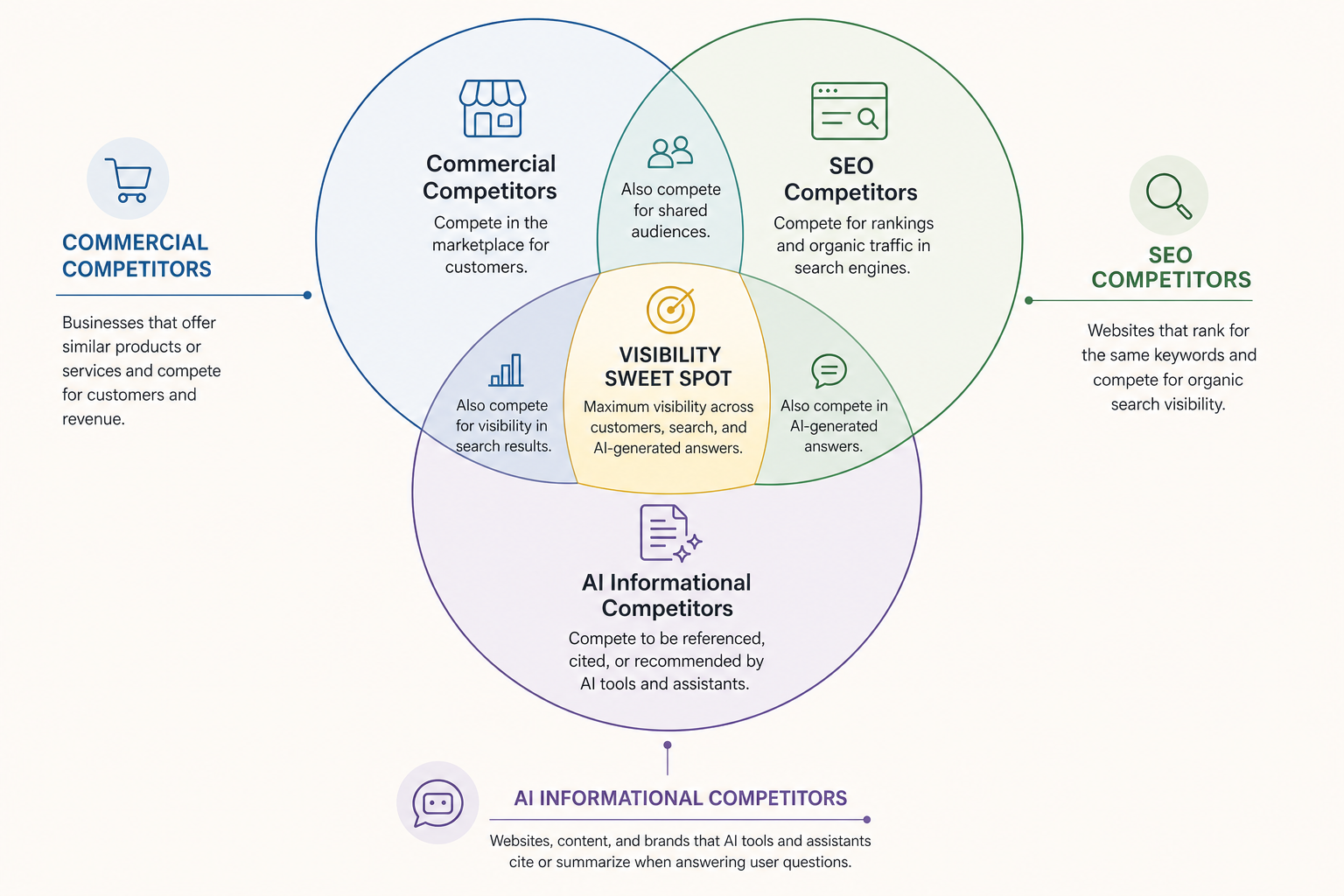
Visual diagram

[ diagram placeholder ]

A Venn diagram showing the overlap between 'Commercial Competitors', 'SEO Competitors', and 'AI Informational Competitors', with the centre representing the ‘Visibility Sweet Spot’.

Exercise

Select your primary service and ask Perplexity: 'What are the pros and cons of [Service Name]?'. Identify the top three sources cited. Identify one source that is NOT a direct commercial competitor and list two content features (e.g., a table, a list, a specific data point) that they have which your site lacks.

Key takeaways

  • AI competitors are often different from your commercial business rivals.
  • Informational authorities like Wikipedia or niche blogs often outrank brands in AI citations.
  • RAG (Retrieval-Augmented Generation) prioritises semantic similarity over link equity.
  • Aggregators and 'Best Of' lists are frequently cited as neutral authorities by AI models.
  • AI visibility is driven by being a 'hallucination-resistant' source of factual data.
  • Reverse-engineering citations in Perplexity or Gemini is the fastest way to find AI rivals.
  • The 'Authority Gap' occurs when a non-commercial site explains your industry better than you.
  • Structured data, tables, and lists make content more 'citeable' for AI models.
  • Niche forums like Reddit can be major AI competitors due to perceived human 'authenticity'.
  • Monitoring 'Information Disruptors' helps you spot shifts in how AI models interpret your niche.

Lesson Quiz

Pass at 70%.

1. How does an AI competitor differ from a commercial competitor?
2. What is the primary mechanism AI models use to select sources for a response?
3. Why might Reddit be considered a major AI competitor?
4. What is an 'Information Disruptor' in the context of AI visibility?
5. If an AI response consistently cites Forbes instead of your brand for industry trends, what should you do?
6. Which type of query is best for identifying informational AI competitors?
7. What does 'Hallucination-resistant' source mean?
8. In the 'Corporate Wellness' example, why was Mayo Clinic an AI competitor?
9. What is the benefit of a 2x2 AI Competitive Matrix?
10. Which tool is specifically mentioned as useful for reverse-engineering AI citations?
Create a free account to save progress and earn a certificate.