Introduction
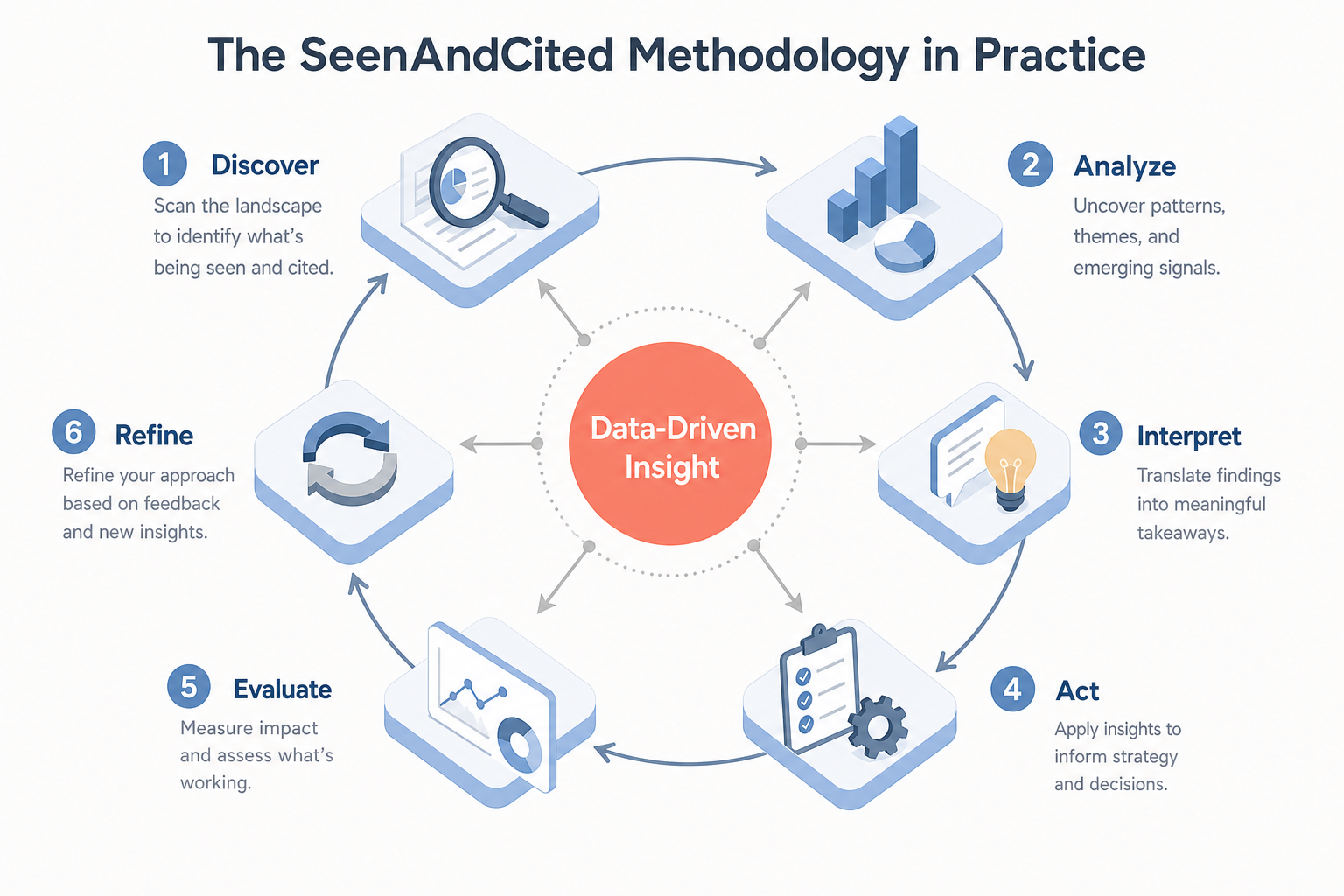
The SeenAndCited methodology moves beyond theoretical understanding of AI engines to provide a structured, repeatable framework for practitioners. Unlike traditional SEO, which often focuses on keyword rankings and backlinks, AI Visibility Practitioner (AVP) work requires a focus on semantic relationships, conversational relevance, and citation accuracy across Large Language Models (LLMs). This lesson breaks down our six-stage proprietary workflow: Discover, Monitor, Analyse, Recommend, Execute, and Measure. By following this sequence, practitioners can ensure their clients’ brands are not only mentioned but accurately cited and recommended by engines like Perplexity, ChatGPT (Search), and Gemini.
Phase 1: Discover – Identifying the LLM Footprint
Discovery is the foundational audit phase. It involves determining how an AI model currently perceives a brand, its products, and its competitive set.
Practical Steps:
- Baseline Prompting: Use a structured set of prompts (Informational, Navigational, Transactional, and Comparison) across the three major LLMs.
- Competitor Mapping: Identify which competitors are consistently cited for your primary service categories.
- Entity Health Check: Check common knowledge bases (Wikipedia, Crunchbase, LinkedIn, Industry-specific wikis) to see how the 'entity' of the brand is defined.
Example: If you are working for a 'Sustainable Packaging SaaS', you would prompt: "Who are the leaders in plastic-free supply chain software for European SMEs?" If your client is absent, discovery confirms a visibility gap.
Phase 2: Monitor – Tracking the Volatility
AI responses are non-deterministic; they change frequently based on model updates and new training data. Monitoring involves setting up a cadence for checking visibility performance.
Practical Steps:
- Sentiment Tracking: Is the AI describing the brand positively, neutrally, or negatively?
- Citation Frequency: How many times is the brand’s domain cited as a primary source compared to secondary news sources?
- Snippet Attribution: Is the AI using your content as the direct answer (the 'Answer Box' equivalent for LLMs)?
Phase 3: Analyse – The 'Why' Behind the Citation
Analysis is the most critical technical step. You must deconstruct the source material the AI uses to generate its response. Most modern AI search engines (GEO/AEO) use Retrieval-Augmented Generation (RAG). They fetch top search results and then summarise them.
Key Metrics to Analyse:
- Source Authority: Are the sources cited by the AI high-authority industry journals or low-quality scraped sites?
- Semantic Proximity: How closely related is your brand to the user’s intent keywords in the training data?
- Fact Accuracy: Is the AI hallucinating facts about your price points or features? If so, your structured data or 'About' page may be unclear.
Phase 4: Recommend – Strategic Planning
Once you know the gaps, you create a prioritised recommendation roadmap. In AI Visibility, recommendations often fall into three buckets: Technical (Schema), Content (Pragmatic/Semantic), and External (Digital PR/Citations).
Typical Recommendations:
- Expand Schema.org Markup: Move beyond basic Organization schema to include
Product,Review,FAQPage, andSameAslinks to verified profiles. - Update Fact-Heavy Content: Create dedicated 'Comparison' pages that provide the AI with easy-to-parse data tables.
- Third-Party Calibration: Target industry-specific directories that the AI consistently uses as sources for your competitors.
Phase 5: Execute – Implementing Changes
Execution involves coordinating with developers and content teams to move the needle.
Worked Example: 'The FinTech Startup'
- Problem: Perplexity cites a competitor for 'Best Neobank for Freelancers' because the competitor has a specific landing page with a comparison table.
- Execution: We implement a 'Comparison Hub' on our client’s site. We use structured data to define the 'Service' entity and clear, non-ambiguous headers (H2s and H3s). We then update the brand's LinkedIn and Crunchbase profiles to mirror this specific positioning.
Phase 6: Measure – Quantifying Success
Measuring AI visibility is different from measuring organic traffic. While traffic is a secondary benefit, the primary goal is 'Share of Model' (SoM).
Measurement Metrics:
- Citation Share: Your brand's percentage of total citations for a specific category prompt.
- Sentiment Shift: Moving from 'neutral' mentions to 'recommended' mentions.
- Conversion via AI Referral: Tracking UTM-tagged links that originate from AI engines (visible in Google Search Console as referral traffic from domains like chatgpt.com or perplexity.ai).
Putting it into Practice
To apply the SeenAndCited methodology effectively, start small. Choose one high-value product or service and run through the six phases over a 30-day period.
- Week 1 (Discover & Monitor): Map the current landscape and set a baseline.
- Week 2 (Analyse): Identify exactly why the top 3 cited sources are being preferred by the AI.
- Week 3 (Recommend & Execute): Update your technical schema and on-page content to provide 'perfect' answers for those RAG pipelines.
- Week 4 (Measure): Re-prompt and check for shifts in citation behavior and sentiment.
Remember: AI engines are looking for the path of least resistance to the most accurate information. Your job is to make your brand the most legible, credible answer available.