From Concepts to Practice

This lesson details the transition from theoretical AI knowledge to practical client delivery, outlining the responsibilities, workflows, and deliverables of an AI Visibility Practitioner.

12 min read
Foundations

Introduction

Transitioning from a learner who understands the theory of Generative Engine Optimization (GEO) to a practitioner who delivers value for clients requires a paradigm shift. In the learning phase, you study how Large Language Models (LLMs) work; in the practitioner phase, you operationalise that knowledge to influence how models perceive and cite your clients' brands. This lesson bridges the gap between 'knowing' and 'doing', providing a blueprint for professional AI Visibility engagements.

The Practitioner vs. The Learner

The fundamental difference lies in accountability and methodology. A learner understands that citations are important; a practitioner develops a repeatable audit process to identify citation gaps and implements technical schema or digital PR strategies to close them.

Key Differences in Focus:

  • Learner: Focuses on general trends (e.g., "SGE is changing search").
  • Practitioner: Focuses on specific entity health (e.g., "Why is Gemini omitting our client from 'Best CRM for SMEs' queries despite high organic rankings?").
  • Learner: Experiments with prompts for curiosity.
  • Practitioner: Architects data structures to ensure LLMs consistently pull accurate brand attributes.

Anatomy of a Real Engagement

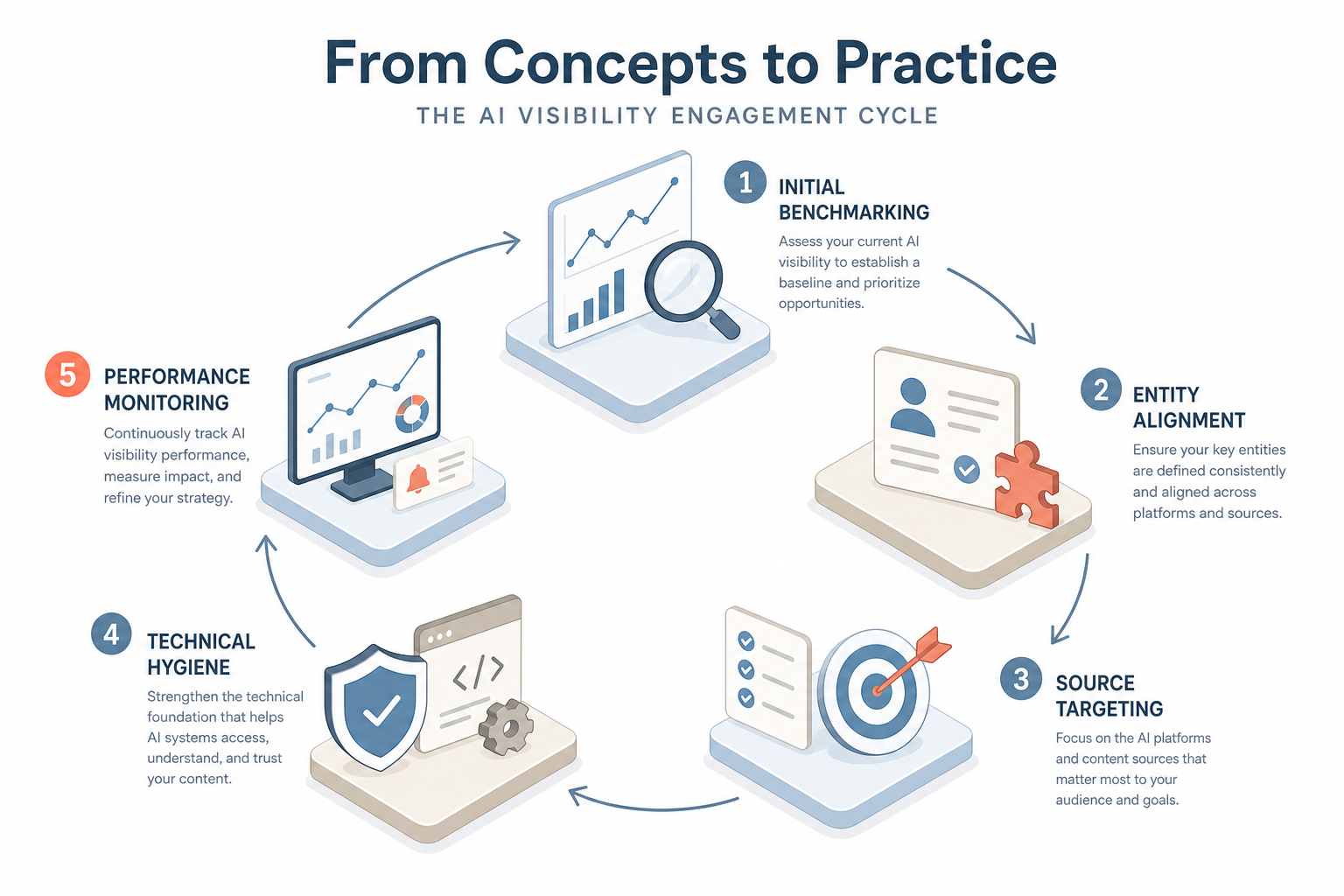
A typical AI Visibility engagement isn't a one-off task but a cyclical process integrated with broader SEO and brand authority efforts. Professional engagements usually follow a four-stage lifecycle.

1. The Benchmark Audit

Practitioners begin by mapping the client's current 'AI Footprint'. This involves querying a range of models (GPT-4, Claude, Gemini, Perplexity) with a controlled set of brand, category, and comparison prompts.

Example Audit Step: Check for 'Hallucination Risks' by asking models for specific technical specifications of the client's product. If the AI provides outdated or incorrect data, the practitioner identifies the source of the misinformation (often scrapers or old PDFs) and initiates a cleanup.

2. Entity Alignment

LLMs rely heavily on Knowledge Graphs. The practitioner's job is to ensure the client’s 'Entity' is clearly defined. This involves:

  • Schema Markup: Implementing Advanced JSON-LD that defines relationships (e.g., parent companies, key executives, specific service areas).
  • Wikidata/Wikipedia Management: Monitoring and suggesting factual updates to the primary sources used by training sets.
  • NAPs + V (Name, Address, Phone + Values): Ensuring brand values and unique selling points are consistently stated across high-authority signals.

3. Source Optimisation (The Citation Hunt)

AI engines cite their sources. Practitioners identify which domains the AIs are currently favouring for a specific niche and target those for placement. If Perplexity consistently cites a specific industry forum for 'Cloud Security' queries, the practitioner develops a strategy to have the client’s expertise represented on that forum.

4. Feed Management and Technical Hygiene

For e-commerce or product-led clients, this involves optimising Merchant Center feeds and product pages not just for human shoppers, but for the 'extractors' used by AI to compile comparison tables.

Worked Example: The Boutique Law Firm

The Client: A medium-sized London law firm specialising in Intellectual Property (IP).

The Problem: When asked "Who are the top IP lawyers in London?", ChatGPT and Perplexity frequently mention competitors but ignore the client, despite the client having high-quality blog content.

The Practitioner’s Approach:

  1. Diagnosis: The practitioner discovers that while the client has good blogs, they lack presence in 'Legal Directories' that the LLMs use as authoritative 'Entity Lists'.
  2. Action: Instead of just writing more blogs, the practitioner focuses on securing updated profiles in the Legal 500 and Chambers & Partners.
  3. Refinement: The practitioner updates the firm’s 'About' page using the 'AboutPage' and 'LegalService' schema, explicitly linking the firm's partners to specific high-profile cases they won.
  4. Result: Within a three-month window, the LLMs begin to include the firm in recommendations because the 'probabilistic link' between the firm and the 'IP Law' entity has been strengthened via third-party validation.

Deliverables in a Professional Engagement

Practitioners don't just send emails; they provide structured documents. Common deliverables include:

  • LLM Sentiment Report: A summary of how different AIs describe the brand (Positive, Neutral, Misinformed).
  • Gap Analysis: A comparison of the client’s mentions versus competitors in generative responses.
  • Source Target List: A list of 10-15 high-authority domains that the client must be featured on to influence AI citations.
  • Technical Schema Audit: A specific list of missing or poorly implemented structured data types.

Putting it into Practice

To move into a practitioner role, you must start treating AI engines as 'digital stakeholders'. Follow these steps in your next client session:

  1. Define your Prompts: Create a 'Base Prompt Library' for the client (e.g., 5 Brand questions, 5 Category questions, 5 Comparison questions).
  2. Establish a Baseline: Run these prompts through at least three different models and record the results in a spreadsheet. Do not guess; document.
  3. Identify the 'Authority Sites': Look at the citations provided by the AI. If the AI is citing a competitor or a third-party review site, that site is now your primary SEO target.
  4. Optimise for Extraction: Ensure the most important facts about the business (Price, Location, Features) are in clear, unstyled text or high-quality tables that LLM scrapers can easily parse.
  5. Review and Repeat: AI models update their weights and some have access to the live web. Monthly 'Visibility Check-ins' are essential to track if your optimisations are moving the needle.

Visual diagram

[ diagram placeholder ]

A flowchart showing the cycle of an AI Visibility engagement: from Initial Benchmarking to Entity Alignment, Source Targetting, Technical Hygiene, and finally Performance Monitoring.

Exercise

Select a client or a local business website. Run three prompts through Perplexity AI: 'What does [Business Name] do?', 'Who are the main competitors of [Business Name]?', and 'Why should I choose [Business Name] over others?'. Document which websites the AI cites as sources for these answers and identify one missing source you could influence.

Key takeaways

  • A practitioner moves from understanding concepts to implementing repeatable visibility workflows.
  • The role involves auditing how Large Language Models perceive and describe a brand.
  • Real-world engagements focus on influencing the 'Entity' rather than just ranking for keywords.
  • Practitioners must manage the client’s 'AI Footprint' across multiple models like GPT, Gemini, and Claude.
  • Citations are the 'new backlinks' in the world of Generative Search and AI visibility.
  • A significant part of the role is identifying and correcting AI hallucinations or misinformation.
  • Structured data (Schema) is a primary tool for telling AI exactly what a business does.
  • Practitioners must identify which third-party sites are being used as 'Truth Sources' by LLMs.
  • Deliverables include Sentiment Reports, Gap Analyses, and Source Target Lists.
  • Success is measured by the frequency and accuracy of brand mentions in generated answers.

Lesson Quiz

Pass at 70%.

1. What is the primary difference between an AI learner and an AI practitioner?
2. Which of these is a typical practitioner deliverable?
3. Why is 'Entity Alignment' important for a practitioner?
4. In the worked example of the Law Firm, why did the practitioner focus on directories?
5. What should a practitioner do if they find an AI is hallucinating facts about a client?
6. What are 'Source Targets' in an AI Visibility audit?
7. Which technical implementation is vital for helping AI parse business facts?
8. Why is 'Feed Management' mentioned for e-commerce clients?
9. How often should an AI Visibility 'Check-in' generally occur?
10. In a practitioner engagement, what does a 'Gap Analysis' compare?
Create a free account to save progress and earn a certificate.