Discover the foundational concept of Search Intent, the crucial 'why' behind every search query. Learn the four main types of intent and why satisfying the user's true goal is the key to visibility.
15 min read
Foundations
Visual diagram
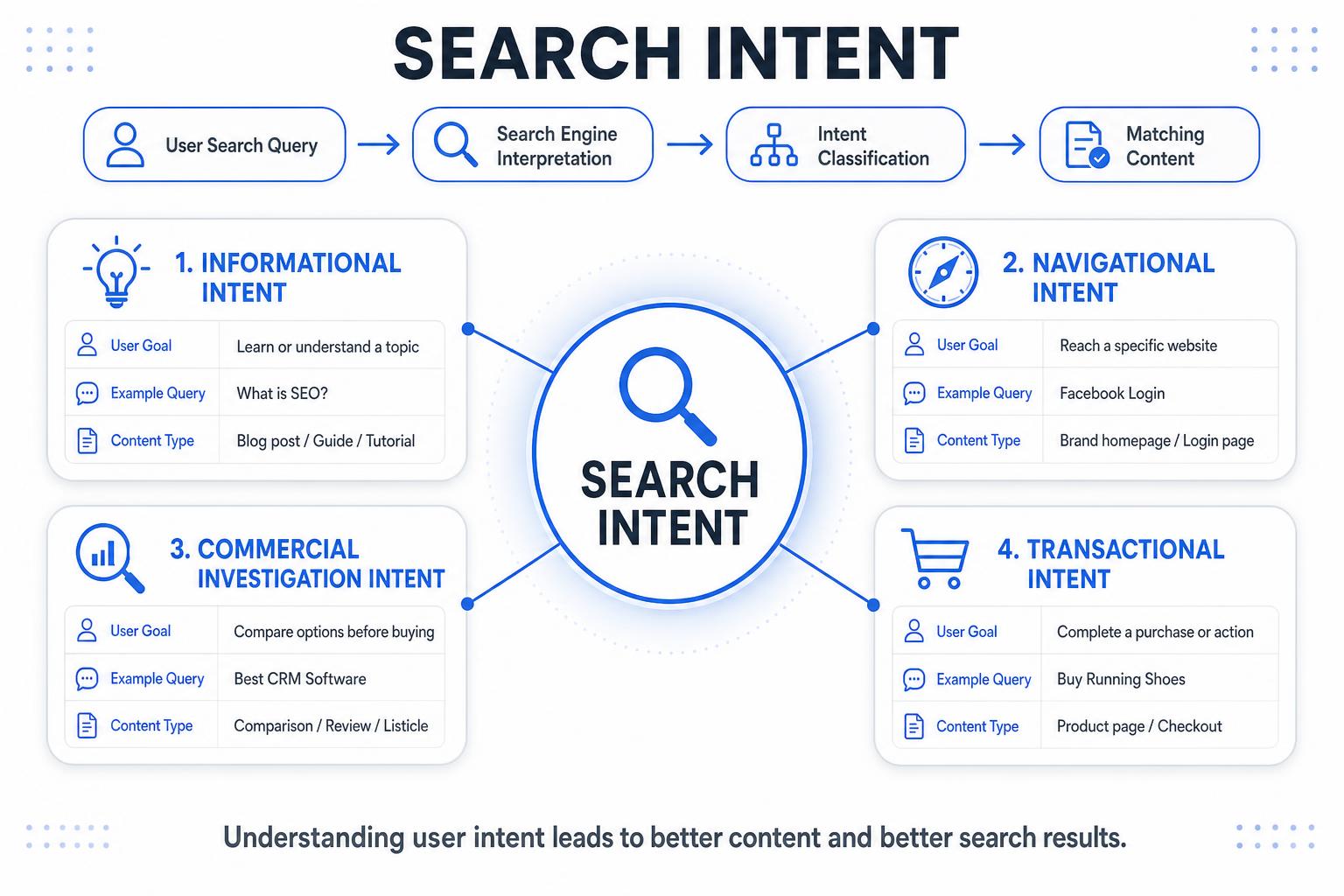
The four major categories of search intent — informational, navigational, commercial investigation, and transactional — and how a search engine moves from a user query to matching content.
Section 1 of 19
Introduction
Imagine walking into a large department store. Sometimes you walk in knowing exactly what you want across the room: a pair of running shoes in size eight. Other times, you are just window shopping to see what the new winter trends look like. And occasionally, you are looking for the customer service desk to ask a question about store hours. In each of these scenarios, your physical actions might look similar—you are walking through the doors of a store—but your underlying goal is entirely different.
The internet operates in the exact same way. When millions of people open a browser and type words into a search box, they are walking through the digital doors of a search engine. But what do they actually want? Are they looking to buy something immediately? Do they just want to read an interesting fact? Are they trying to navigate to their favorite social media site? The answer to that question is the most important concept in the entire world of search visibility. Let us embark on a journey to understand this foundational idea.
Introduction
Search Intent — Knowledge Check
Pass at 70%.
1. Why does search intent matter for both search engines and content creators?
2. What does "search intent" mean?
3. Which of these best describes informational intent?
4. A user types "Facebook login" into Google. What type of intent is this?
5. Which query best represents commercial investigation intent?
6. You run a shop and want to attract people ready to buy hiking boots. Which query shows transactional intent?
7. A blogger writes a long article titled "What is a CRM" but fills it with buy-now buttons and pricing tables. Why might this page perform poorly?
8. Which query is most likely to have mixed intent?
9. How does matching the right content format to intent improve a page's performance?
10. Why is understanding search intent even more important in AI search systems like ChatGPT or Google AI Overviews?
11. A small business publishes a clear, well-structured guide that directly answers a beginner question. Why is this strong for AI Visibility?