Introduction to AI Visibility Prioritisation
Identifying opportunities for AI visibility—such as getting cited in ChatGPT Search, Perplexity, or Google’s AI Overviews—is only the first step. For the intermediate practitioner, the real challenge lies in selection. Not every 'unclaimed' citation is worth pursuing, and not every featured snippet translates into commercial value. Without a rigorous scoring system, marketing teams often succumb to 'shiny object syndrome', chasing high-volume queries that do not drive conversions or wasting resources on high-effort technical fixes with low probability of success.
This lesson introduces a systematic approach to qualifying opportunities using a modified ICE (Impact, Confidence, Effort) framework specifically tailored for AI Engine Optimisation (AEO) and Generative Engine Optimisation (GEO). By the end of this module, you will be able to transform a chaotic list of potential optimisations into a data-backed roadmap.
The Three Pillars of Qualification
To score an opportunity effectively, we evaluate it against three core dimensions. Each is scored on a scale of 1 to 10.
1. Impact (Potential Gain)
Impact measures the potential uplift in brand visibility and traffic if the optimisation succeeds. In AI visibility, we look at several sub-factors:
- Commercial Intent: Does the query relate to a product or service you sell? (e.g., "Best CRM for small business" vs "What is a CRM?").
- Citation Value: Does the AI engine provide a direct clickable link to the source?
- Query Volume & Frequency: How often is this specific problem or question asked by your target persona?
- Brand Authority Gap: Is the current cited source a direct competitor or a generic information site (like Wikipedia)? Displacing a competitor has higher strategic value.
2. Confidence (Probability of Success)
Confidence is your professional assessment of how likely you are to achieve the desired result based on the evidence available.
- Content Alignment: Do you already have a high-quality asset that answers the query, or must you create one from scratch?
- Technical Readiness: Does the site support the necessary schema markup or structured data required for the specific AI feature?
- Historical Performance: Have you successfully captured similar AI citations for this client before?
- Data Certainty: Are you basing this on clear data from tools like Google Search Console or third-party AI trackers, or is it a 'gut feeling'?
3. Effort (Resource Cost)
Effort estimates the total resources required to implement the change. This includes:
- Creative Time: Writing new copy, designing charts, or producing video.
- Technical Time: Implementing JSON-LD, improving Core Web Vitals, or altering site architecture.
- Stakeholder Approval: How many layers of legal or brand review will the content need to pass through?
The Scoring Formula
To calculate the final priority score, we use the following calculation:
Priority Score = (Impact x Confidence) / Effort
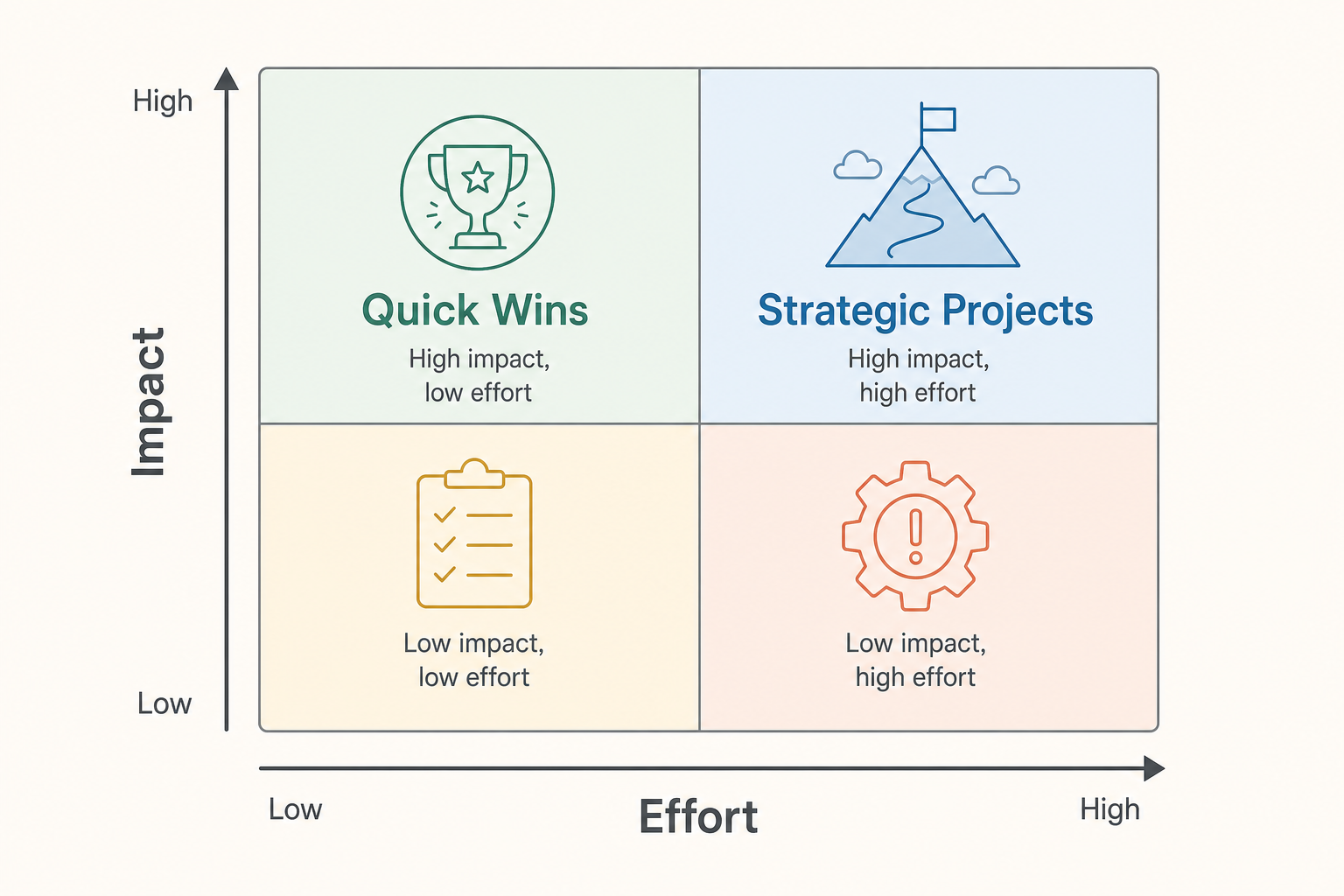
High impact, high confidence, and low effort produce the highest scores. These are your 'Quick Wins'. Conversely, high effort tasks with low impact should be deprioritised or moved to a 'Backlog' for when resources are more abundant.
Worked Example: B2B SaaS Client
Imagine you are working for a 'Project Management Software' provider. You have identified two opportunities:
Opportunity A: Optimising for "Project Management Software with Gantt Charts"
- Impact (9/10): High commercial intent. Directly relates to a core feature. AI engines often provide a list of recommended tools here.
- Confidence (4/10): Your current landing page for Gantt charts is thin on content and lacks structured data. You haven't ranked for this in traditional SEO either.
- Effort (7/10): Requires a total page rewrite, new screenshots, and developer time to add SoftwareApplication schema.
- Score: (9 x 4) / 7 = 5.1
Opportunity B: Defining "Critical Path Method" in AI Overviews
- Impact (6/10): Top-of-funnel educational query. High volume, but lower immediate conversion potential.
- Confidence (8/10): You already have a high-ranking blog post on this topic. You just need to reformat the lead paragraph into a concise 45-word 'definition' block.
- Effort (2/10): Simple CMS edit. No dev work needed.
- Score: (6 x 8) / 2 = 24
Conclusion: Even though Opportunity A is more commercially relevant, Opportunity B is the significantly better task to tackle first. It builds immediate visibility and momentum while you plan the more intensive work for Opportunity A.
Qualifying Through 'Brand Sentiment' Filters
Beyond the ICE score, an intermediate practitioner must filter opportunities through brand safety and sentiment requirements. Ask:
- Accuracy Risk: If an AI engine hallucinates using your data, does it create a legal liability? (Critical for YMYL niches like Finance or Health).
- Alignment: Does the AI's current summary of your brand align with your actual values? If the AI currently associates your brand with 'cheap' when you are 'premium', the priority should be sentiment correction over high-volume traffic.
The Validation Step: Manual Verification
Scores can be misleading if the underlying data is stale. Before committing to a high-effort task, perform a 'Hand-Check':
- Use a clean browser or VPN to trigger the AI response.
- Verify if the cited sources are actually providing value or if the AI is 'cannibalising' the click (answering so well that the user never clicks through).
- If the AI provides a full answer and no one clicks, the 'Impact' score should be lowered regardless of the search volume.
Putting it Into Practice
Follow these steps for your next client engagement:
- Audit: List 20 keywords where your client is currently not cited but competitors are.
- Categorise: Group these into 'Informational' (How-to), 'Commercial' (Best tools), and 'Navigational' (Brand queries).
- Score: Apply the (I x C) / E formula to each keyword.
- Filter: Remove any queries that carry high hallucination risks or brand misalignment.
- The Roadmap: Select the top 5 highest-scoring items. Present these to the client as 'Sprints'. Document the baseline visibility before you begin.
Remember, in the fast-moving world of AI, a 'Done' score of 15 is better than a 'Perfect' score of 30 that never gets implemented because the effort was too high.