Sources of AI Visibility Opportunity

Master identifying AI visibility gains by analysing content relevance, authority signals, and entity relationships within the context of Generative Search and LLMs.

12 min read
Foundations

Introduction

Identifying opportunities for AI visibility requires a departure from traditional keyword-centric SEO. In an AI-first search environment, visibility isn’t just about ranking for a specific query; it is about being the 'trusted source' that an LLM (Large Language Model) synthesises to form its answer. Opportunity identification involves looking at the delta between what AI engines (like ChatGPT with Search or Google Gemini) currently provide and what your brand can offer in terms of depth, unique data, and expert consensus. This lesson explores the three primary pillars of visibility: Content gaps, Authoritative signals, and Entity mapping.

Pillar 1: Content-Driven Opportunities

Content opportunities in AI visibility are often found in the 'nuance gap'. Because LLMs thrive on detail and structured information, standard marketing copy often fails to be cited.

Conversational Pattern Matching

Users interact with AI through natural language. Opportunities exist where your content answers the 'why' and 'how' rather than just the 'what'.

  • Example: Instead of a page titled 'Low-Interest Mortgages', an AI visibility opportunity exists in 'How low-interest mortgage rates impact first-time buyer affordability in Manchester'.

The 'Unique Data' Advantage

LLMs are trained on massive datasets, but they lack real-time or proprietary data unless provided in the context window. Your opportunity lies in publishing:

  • Original research and survey results.
  • Proprietary benchmarks.
  • Real-world case studies with specific metrics.
  • Price comparison data that requires manual verification.

Formatting for LLM Ingestion

AI engines prefer content that is easy to parse. There is a significant opportunity in transforming existing long-form articles into highly structured formats:

  1. Definitions: Clear, concise 'is' statements at the top of pages.
  2. Lists: Multi-step processes clearly numbered.
  3. Tables: Comparative data that an LLM can easily extract for a 'Pros and Cons' summary.

Pillar 2: Authority and Trust Opportunities

Authority in AI search is less about PageRank and more about 'Probabilistic Trust'. The AI engine asks: 'How likely is this source to be accurate based on its context?'.

Digitising Subject Matter Expertise (SME)

Many brands have experts who don't have a public digital footprint. Bringing these experts to the forefront creates a visibility opportunity.

  • The Action: Create detailed author bios that link to external credentials (academic papers, talks, LinkedIn profiles).
  • Why it works: AI models use secondary sources to verify the credibility of the primary source. If an author is mentioned in industry news, the AI is more likely to cite their content.

Citation Gap Analysis

Perform a search within an AI engine for your core topic. If the engine cites three competitors but not you, look at the sentiment and sources of those citations.

  • Are they citing a specific PDF whitepaper?
  • Are they pulling from a Reddit thread?
  • Are they referencing a Wikipedia entry? If the AI is citing third-party platforms (like Reddit or Quora), your opportunity is to participate in those community discussions to influence the 'corpus' the AI learns from.

Pillar 3: Entity Relationship Mapping

AI sees the world as a graph of entities (People, Places, Things, Brands) and the relationships between them. Visibility opportunities occur when you strengthen the link between your brand and its primary category.

Establishing Entity Associations

If your brand is 'FinTech Corp', you want the AI to associate you with 'Sustainable Investing'.

  • Opportunity: Create content that bridges the two entities. 'FinTech Corp's approach to Global ESG Standards'.
  • Execution: Use Schema.org markup (specifically mentions and about properties) to explicitly tell the AI which entities your content relates to.

Semantic Completeness

AI engines assess the 'completeness' of a topic coverage. If you write about 'Electric Vehicles' but never mention 'Charging Infrastructure', the AI views your content as less authoritative.

  • The Opportunity: Use tools to map out the 'Semantic Cloud' of your topic. Fill the gaps where your competitors are silent, particularly on emerging sub-topics like 'Solid-State Battery Longevity'.

Worked Example: A B2B Software Provider

The Client: A SaaS company providing project management tools for architects.

Step 1: Identify the Content Opportunity The AI currently gives generic advice on project management. The client has internal data on 'average project delays in UK architecture firms'.

  • Action: Publish an annual 'Architecture Industry Productivity Report'. Content is now high-value for citations.

Step 2: Identify the Authority Opportunity The CEO is a former architect but has no digital profile.

  • Action: Secure guest spots on industry podcasts and ensure the transcripts are indexed. AI engines now link the CEO (Person Entity) to the Brand (Organisation Entity).

Step 3: Identify the Entity Opportunity The brand is not mentioned in 'Best Software' lists generated by Gemini.

  • Action: Optimise the 'Features' page with structured Compare-and-Contrast tables against known competitors, using standard industry terminology (e.g., BIM integration).

Putting It Into Practice

  1. Audit the AI Response: Use Gemini or ChatGPT to ask: 'Who are the experts in [Your Niche]?' Note who is listed and why.
  2. Identify the Data Void: Look for questions in your industry that currently receive 'hallucinated' or vague answers from AI. Build the definitive data-backed answer.
  3. Schema Check: Ensure your SiteNavigationElement and Organisation schema are robust. This is the 'ID Card' for the LLM.
  4. The 'Niche' Strategy: Don't try to be visible for 'Marketing'; aim for 'AI-Driven Retention Marketing for UK Retail'. The narrower the niche, the higher the probability of becoming the AI's primary source.

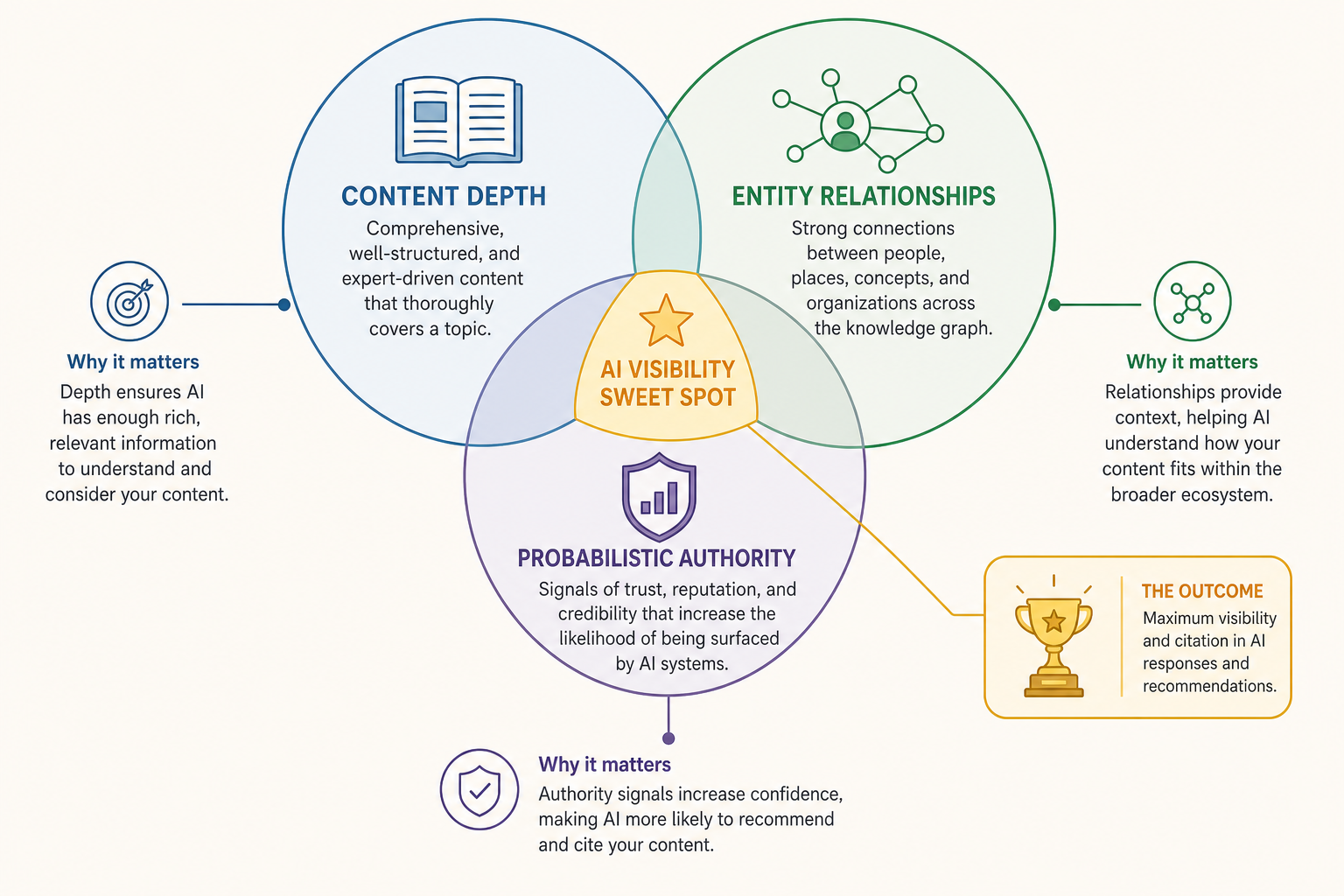
Visual diagram

[ diagram placeholder ]

A Venn diagram showing the intersection of Content Depth, Entity Relationships, and Probabilistic Authority as the 'AI Visibility Sweet Spot'.

Exercise

Choose a specific service page on your website. Use an AI tool (Gemini or Perplexity) to ask a complex question related to that service. Identify one specific piece of missing data or a structured table you could add to your page that would make it a better citation source than the current results.

Key takeaways

  • AI visibility is based on synthesis and citation rather than traditional keyword ranking.
  • Content opportunities lie in the 'nuance gap' where generic AI answers lack depth.
  • Proprietary data and research are the most effective drivers of premium AI citations.
  • LLMs prefer structured data formats like tables and lists for easier information extraction.
  • Authority in AI search is 'Probabilistic Trust' built through cross-platform recognition.
  • Author bios and external credentials are critical for establishing Subject Matter Expertise.
  • Entity mapping involves connecting your brand to relevant industry concepts in the knowledge graph.
  • Schema.org markup acts as a direct communication channel to help AIs understand entity relationships.
  • Semantic completeness requires covering all sub-topics related to a main entity to signal authority.
  • Participating in third-party platforms like Reddit can influence the AI's training data and citations.

Lesson Quiz

Pass at 70%.

1. What is the primary difference between traditional SEO and AI visibility opportunity identification?
2. Which content type is most likely to earn a high-value citation from an AI engine?
3. In the context of AI visibility, what does 'Probabilistic Trust' refer to?
4. Why are structured tables highly valued for AI visibility?
5. Which Schema.org property is most helpful for defining Entity Relationships?
6. What is a 'Citation Gap Analysis'?
7. How can third-party platforms like Reddit influence AI visibility?
8. What is 'Semantic Completeness'?
9. What is an effective way to 'digitise' an expert's authority?
10. Why is a 'niche' strategy often better for AI visibility than a broad strategy?
Create a free account to save progress and earn a certificate.