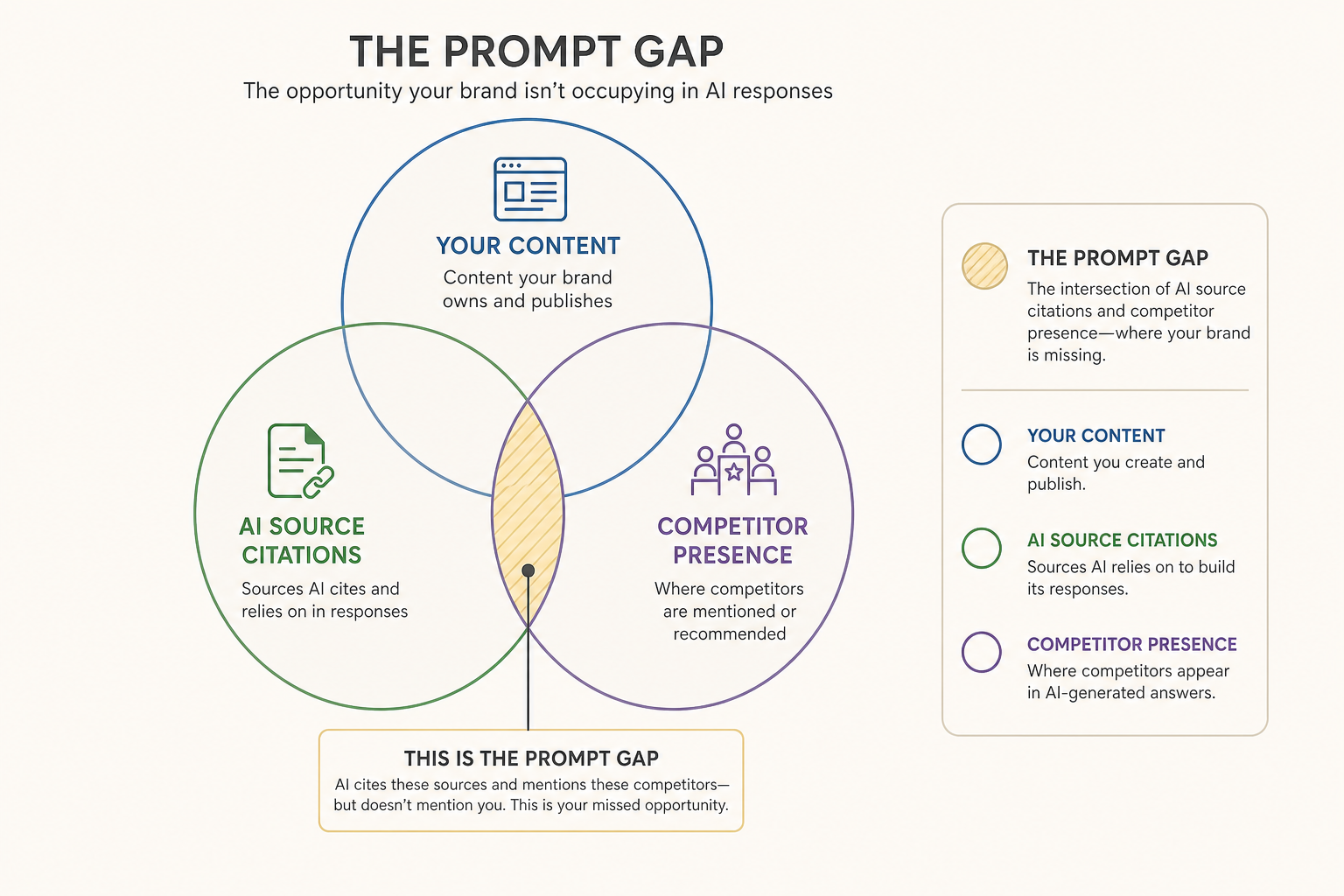
Introduction to Prompt Gap Analysis
Prompt Gap Analysis is the systematic process of identifying queries, personas, and intent-driven prompts where your brand or client is currently absent from AI-generated answers, despite competitors being cited. In traditional SEO, we focus on 'Keyword Gaps' based on search volume. In AI Visibility, we focus on 'Prompt Gaps' based on intent, attribution, and context.
As LLMs (Large Language Models) like ChatGPT, Claude, and Perplexity become primary discovery tools, being the 'missing citation' is a significant commercial risk. This lesson provides a framework for auditing these gaps and prioritising the content interventions needed to secure your place in the AI-generated consensus.
The Three Dimensions of the Prompt Gap
Unlike standard search results, AI visibility is multi-dimensional. When performing a gap analysis, we look at three specific areas:
- Direct Brand Omission: The AI is asked for recommendations in your category (e.g., "Best project management software for SMEs") and your brand is not mentioned, while competitors are.
- Attribute Misalignment: The AI mentions your brand but fails to associate it with specific key USPs or attributes that competitors are winning (e.g., "Which coffee machine is the easiest to clean?").
- Persona Exclusion: The AI recommends your brand for one user type but ignores it for another, higher-value persona (e.g., "Recommended laptops for creative pros" vs "Recommended laptops for students").
Step-by-Step Methodology for Gap Identification
1. Seed Prompt Generation
Start by categorising your target prompts. Do not just use keywords; use the natural language prompts real users employ.
- Informational: "How do I..."
- Commercial Investigation: "Compare X and Y for..."
- Transactional: "What is the best [product class] for [specific use case]?"
2. Competitive Benchmarking
Select 3-5 primary competitors. Use an AI discovery tool or manual testing across Perplexity, Gemini, and ChatGPT to see who the 'incumbent' citations are. Create a matrix: Row = Prompt, Column = Brand. Mark a '1' if cited, '0' if absent.
3. Source Mapping
For the prompts where you are missing, look at the citations provided by the AI. Where is the LLM getting its information?
- Are they citing niche review sites?
- Are they citing Reddit or Quora threads?
- Are they citing competitor whitepapers?
If the AI is pulling from a specific set of 10-15 domains where your brand is unrepresented, the 'Gap' isn't just a content gap on your site—it is an external 'Trust Gap'.
Worked Example: Enterprise SaaS Gap Analysis
Scenario: A mid-market CRM provider (Brand Alpha) wants to increase visibility in AI engines.
The Prompt: "Which CRM is best for decentralised sales teams of 50+ people?"
The Baseline Discovery:
- ChatGPT: Recommends Salesforce and Hubspot. Cites G2 and a Forbes Advisor article.
- Perplexity: Recommends Salesforce, Pipedrive, and Monday.com. Cites a Reddit thread and three independent tech blogs.
- Brand Alpha Status: Absent from all responses.
The Analysis:
- The Gap: Brand Alpha has plenty of content about 'CRM for sales', but zero content or external mentions specifically addressing 'decentralised teams' or 'teams of 50+'.
- The Source Gap: The competitors are mentioned in a specific Forbes listicle and a high-ranking Reddit thread from 2023. Brand Alpha is missing from both.
The Solution:
- Create a dedicated landing page on the Alpha site titled "Managing Decentralised Sales Teams: A CRM Guide".
- Update the brand's G2 profile to highlight 'multi-location' features.
- Engage in the relevant Reddit communities to ensure the brand is part of the conversation organically.
Analysing the 'Negative Gap'
A negative gap occurs when the AI mentions your brand but in a negative or outdated context. For example: "Brand X is good but expensive and lacks a mobile app." If you have since launched a mobile app, this is a factual gap.
To bridge a factual gap, you must provide 'Structured Proof'. This involves updating your schema markup (Product and Organization schema) and ensuring your latest press releases and product pages are indexed by the aggregators the LLMs use as training data or RAG (Retrieval-Augmented Generation) sources.
Prioritisation Matrix
Not every gap is worth closing. Use this simple scoring system (1-5):
- Relevance: How likely is the user of this prompt to buy?
- Difficulty: How entrenched are the current citations? (E.g., if the AI only cites government URLs, it’s a high difficulty).
- Impact: Does this prompt lead to high-margin products?
Focus on High Relevance / Low Difficulty gaps first. These are often 'Niche Use Cases' where the AI relies on a limited number of sources.
Putting it into Practice
To implement Prompt Gap Analysis for your clients, follow these three phases:
Phase A: Discovery (Week 1) Run a set of 50 core prompts through a tracking tool. Identify the 'Visibility Share'. If your brand is under 20%, you have a significant prompt gap.
Phase B: Attribution Audit (Week 2) Identify the top 10 domains that the AI cites when it doesn't mention you. Check if you have a presence on those domains (reviews, guest posts, mentions).
Phase C: Content Correction (Ongoing) Rewrite onsite meta-content and technical specs to mirror the language used in the winning citations. Introduce 'Compare' pages that specifically mention the competitors the AI is already fond of; this helps the LLM understand your brand's position in the same 'semantic neighbourhood'.