Introduction to AI Content Gap Analysis
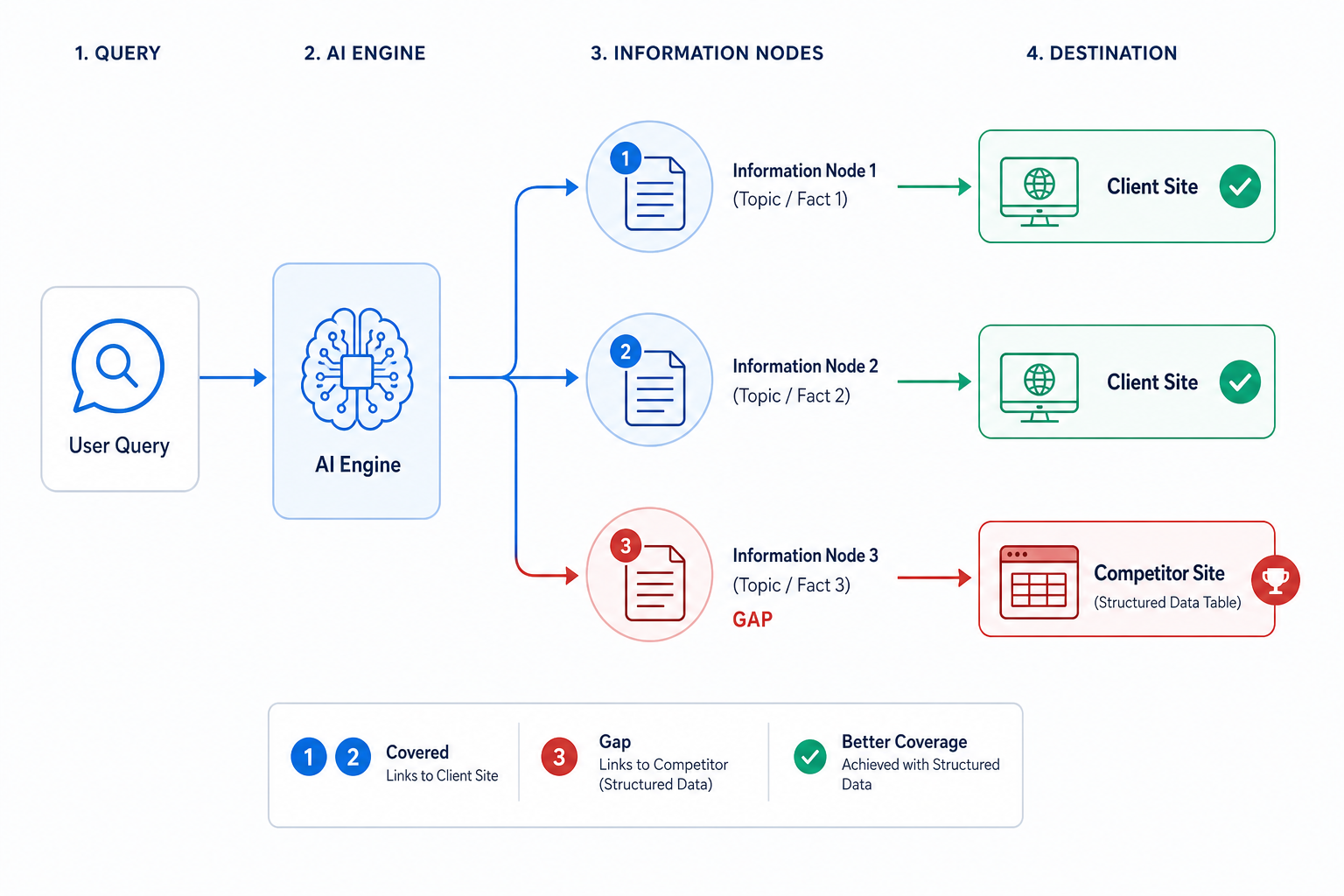
Traditional SEO gap analysis focuses on keywords and search volume. In the era of AI-generated answers, the focus shifts to information utility and citation frequency. AI engines like Perplexity, SearchGPT, and Google Gemini do not just rank pages; they synthesise information. When they cite a competitor instead of you, it is often because that competitor provides a specific type of data, a unique perspective, or a structured format that the AI finds easier to parse and relay to the end user.
Content gap analysis for AI is the systematic process of identifying these 'missing nodes'. It involves looking beyond keywords to understand the logical components that make a source 'citeable' in an AI summary. This lesson will teach you how to audit the citations within AI responses to identify where your content falls short and how to bridge those gaps effectively.
The Difference Between Keywords and Citation Nodes
In traditional SEO, you might target the keyword 'commercial property insurance costs'. In AI Visibility, you must target the Citation Nodes that satisfy the query. These might include:
- The Baseline Node: Current average premiums by sector.
- The Variable Node: How regional location affects risk profiles.
- The Comparative Node: Differences between basic liability and comprehensive coverage.
- The Visual Node: A table or list that the LLM can easily ingest.
If an AI engine provides an answer and cites a competitor for the 'Variable Node', even if you have a page about 'commercial property insurance', you have a content gap in that specific information node.
Step-by-Step AI Gap Audit
1. Define Your Core Query Clusters
Start by identifying the high-intent queries relevant to your client. Group these into clusters based on the 'user intent' (e.g., 'Inquiry/Research', 'Comparison', 'Implementation').
2. Capture the AI Snapshot
Run these queries through the major engines: SearchGPT, Perplexity, and Gemini. Do not just look at the text output; click on the citations and the 'Sources' section. Document which competitors are being referenced and for which specific claim or data point.
3. Deconstruct the Citation Utility
For every competitor citation, ask:
- What specific fact or figure was cited?
- What format was it in (Table, Bullet list, FAQ section, Case study)?
- What was the 'voice' (Objective data, Expert opinion, First-hand experience)?
4. Categorise the Missing Content Types
Usually, AI gaps fall into these four categories:
- Structured Data Gaps: You have the text, but not the clean table or schema the AI prefers.
- Specificity Gaps: You are too generic; the competitor provides specific pound-and-pence figures.
- Proof Gaps: You make a claim; the competitor provides a cited case study or whitepaper link.
- Perspective Gaps: The AI is looking for a 'contrarian' or 'expert' view that you are currently avoiding.
Worked Example: Sustainable Packaging SaaS
Scenario: A client provides software for tracking supply chain sustainability. The Query: "How to measure scope 3 emissions for UK retail businesses." AI Response Analysis: Perplexity provides a 5-step guide. It cites 'Competitor A' for the definition of Scope 3 and 'Competitor B' for a specific breakdown of 'Transport vs. Waste' emissions levels in UK retail.
The Gap Identification:
- Your client has a long-form blog post about Scope 3.
- However, your client does not have a specific breakdown of emissions levels by sub-sector (e.g., Fashion Retail vs. Grocery Retail).
- The Gap: A statistical breakdown or data table showing industry-specific emission benchmarks.
The Solution: Create a technical whitepaper page titled 'UK Retail Scope 3 Benchmarks' featuring a JSON-LD structured table. Within weeks, the AI starts pulling the specific figures from your table instead of the competitor's outdated PDF.
Identifying High-Value Content Formats
AI engines have a preference for certain content structures because they are 'low energy' to process. To close gaps, consider these formats:
- Comparison Tables: Side-by-side feature or cost comparisons.
- Definition Blocks: Clear, one-sentence definitions of industry terms with
<dfn>tags. - Process Flowcharts: Step-by-step instructions with clear numbering.
- Citable Statistics: Original research or aggregated data presented as a highlight.
- Entity Relationships: Content that clearly links your brand to other established industry entities.
Mapping the 'Missing Entities'
AI sees the world in terms of entities and their relationships. Use tools like the Google Knowledge Graph Search API or simple 'Mention' searches to see what entities are frequently associated with your topic. If an AI summary for 'Electric Vehicle Home Charging' always mentions 'OZEV Grant', but your site never mentions it, you have an entity gap. You are missing a key piece of the knowledge map that the LLM expects to find.
Putting It Into Practice
To apply this knowledge in your next client engagement:
- The Citation Audit: Select 20 high-value queries and map every single citation to a 'Content Type' and 'Competitor'.
- The Logic Map: Create a spreadsheet with three columns: [AI Claim] | [Source Cited] | [Our Equivalent Content].
- The Scorecard: If the third column says 'None' or 'Vague', mark it as a 'Critical Gap'.
- Content Briefing: Send these gaps to the content team, specifically requesting 'Format-first' content. Don't just ask for a blog post; ask for a 'Benchmarking Table' or an 'Expert Perspective Piece'.
- Schema Implementation: Ensure every new piece of 'gap-filling' content is supported by relevant Schema markup (e.g.,
Dataset,Table,HowTo) to make it even more accessible to the LLM crawlers.
By systematically filling these information voids, you move from being a 'keyword' player to being an essential 'Knowledge Source' for the AI ecosystem.