Introduction
Transitioning from high-level AI visibility concepts to actionable execution requires a central repository of tasks: the Opportunity Backlog. In the context of AI-led search (GEO/AEO), a backlog is not merely a list of keywords to target. Instead, it is a dynamic document that categorises content gaps, technical structured data requirements, and brand citation opportunities. For a practitioner, the backlog is the bridge between strategic audits and tangible results. This lesson details how to construct, score, and maintain a living backlog that your team or client can execute against systematically.
The Anatomy of an AI Opportunity Backlog
Unlike traditional SEO backlogs that focus heavily on on-page fixes and backlink acquisition, an AI visibility backlog must account for how Large Language Models (LLMs) digest and verify information.
A robust backlog should include the following data points for every entry:
- Objective: What are we trying to achieve? (e.g., "Secure citation in Perplexity for 'best enterprise CRM'")
- Entity Type: Is this a brand, a product, a person, or a service?
- Source Type: Where does the opportunity live? (Own site, third-party review site, industry forum, or academic paper)
- Effort Score: A 1-5 rating of technical or creative resources required.
- Impact Score: The potential traffic or brand authority gain.
- Confidence Score: How certain are we that this change will trigger an AI response?
Step 1: Data Gathering and Categorisation
Start by centralising the findings from your initial visibility audits. You should categorise these opportunities into four distinct buckets to help with team delegation:
Technical Foundations
These are the 'table stakes.' If your site's schema is broken or your robots.txt blocks AI crawlers, no amount of quality content will help. Items in this category might include implementing Speakable schema or refining Organization markup to include clear social proofs.
Content Enrichment
This involves updating existing pages to better answer 'Why' and 'How' questions. AI engines prefer structured, fact-dense content. Opportunities here include adding 'Key Takeaway' boxes, expert quote injection, and converting long-form paragraphs into extractable data lists.
Relationship and Entity Mapping
AI models map entities. Your backlog must include tasks to strengthen the digital links between your brand and relevant industry categories. This might involve updating Wikipedia entries (within guidelines), securing mentions in top-tier industry directories, or appearing on 'best of' lists that AI engines frequently cite.
Gap Analysis Response
Look at your competitors who are currently featured in AI snapshots (like Google SGE or Perplexity). If they are cited for a specific query and you are not, that is a direct backlog item. The task is to identify the unique 'data point' the competitor provides and exceed it on your own platform.
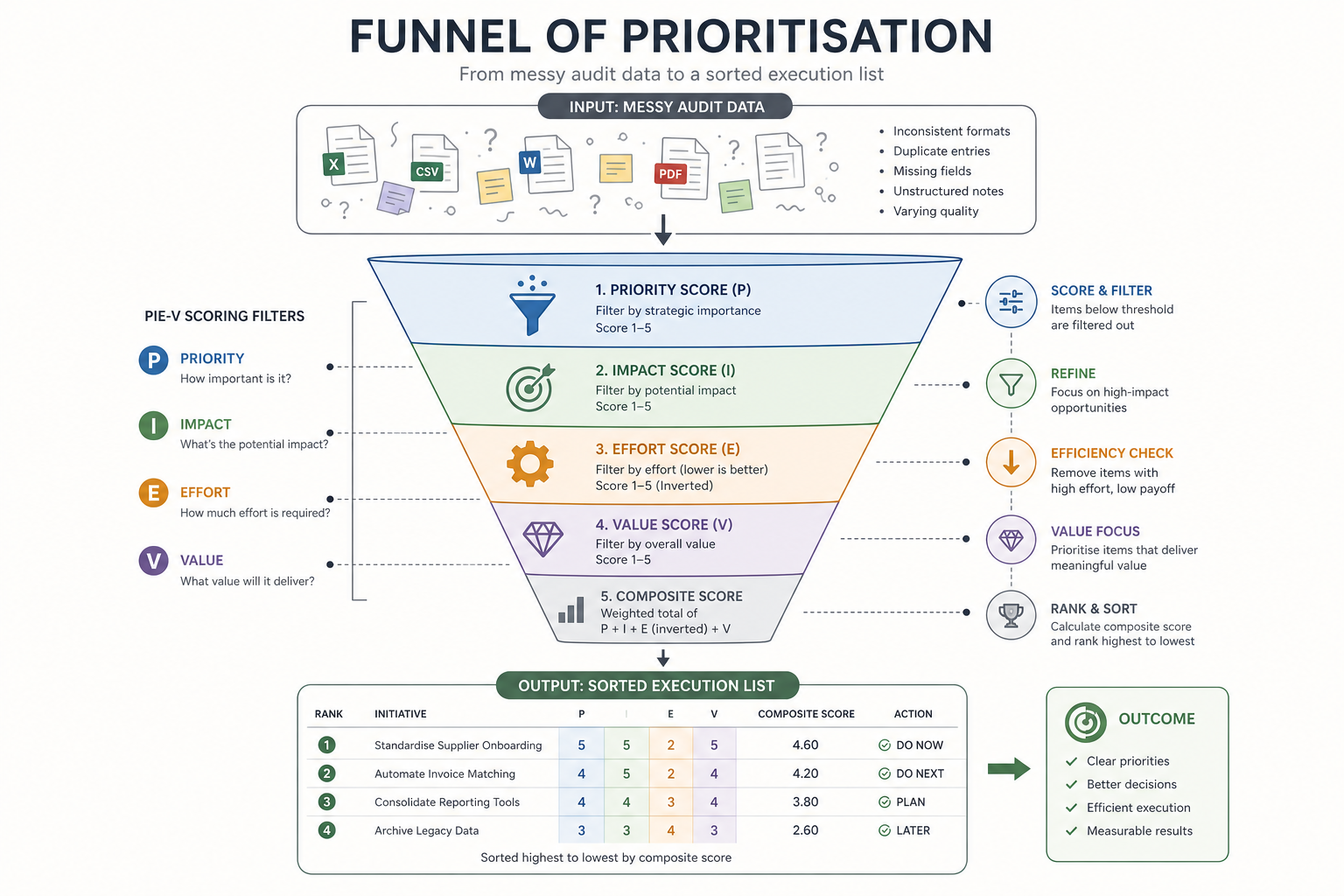
Step 2: The Scoring Framework (PIE-V)
To move from a list to a plan, apply the PIE-V framework to every item in your backlog:
- Probability: How likely is it that the AI engine will crawl and understand this update?
- Impact: If we land this citation, does it influence a high-value stage of the customer journey?
- Ease: Can this be done in-house or do we need external developers/PR support?
- Value: Does this align with the client’s current revenue goals?
Each item is scored 1-10. Sum the scores and sort the list. The items with the highest scores represent your 'Quick Wins.'
Worked Example: B2B SaaS Platform
Scenario: A cloud-based accounting software company wants to increase their presence in AI recommendations for "secure accounting software for UK small businesses."
Backlog Item A: Structured Data Expansion
- Task: Implement
SoftwareApplicationandReviewschema on all product pages. - Rationale: AI engines use structured data to verify security ratings and user satisfaction.
- Score: High Ease (Technical), High Probability.
Backlog Item B: External Authority Building
- Task: Outreach to three major UK tech review sites to update their 2024 'Security Comparison' tables.
- Rationale: AI engines often aggregate data from trusted third-party 'authority' sites rather than the brand itself.
- Score: Low Ease (Manual PR), Very High Impact.
Backlog Item C: Internal FAQ Optimisation
- Task: Rewrite the 'Security' FAQ to use direct, declarative sentences (e.g., "Our platform uses AES-256 encryption" instead of "We take security very seriously and use various methods.")
- Rationale: AI prefers factual, concise statements over marketing fluff.
- Score: Very High Ease, Medium Impact.
By placing these in the backlog, the team can see that Item C can be done today by a content writer, while Item A requires a developer sprint next week. Item B becomes a long-term goal for the PR team.
Maintaining the Living Document
A backlog is not a static PDF. It should be reviewed bi-weekly. AI models are updated frequently; a source that was cited last month may be dropped this month.
- Status Tracking: Use statuses such as 'Proposed', 'In Progress', 'Vetting', and 'Resolved'.
- Feedback Loop: When an item is 'Resolved', monitor the AI engines for 14-21 days. If your brand starts appearing, note it in the backlog to validate your strategy.
- Deprioritisation: If an LLM changes its sourcing patterns (e.g., stops citing Reddit), move platform-specific tasks lower in the priority list.
Putting it into Practice
To begin your opportunity backlog, choose one core topic your brand wants to be known for. Search for that topic in an AI engine (e.g., Claude or Gemini) and see who is cited. From that single search, you can usually generate at least five backlog items:
- Copy the formatting of the cited source.
- Identify a fact they mentioned that you also provide.
- Spot a structured data type they are using.
- Find an external site they are quoted on where you are missing.
- Identify a question the AI answered that your site doesn't explicitly address.