Introduction
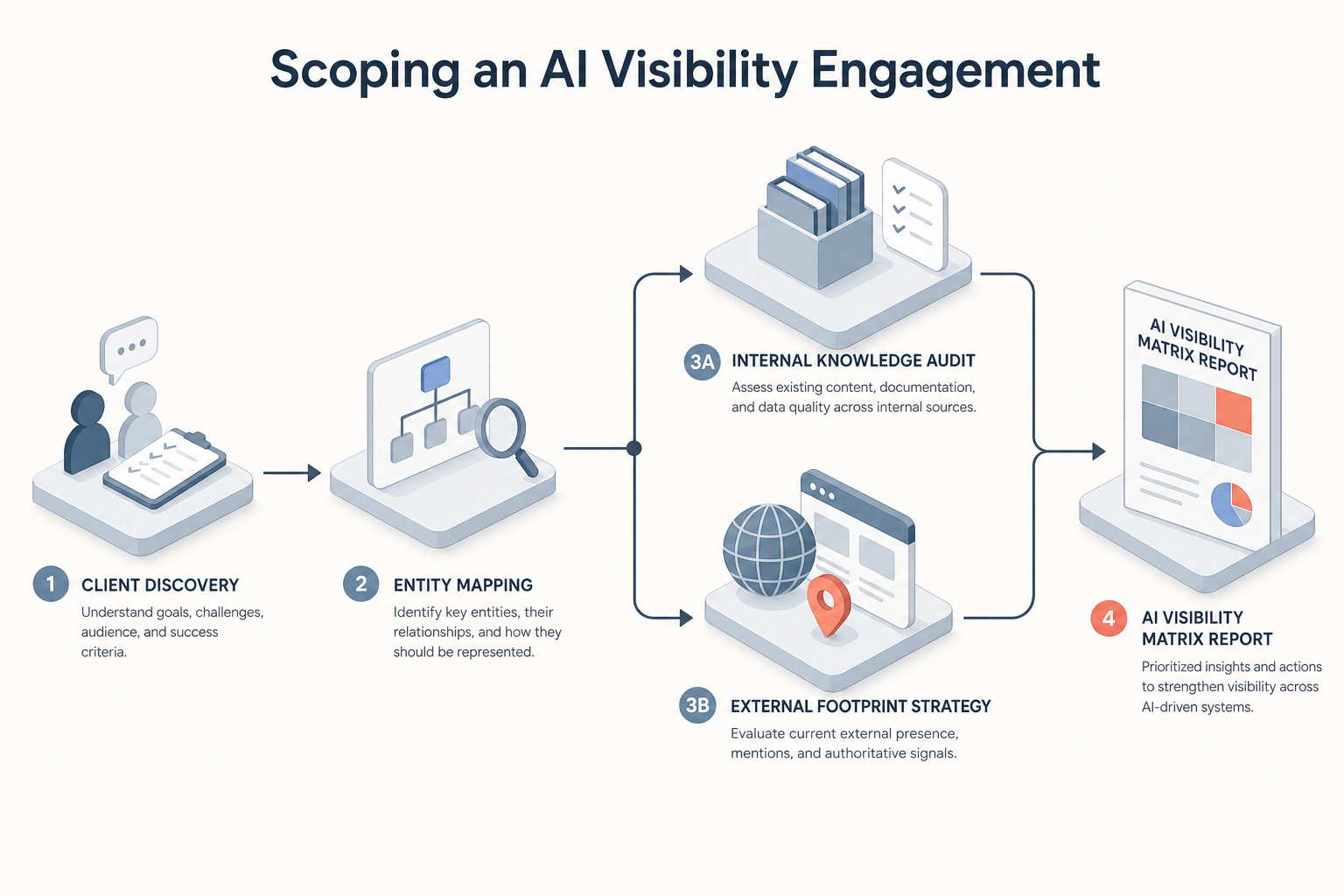
Transitioning from traditional Search Engine Optimisation (SEO) to AI Visibility (AEO/GEO) requires a fundamental shift in how we scope projects. While SEO often focuses on keyword rankings and traffic volume, AI Visibility is about influence—ensuring your brand is the chosen entity in the 'answer engine' result. Scoping an engagement correctly prevents 'scope creep' and ensures that both the practitioner and the client have a shared understanding of what success looks like in a non-linear, probabilistic search environment.
The Three Pillars of AI Visibility Scoping
Before drafting a Statement of Work (SOW), you must define the engagement across three specific pillars: The Knowledge Base, The Footprint, and The Referenceability.
1. The Knowledge Base (Internal)
This part of the scope addresses the quality of the client's own data. Are you merely optimising existing blog posts, or are you architecting a Knowledge Graph? Scoping must include an audit of structured data (Schema.org), the clarity of entity relationships, and the accessibility of information for LLM crawlers like GPTBot or OAI-SearchBot.
2. The Footprint (External)
AI models rely heavily on third-party validation. Your scope must define which external platforms are 'in-bounds'. For a B2B SaaS client, this might mean focusing on G2, Gartner, and Reddit. For a local service, it might mean Niche directories and local news mentions. Without a defined footprint, the project becomes an endless chase across the entire web.
3. The Referenceability (Citations)
Success in AI platforms like Perplexity or SearchGPT is often measured by the frequency and accuracy of citations. Scoping must clarify whether the goal is 'Brand Inclusion' (being mentioned) or 'Brand Preference' (being recommended as the primary solution).
Defining Success Criteria and KPIs
Traditional metrics like 'Position 1' are irrelevant in a world of generative summaries. When scoping, you should propose a 'Visibility Matrix' as your primary KPI:
- Share of Model (SoM): What percentage of queries within a specific category mention the brand?
- Attribution Accuracy: How often does the AI correctly link to the client's preferred landing page?
- Sentiment and Intent Alignment: Does the AI characterise the brand correctly (e.g., 'affordable option' vs 'premium leader')?
- Conversion from Citation: Measuring referral traffic from known AI user agents.
Concrete Steps for the Scoping Process
Step 1: Industry Entity Mapping
Start by mapping the client's primary entities. If the client sells 'Enterprise CRM', you need to scope the discovery of which 'nodes' (related concepts like CRM integration, cloud security, sales automation) the AI currently associates with them.
Step 2: Current AI Baseline Audit
Run a set of 50-100 standardised prompts across Perplexity, Gemini, and ChatGPT. This establishes the pre-engagement baseline. The scope should specify the number of prompts and the models used.
Step 3: Technical Constraints and AI-Bot Management
Define the boundaries of technical intervention. Will you be managing the robots.txt specifically for AI crawlers? Will you be implementing nosnippet tags for specific sections to prevent data scraping? These technical tasks must be explicitly listed.
Worked Example: 'LuxStay' Boutique Hotels
Client: A group of 10 high-end boutique hotels in the UK. The Problem: They rank well on Google for 'luxury hotels Cotswolds' but are never mentioned by Perplexity or ChatGPT when users ask for 'quiet, eco-friendly weekend retreats in the UK'.
Engagement Scope:
- Knowledge Audit: Re-structure the 'Sustainability' pages into machine-readable formats using JSON-LD (Hotel, LocalBusiness, and GreenAction schemas).
- Citation Strategy: Target five specific travel forums and two high-authority green-travel blogs for brand mentions over 3 months.
- Deliverable: A monthly 'AI Presence Report' showing the inclusion rate for the prompt 'Recommend eco-friendly luxury stays near London'.
- Out of Scope: Traditional backlink building or managing the client’s social media accounts.
Deliverables Checklist
A professional AI Visibility SOW should include:
- Entity Gap Analysis: A report identifying where the AI lacks information about the client.
- Schema Architecture Map: A blueprint for site-wide structured data.
- Preferred Source List: A curated list of 10-20 'Citational Magnets' (third-party sites) to influence.
- Prompt Library: A set of 25 core prompts used to track progress over the engagement.
Putting it into Practice
To apply this immediately, take your current lead or client and perform the following:
- Identify their top three commercial queries.
- Input these into three different AI engines (ChatGPT, Perplexity, Claude).
- Document the 'Source Footprint'—which websites is the AI citing to answer those queries?
- Use this 'Source Footprint' as the basis for your 'Phase 1: External Influence' scope. If the AI only cites Wikipedia and Reddit, your scope must involve a strategy for those specific platforms.
Finally, ensure your contract includes a 'Stochastic Disclaimer'. Unlike traditional SEO, you cannot guarantee a result because AI models are probabilistic. Your scope is for optimisation and influence, not a guaranteed output.