Working With Brands, Sites and Entities

Master the methodology of mapping a subject across brand perception, technical site performance, and Knowledge Graph entity status to define its complete AI visibility footprint.

12 min read
Foundations

Introduction

Transitioning from traditional Search Engine Optimisation (SEO) to AI Visibility requires a shift in how we define the 'subject' of our work. In traditional SEO, we lead with the domain. In the era of Generative Engine Optimisation (GEO) and Answer Engine Optimisation (AEO), we must work across three distinct but overlapping layers: the Brand, the Site, and the Entity. This lesson provides a practitioner's framework for modeling these layers to ensure large language models (LLMs) and retrieval-augmented generation (RAG) systems can accurately identify, verify, and recommend your client.

The Three-Layer Framework

To move beyond basic keyword rankings, we must evaluate the practitioner’s subject through three lenses. If these are not aligned, AI models will experience 'hallucination' or 'omission' regarding the client.

1. The Entity Layer (The Semantic Root)

An entity is a uniquely identifiable thing or concept that is distinct, independent, and well-defined. For AI models, the entity is the primary unit of storage. Before an AI can recommend a brand, it must understand what that brand is within a Knowledge Graph (like Google Knowledge Graph, Wikidata, or a proprietary RAG database).

  • Identifiers: Machine-readable IDs (e.g., Wikidata Q-codes).
  • Attributes: The facts associated with the entity (headquarters, founder, category).
  • Relationships: Links to other entities (e.g., 'Company A' is a 'Subsidiary' of 'Company B').

2. The Site Layer (The Content Pipeline)

While the entity is the concept, the site is the technical and lexical vehicle. AI models use crawlers and scrapers to ingest data. If the site is technically inaccessible or the content is unstructured, the AI's 'view' of the entity becomes fragmented.

  • Crawlability: Ensuring LLM-specific user agents (like GPTBot) can access the data.
  • Structure: Using Schema.org to explicitise the relationship between content and the entity.
  • Corroboration: Providing the primary source facts that AI models use to verify external mentions.

3. The Brand Layer (The Perceptual Layer)

This is how the market discusses the entity. AI models trained on vast datasets (Common Crawl, Reddit, news archives) build a 'persona' for a brand based on sentiment, context, and associations found in third-party citations.

  • Sentiment: Is the brand associated with 'premium quality' or 'budget' terms?
  • Authority: Do trusted third-party entities (industry journals, influencers) cite the brand?
  • Co-occurrence: Which other brands or keywords appear frequently in the same context as the brand?

The Extraction Process: A Practitioner’s Workflow

When starting a audit for a client, follow this sequence to model their current footprint.

Step 1: Locating the Entity ID

Do not assume a brand is a recognised entity. Use the Google Knowledge Graph Search API or tools like Kalicube to find the client’s unique identifier. If no ID exists, your first practitioner task is entity establishment via Wikidata or LinkedIn visibility.

Step 2: Mapping Parent-Child Entities

For larger clients, you must model the hierarchy. Is the site representing a single product, a local branch, or a global corporation? AI models struggle with 'ambiguation' where multiple entities share similar names. You must define the boundaries.

Step 3: Auditing the 'Source of Truth'

The site's 'About Us' and 'Contact' pages are the primary corroborative signals. These must use JSON-LD to link the Site to the Entity. Use the sameAs attribute in your Schema to point directly to the Wikidata entry or official social profiles. This creates a closed-loop verification for the AI.

Worked Example: Sustainable Apparel Brand 'EcoThread'

Scenario: EcoThread wants to be cited in ChatGPT responses for "best sustainable workwear."

  1. Entity Audit: We find EcoThread has no Wikidata entry. It is often confused with 'Eco-Thread Tools' (a hardware company).

    • Action: Create a LinkedIn Professional Page and ensure the 'Organization' Schema is deployed on the home page with a unique @id URL.
  2. Site Audit: The site uses vague language like "We care about the planet."

    • Action: Change content to specific, extractable facts: "EcoThread uses 100% GOTS-certified organic cotton." This provides the AI with 'proof points' it can cite.
  3. Brand Audit: External sentiment is positive, but the brand is rarely mentioned alongside 'workwear,' mostly 'casual wear.'

    • Action: Execute a PR campaign targeting B2B fashion journals to build the association between the 'EcoThread' entity and the 'Workwear' category.

Overcoming Naming Ambiguity

A common practitioner hurdle is the 'Generic Name' problem. If a client is named 'The Coffee House,' an AI model will struggle to distinguish it as a specific entity. In these cases, the Site layer must work harder. You must use specific geographic headers and 'founder' schema to tether the generic brand to a specific, unique entity location.

Managing the Entity Life Cycle

Entities are not static. As a practitioner, you must manage three stages:

  1. Creation: For new brands, focus on authoritative directory listings and Schema implementation.
  2. Maintenance: Regular audits of 'Near-Me' signals and Wikipedia references (if applicable) to ensure data hasn't drifted.
  3. Defence: Correcting hallucinations where AI models wrongly attribute a competitor's features to your client.

Putting it into Practice

To apply this methodology in your next client engagement:

  1. Audit the Knowledge Graph: Use an API or a tool like 'WordLift' to see what entities the AI currently associates with the client's domain.
  2. Check for Schema Completeness: Ensure the Organization schema includes brand, logo, url, and sameAs properties.
  3. Map the Citations: Use a backlink tool to find where the brand is mentioned without a link. These 'unlinked mentions' are vital for AI entity building even if they don't help traditional SEO rankings.
  4. Align the Messaging: Ensure the 'Brand' (what people say), the 'Site' (what the client says), and the 'Entity' (the database facts) are perfectly synchronised. Discrepancies lead to low trust scores in AI-generated answers.

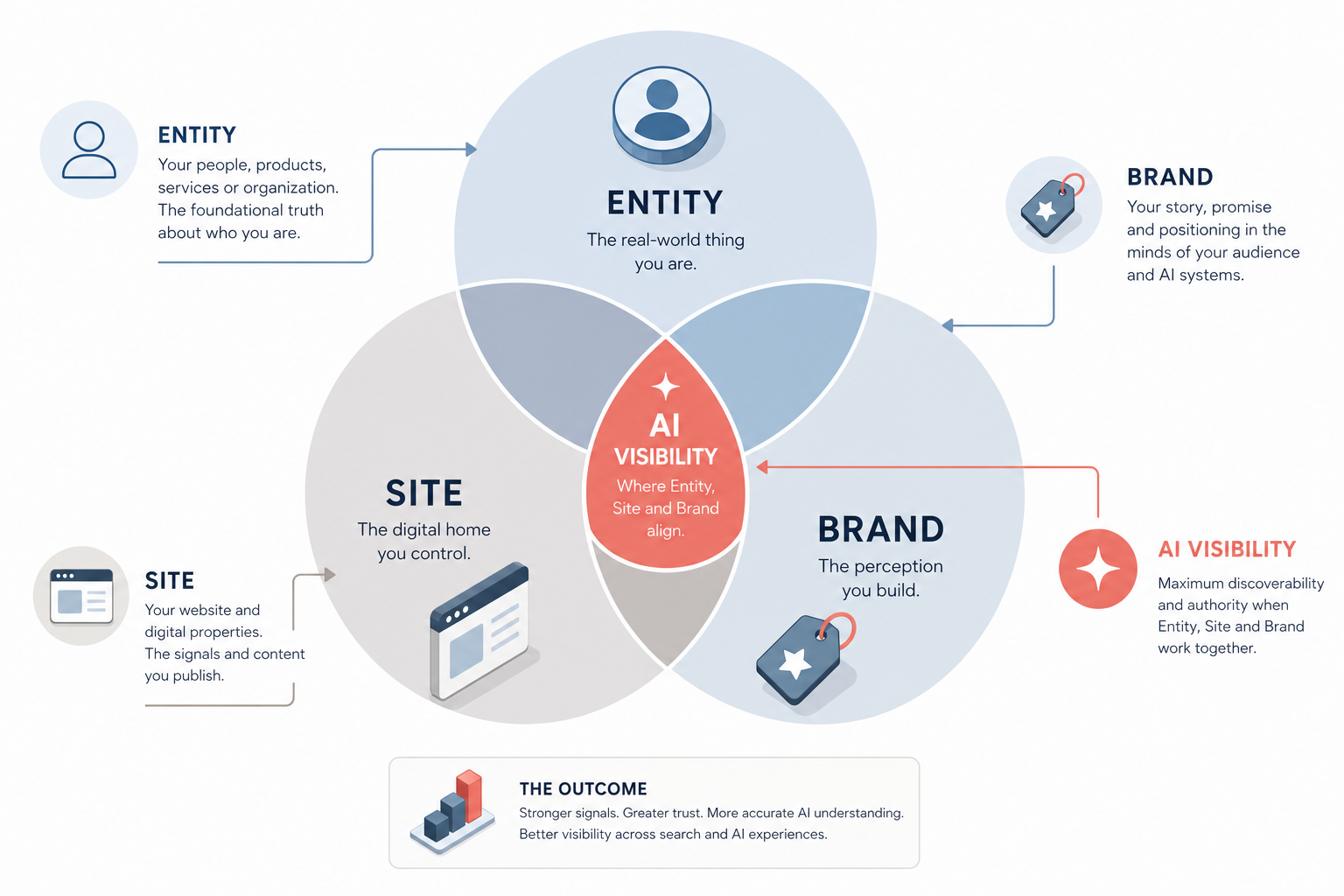
Visual diagram

[ diagram placeholder ]

A Venn diagram showing three overlapping circles labeled Entity, Site, and Brand, with 'AI Visibility' at the central intersection where all three align.

Exercise

Take your own company or a client's domain and search it in the Google Knowledge Graph Search API tool. Identify if a Result Score and ID are present; if not, list three 'sameAs' URLs you would add to their homepage Schema to establish their entity status.

Key takeaways

  • AI visibility requires managing three layers: Brand, Site, and Entity.
  • An entity is a unique, machine-readable concept in a Knowledge Graph.
  • The Site layer serves as the primary technical source of truth for the AI.
  • The Brand layer is defined by external sentiment and co-occurrence in training data.
  • Unique identifiers (like Wikidata IDs) are essential to prevent naming ambiguity.
  • Schema.org JSON-LD is the bridge that connects a site to an entity.
  • AI models use RAG (Retrieval-Augmented Generation) to verify facts against trusted sites.
  • Ambiguity occurs when multiple entities share names; practitioners must define boundaries.
  • Unlinked citations are significant for AI entity recognition, unlike traditional SEO.
  • Consistent facts across all three layers increase the 'Trust Score' for AI responses.

Lesson Quiz

Pass at 70%.

1. What is the primary difference between a Brand and an Entity in AI Visibility?
2. Which Schema.org property is most important for linking a site to its Wikidata entry?
3. What does a search for an entity ID help a practitioner identify?
4. Why are 'unlinked mentions' valuable in the context of AI visibility?
5. In the EcoThread example, why was the hardware company 'Eco-Thread Tools' a problem?
6. Which of these is a component of the 'Site Layer'?
7. What is the danger of having 'Fact Drift' between the Site and the Entity layer?
8. Which tool would you use to find a Wikidata Q-code?
9. What does the 'Corroboration' function of the site layer involve?
10. Which layer is most influenced by PR and external mentions?
Create a free account to save progress and earn a certificate.