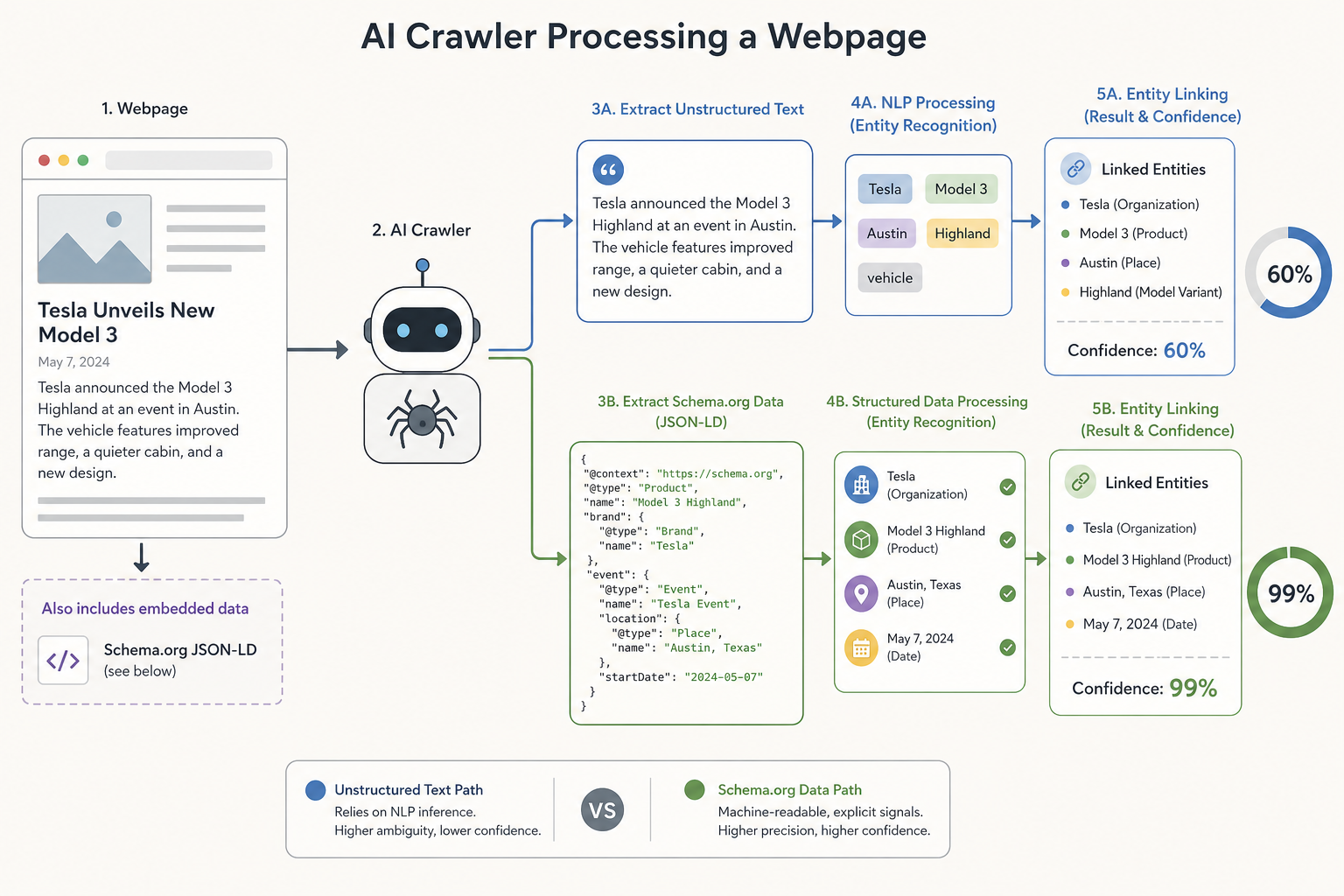
Introduction to Schema for AI Visibility
In the era of Generative Search Experiences (SGE) and AI Overviews, Schema.org structured data has evolved from a rich-snippet tool into a primary source of ground truth for Large Language Models (LLMs). While traditional SEO often focuses on generating star ratings in SERPs, the AI Visibility Practitioner focuses on Entity Disambiguation. For an AI to recommend your client as a solution, it must first understand exactly what that client is, who they serve, and how they relate to other verified entities on the web. This lesson provides a tactical guide to the schema types that move the needle in AI visibility.
The Shift: From Search Engines to Answer Engines
Traditional search engines used structured data to display visual enhancements. AI answer engines use it to build a Knowledge Graph. When an LLM crawls a page, it looks for explicit markers to confirm its internal probability models. For instance, if an AI is 70% sure a page refers to 'Apple' the tech company rather than 'Apple' the fruit, the presence of Organization schema with a sameAs link to a Wikidata entry increases that confidence to 99%. High confidence leads to inclusion in AI citations.
The Hierarchy of Importance
Not all schema types are created equal for AI visibility. We categorise them into three tiers:
- Core Identity: Who you are (Organization, Person).
- Contextual Authority: What you know (Article, FAQPage, HowTo).
- Transactional Proof: What you offer (Product, Service, Offer).
Core Identity: Building the Knowledge Graph
The foundation of AI visibility is the Organization or Brand schema. For an AI to cite you as an authority, it must reconcile your website with real-world entities.
Key Properties for Identity
- @id: Use a unique URI (usually the homepage URL) to serve as the global identifier for the entity across the site.
- sameAs: This is the most critical property for AI. Link to official social media profiles, but more importantly, to authoritative database entries like Wikidata, Wikipedia, or Crunchbase.
- knowsAbout: List specific topics or keywords that the entity is an expert in. This helps the AI map the organization to specific niche clusters.
- memberOf: Links the entity to industry bodies or trade associations, providing third-party validation of status.
Contextual Authority: Supporting AI Summarisation
AI Overviews frequently synthesise information from multiple articles. Structured data helps the AI parse the most important parts of your content quickly.
Article and NewsArticle
- author: Use a
Personobject rather than a string. Include the author'sjobTitleandsameAslinks to their professional profiles to satisfy E-E-A-T requirements. - keywords: Explicitly state the primary entities discussed in the article.
- significantLink: Point to the primary external resources that support the article's claims.
FAQPage
While Google has reduced the visibility of FAQ snippets in standard search, LLMs still use FAQPage schema to extract direct answers for conversational queries. Ensure each Question and AcceptedAnswer is concise and factual.
Transactional Proof: Enhancing Product Discovery
For e-commerce and B2B services, the Product and Offer types are vital. AI models like ChatGPT with Search or Google's shopping graph rely on structured data to compare prices, availability, and features.
Beyond the Basics
- audience: Define who the product is for (e.g., 'Target Audience: SEO Professionals').
- isRelatedTo: Link to complementary products to help the AI understand where you sit in the market ecosystem.
- review: Aggregate reviews provide the 'social proof' indicators that AIs often cite when explaining why they recommended a specific result.
Worked Example: Optimising a SaaS Company
Let’s look at a hypothetical SaaS company, 'DataViz Pro'.
Standard Schema: Only uses Organization with a name and logo.
AI-Optimised Schema:
- Organization: Includes
sameAslinks to their LinkedIn and a Wikidata entry for 'Data Visualization Software'. - Founder: A
Personschema for the CEO, linked to their published research on IEEE usingknowsAbout. - SoftwareApplication: Includes
featureListdetailing specific AI integrations andoperatingSystemrequirements. - HowTo: A guide on 'How to visualize Big Query data' with step-by-step schema, making it a prime candidate for an AI-generated 'how-to' summary.
Common Implementation Pitfalls
Avoid these mistakes that confuse LLMs:
- Schema-Content Mismatch: Providing structured data for information not visible on the page. This is viewed as a manipulation attempt by both traditional algorithms and AI filters.
- Broken Nesting: Failing to nest entities (e.g., placing the
Authorinside theArticlerather than as a separate, unlinked entity). Proper nesting shows the relationship clearly. - Generic @types: Using
Thingwhen you could use a specific subtype likeFinancialServiceorMedicalBusiness.
Putting it into Practice
To implement an AI-first schema strategy, follow these steps:
- Entity Audit: Identify the 5 most important entities associated with your client (Brand, CEO, Lead Product, Primary Location, Core Topic).
- Wikidata Mapping: Find the corresponding Wikidata IDs for these entities to use in
sameAsproperties. - Author Verification: Update all blog posts to use
Personschema for authors, includingalumniOfandknowsAboutproperties. - Nesting Check: Ensure your
WebPageschema contains theAbout(main topic) andMentions(secondary topics) properties to define the page's focus for the AI. - Validation: Use the Schema Markup Validator (schema.org) rather than just the Rich Results Test. The Rich Results Test only shows what Google displays, while the Validator shows what the AI sees.