Entity Linking Across the Web

Master the techniques of linking disparate web mentions to a central entity node, ensuring Search Generative Experiences and LLMs recognise your brand as a single, authoritative authority.

15 min read
Foundations

Introduction to Entity Linking

Entity linking is the technical process of ensuring that every mention of your brand, person, or product across the digital ecosystem is correctly attributed to a single, unique identifier in the Knowledge Graph. In the era of Generative Search (SGE) and AI-driven discovery, the 'strings' (textual characters) matter less than the 'things' (the concepts they represent). If an AI model sees "ACME Corp" on one site and "ACME Global" on another, but cannot confidently link them, your authority is fragmented. Your goal as an AI Visibility Practitioner is to glue these mentions together using Schema.org, persistent IDs, and semantic proximity.

The Role of the 'SameAs' Property

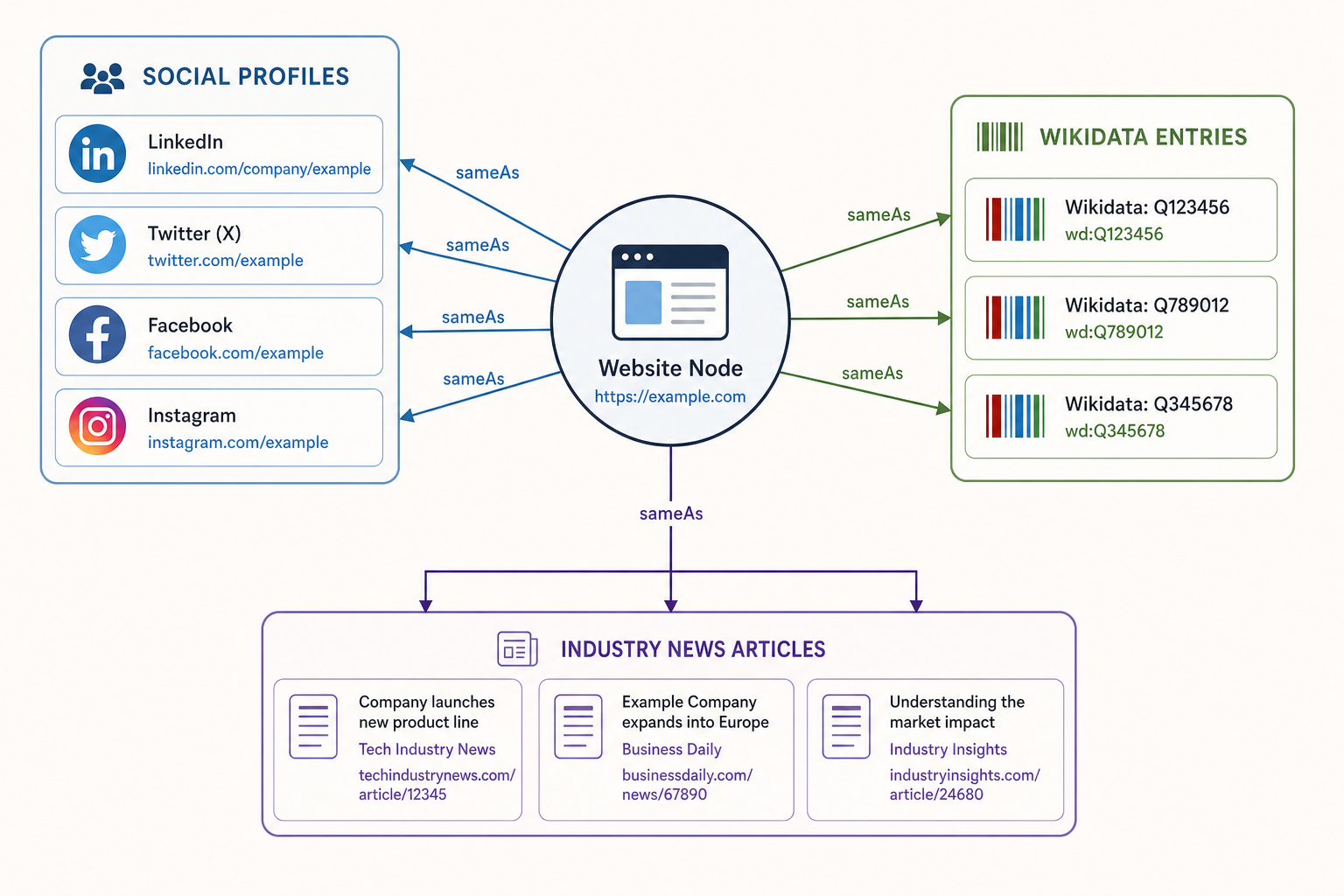
The most powerful tool in your entity-linking toolkit is the sameAs property within JSON-LD Schema. This property tells search engines: "This entity you are currently crawling is identical to the entity found at this other URL."

To build a robust entity graph, you must link your primary website (the 'canonical' source of truth) to high-authority nodes including:

  • Wikidata & Wikipedia: The gold standard for entity verification.
  • Official Social Profiles: LinkedIn, X, and YouTube.
  • Professional Directories: Crunchbase, Bloomberg, or industry-specific registries (e.g., the FCA register for financial services).
  • Google Knowledge Panel URLs: Explicitly linking back to the Google-generated ID for your brand.

Establishing a Canonical URI

AI models thrive on unique identifiers. In Western SEO, this is often the brand's primary domain, but for the Knowledge Graph, it is often a Wikidata QID (e.g., Q95 for Google). When working with established brands, your first task is to identify or create their 'Canonical URI'.

If your brand doesn't have a Wikidata entry, your website's homepage serves as the identifier. You must ensure that every external mention refers back to this entity. This is not just about backlinks for PageRank; it is about 'Entity Reference' for semantic confidence.

Strategic Entity Bridging: A Step-by-Step Guide

1. Audit Current Web Mentions

Use tools like Google Search Console and brand monitoring software to find where your brand is mentioned. Note discrepancies in naming conventions, address details, or key personnel. Inconsistent data creates 'noise' that lowers an AI model's confidence in your entity.

2. Standardise the NAP+W

NAP+W stands for Name, Address, Phone, and Website. Ensure these are identical across:

  • Google Business Profile
  • Bing Places
  • Apple Business Connect
  • LinkedIn Company Page

3. Deploy Recursive Schema

Recursive schema involves referencing the same entities across different pages. For example, if you have an 'About Us' page and a 'Services' page, both should use JSON-LD that points back to the same Organization ID.

4. Leverage Persistent Identifiers (PIDs)

For individuals (Founders or Authors), use ORCID iDs or LinkedIn profile URLs. For products, use GTINs or ISBNs. These numerical identifiers are language-agnostic and provide 100% certainty for LLMs during the training phase.

Worked Example: Linking a Mid-Market SaaS Brand

Imagine 'FinFlow', a fintech startup. They have a website (finflow.io), a LinkedIn page, a Crunchbase profile, and several mentions in tech news sites.

The Problem: Some sites call them 'FinFlow', others 'FinFlow App', and a few mention 'FinFlow Solutions Ltd'.

The Solution:

  1. Define the ID: In the website's JSON-LD, set the @id to https://finflow.io/#organization.
  2. Add sameAs: In the same JSON-LD block, add a list of URLs: ["https://www.linkedin.com/company/finflow", "https://www.crunchbase.com/organization/finflow"].
  3. Cross-Link: Update the Crunchbase 'Website' field to point exactly to https://finflow.io. Update the LinkedIn 'About' section to use the official brand name exactly as it appears in the Schema.
  4. Confirm: Use the Schema Markup Validator. Does the 'Organization' node now list all these connections? If yes, the AI can now traverse these links to build a comprehensive profile of FinFlow's authority.

Entity Disambiguation

Disambiguation is the process of distinguishing your entity from others with similar names. If your client is 'Everest Consulting', they risk being confused with the mountain or hundreds of other firms.

To disambiguate, you must use 'Entity Off-ramps':

  • IsPartOf: Use this in Schema to show ownership (e.g., this brand is part of a larger parent company).
  • KnowsAbout: Link to specific Wikipedia topics (e.g., 'Cloud Computing', 'UK Tax Law') to provide contextual 'neighbourhoods' that separate your brand from irrelevant namesakes.

The Importance of Third-Party Validation

You can claim to be an expert on your own website, but AI models look for third-party corroboration. Entity linking is essentially an 'agreement' between sites. When a reputable industry journal links to your client using their official name and points to their social profiles, it reinforces the entity's validity. High-quality digital PR should focus on obtaining links from sites that are already deeply embedded in the Knowledge Graph in your niche.

Putting it into Practice

  1. Map your ecosystem: List every URL where your brand has a profile or a significant mention.
  2. Harmonise data: Ensure the name and contact details are identical everywhere. Remove old addresses or defunct legal names.
  3. Inject sameAs JSON-LD: Place a comprehensive Organization or Person schema on your 'About' page containing all identified sameAs links.
  4. Request updates: Contact third-party sites where your brand name is misspelled or your website is incorrectly linked.
  5. Monitor the Knowledge Panel: Track if Google or Bing begins to aggregate more information (like social icons or founder names) into your search results. This is a sign of successful entity linking.

Visual diagram

[ diagram placeholder ]

A hub-and-spoke model showing a central Website Node connected via 'sameAs' arrows to social profiles, Wikidata entries, and industry news articles.

Exercise

Identify a client's Wikidata QID (or find a similar brand if they don't have one). Write a JSON-LD Organization snippet for their homepage that correctly links to their LinkedIn, Twitter, and Wikidata URLs using the sameAs property.

Key takeaways

  • Entity linking moves SEO focus from keywords to unique conceptual identifiers.
  • The 'sameAs' property is the primary mechanism for connecting web profiles.
  • Inconsistent brand names (NAP+W) create noise that degrades AI confidence.
  • Wikidata and Wikipedia act as authoritative anchor nodes for the Knowledge Graph.
  • JSON-LD @id tags allow you to define a canonical 'Home' for your entity.
  • Persistent Identifiers (PIDs) like ORCID or GTIN provide language-independent certainty.
  • Recursive schema ensures all pages on a site point to the same central entity node.
  • Entity disambiguation separates your brand from others with identical or similar names.
  • Third-party validation from established entities is required to build 'Trust' in the E-E-A-T model.
  • The ultimate goal is a 1:1 map between your brand and a single Knowledge Graph entry.

Lesson Quiz

Pass at 70%.

1. What is the primary purpose of the 'sameAs' property in JSON-LD?
2. Which of these acts as the most authoritative 'anchor' for an entity in the global knowledge graph?
3. How does 'Entity Linking' differ from traditional 'Backlinking'?
4. What is 'NAP+W' consistency?
5. Why is entity disambiguation important for a brand like 'Apple'?
6. What is the benefit of using an @id in your JSON-LD?
7. Which property would you use to link a person to their academic research ID?
8. What does it mean when an entity has 'low confidence' in a search engine's graph?
9. In the context of AI visibility, what is a 'Canonical URI'?
10. How can Digital PR assist in entity linking?
Create a free account to save progress and earn a certificate.