Fixing Ambiguous and Duplicate Entities

Master the techniques for resolving entity clashes and ambiguity to ensure LLMs correctly associate your brand and subject matter with the right conceptual space.

12 min read
Foundations

Introduction

In the world of Generative Engine Optimisation (GEO) and AI visibility, clarity is the primary currency. Large Language Models (LLMs) like GPT-4, Gemini, and Claude categorise information based on entities—distinct, well-defined objects or concepts. However, ambiguity is a frequent barrier. When a brand name is shared by a tech startup and a 19th-century poet, or when two products share a generic name, LLMs struggle to attribute authority correctly. This lesson covers the identification and resolution of ambiguous and duplicate entities to ensure your client's brand remains distinct and authoritative in the AI ecosystem.

The Problem of Entity Ambiguity

Ambiguity occurs when a single name (a 'surface form') refers to multiple distinct entities. For example, 'Meridian' could refer to a financial institution, a high-end audio manufacturer, a geographical line, or a software suite. If your client is 'Meridian Audio', but the AI's training data is heavily weighted toward 'Meridian Bank', the AI may hallucinate financial services features when asked about audio products.

Duplicate entities are a related but distinct issue. This happens when the AI perceives two different records for the same real-world entity, leading to fragmented authority. This often occurs during brand acquisitions, name changes, or inconsistent NAP (Name, Address, Phone) data across the web.

Step 1: Auditing for Ambiguity

Before you can fix an entity problem, you must define the scope of the confusion.

  1. Zero-Shot Testing: Use prompts like "What is [Brand Name]?" across different LLMs. Observe if the model asks for clarification or defaults to a competitor/different concept.
  2. Knowledge Graph Lookups: Use tools like the Google Knowledge Graph Search API or Wikidata to see which entities are currently associated with your target terms.
  3. SERP Analysis: Look at 'People Also Ask' and Knowledge Panels. If a different entity dominates the Knowledge Panel for your brand name, you have an ambiguity crisis.

Step 2: Strengthening Entity Context

LLMs use context to disambiguate. If the word 'Apple' appears near 'orchard' and 'cider', it is a fruit. If it appears near 'silicon' and 'operating system', it is a corporation. To fix ambiguity, you must surround your brand name with 'Entity-Defining Predicates'.

Practical Disambiguation Tactics:

  • Industry-Specific Language: Ensure every page on the site uses high-density industry terminology. For a tech brand named 'Jaguar', the content should be saturated with terms like 'latency', 'cloud-native', and 'API', and strictly avoid terms like 'feline' or 'automotive'.
  • The 'Parent' Entity: Explicitly link your brand to its parent company or its primary category in initial paragraphs. E.g., "[Brand] is a subsidiary of [Global Corp] specialising in [Niche]."
  • SameAs Linking: Use Schema.org sameAs properties to point to your specific Wikidata, LinkedIn, and Crunchbase profiles. This tells the AI precisely which 'Meridian' you are.

Step 3: Resolving Duplicate Entities

Duplicate entities dilute your 'Authority Score'. If the AI sees 'Acme Ltd' and 'Acme Solutions' as two different entities, your backlinks and citations are split in half.

Consolidation Checklist:

  1. Canonical Profiles: Identify the dominant profile (usually a LinkedIn Company Page or a Wikipedia entry). Update all other profiles to link back to this 'Source of Truth'.
  2. NAP Consistency: Ensure the Name, Address, and Phone number are identical across every directory. A deviation as small as 'Street' vs 'St.' can occasionally trigger the creation of a duplicate entity in some knowledge bases.
  3. Deprecated Entities: If a brand name has changed, use the alternateName and legalName properties in your JSON-LD to bridge the gap between the old and new entity names.

Worked Example: 'Apex Logistics'

The Problem: A client, 'Apex Logistics' (a UK freight company), is being confused with 'Apex Logistics International' (a global giant) and an old, defunct company called 'Apex Delivery'.

The Fix:

  1. Unique Identifier: We updated the website Schema to use a specific @id URL based on their official domain.
  2. Contextual Anchoring: We rewrote the 'About' page to emphasize their unique niche: "Mid-market pallet distribution in the Midlands, UK." This differentiates them from 'International' freight.
  3. Wikidata Refinement: We created a Wikidata entry that specifically cited their UK Company House registration number, distinguishing them from the global entity.
  4. Content Pruning: We removed vague references to 'Apex' and replaced them with 'Apex Logistics UK' in header tags to enforce the distinction.

Result: After three months, LLM responses transitioned from "Did you mean the international freight company?" to providing specific details about the UK-based pallet services.

Putting it into Practice

To resolve ambiguity for your clients, follow this workflow:

  1. Identify the 'Clash': Find the primary entity competing for your brand's name in AI responses.
  2. Schema Hardening: Implement Organization schema with isicV4 or naics codes to define your specific industry sector.
  3. Entity-Based Link Building: Acquire links from websites that are already recognized as authorities in your specific niche. If you are a 'Zenith' in FinTech, a link from a gardening site is useless for disambiguation; you need links from Finextra or Bloomberg.
  4. Wikipedia/Wikidata Maintenance: Ensure your entity has a clear, factual presence that cites external, high-authority sources (BBC, Reuters, Industry Journals).

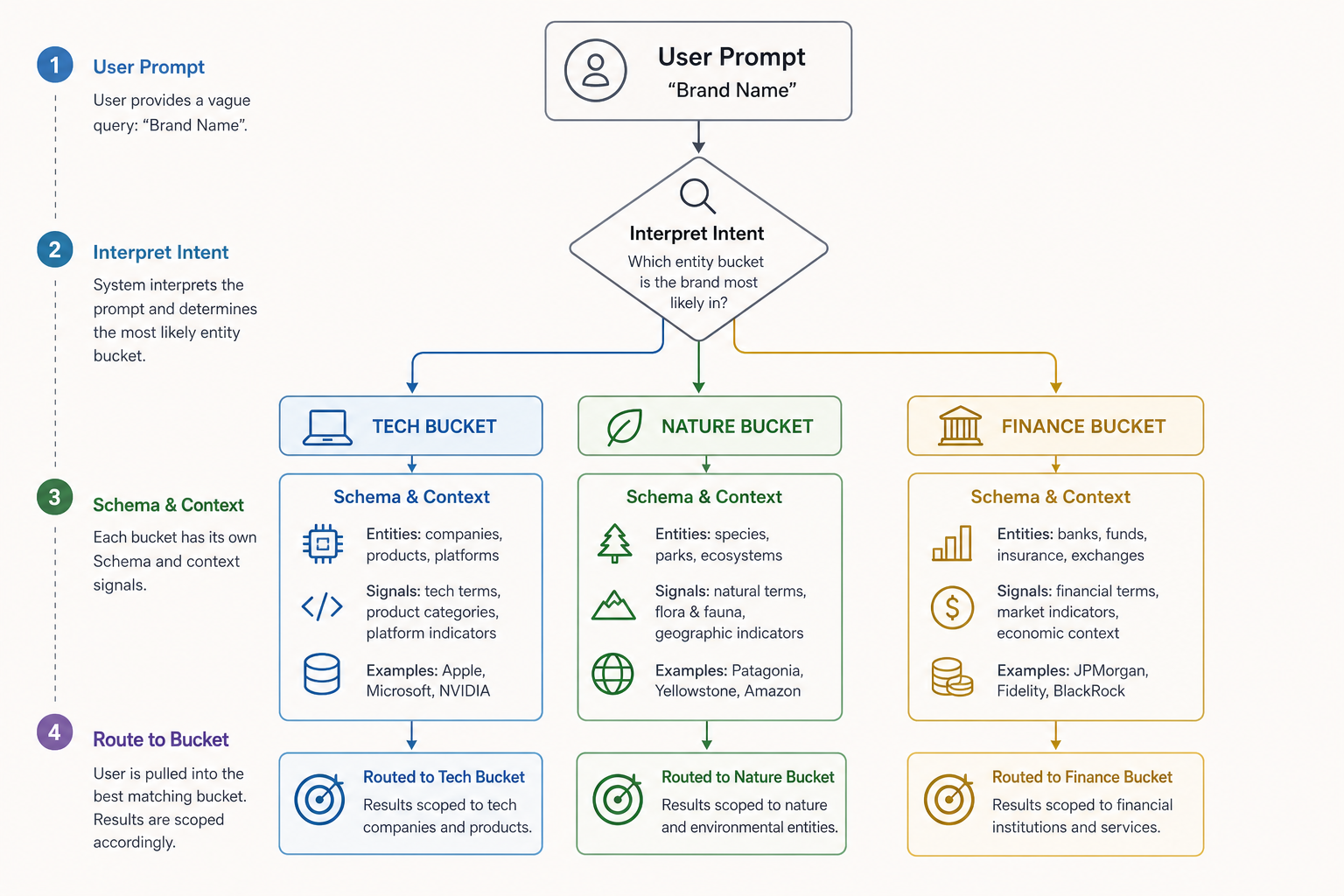
Visual diagram

[ diagram placeholder ]

A flowchart showing a decision tree where a 'Brand Name' prompt leads to three separate entity buckets (Tech, Nature, Finance), illustrating how Schema and context pull the user into the correct bucket.

Exercise

Select a client or brand with a relatively common name. Use a tool like ChatGPT or Claude to ask 'Who is [Brand Name]?'. If it returns a different company, identify three specific Wikipedia or Wikidata entities it is confusing your brand with and list three industry-specific terms you would add to the brand's homepage to improve context.

Key takeaways

  • Ambiguity occurs when one name refers to multiple concepts in an LLM's training data.
  • Duplicate entities fragment brand authority and should be consolidated into one 'Source of Truth'.
  • Contextual predicates (related keywords) help LLMs distinguish between identically named entities.
  • Schema.org 'sameAs' properties are essential for linking a website to established Knowledge Graph nodes.
  • The `@id` attribute in JSON-LD provides a unique URI for an entity, preventing confusion.
  • Niche-specific link building acts as a signal for industry-based disambiguation.
  • Consistent NAP data is critical for merging duplicate local business entities.
  • Zero-shot testing across multiple LLMs is the best way to audit entity clarity.
  • Using NAICS or ISIC codes in Schema provides a machine-readable industry definition.
  • Brand transitions require the 'alternateName' property to maintain entity continuity.

Lesson Quiz

Pass at 70%.

1. What is the primary cause of 'Entity Ambiguity' in LLMs?
2. Which Schema.org property is most effective for linking your site to a Wikidata entry?
3. How do 'Entity-Defining Predicates' assist in disambiguation?
4. What is the danger of having 'Duplicate Entities' for a single brand?
5. When should you use the '@id' attribute in your JSON-LD Schema?
6. Which industry codes can be added to Organization Schema to clarify a business sector?
7. What is 'Zero-Shot Testing' in the context of entity analysis?
8. If a brand changes its name, which property helps maintain the old entity's authority?
9. Why would a link from a niche-relevant authority help in disambiguation?
10. True or False: NAP (Name, Address, Phone) consistency is only important for Google Maps.
Create a free account to save progress and earn a certificate.