Auditing Your Brand Entity

Master the audit of brand visibility across key entity repositories including Wikidata, Wikipedia, and Google’s Knowledge Graph to build a robust foundation for AI-driven discovery.

12 min read
Foundations

Introduction

Entity analysis is the foundation of modern search visibility. As we transition from strings to things, search engines and Large Language Models (LLMs) no longer just index keywords; they attempt to understand the relationships between concepts, organisations, people, and places. To be visible in AI-generated answers and Google’s Knowledge Panels, your brand must be recognised as a distinct entity within the global Knowledge Graph. This lesson provides a systematic framework for auditing a brand’s presence across the three most influential entity nodes: Wikidata, Wikipedia, and the Google Knowledge Graph.

The Triple-Node Audit Framework

To audit a brand entity effectively, we look at three primary layers of validation:

  1. The Structured Layer (Wikidata): The machine-readable database that stores factual data points.
  2. The Contextual Layer (Wikipedia): The narrative validation that provides semantic depth and authority.
  3. The Proprietary Layer (Google Knowledge Graph): How a search engine synthesises these sources into a formal entity ID.

1. Auditing Wikidata Coverage

Wikidata is arguably the most important data source for AI visibility. It is the structured backbone for Wikipedia and a primary feed for Google, Bing, and various LLMs. Unlike Wikipedia, which requires high 'notability' and narrative flow, Wikidata focuses on structured facts.

How to audit:

  • Search by Label: Use the Wikidata search interface to find the brand. Check for aliases (e.g., 'IBM' vs 'International Business Machines').
  • Check the Statement Count: A weak entity has 3–5 statements. A strong entity has 20+. Look for missing critical properties like instance of (P31), industry (P452), official website (P856), and headquarters location (P159).
  • Identifier Integrity: Verify if external identifiers are linked. Does the Wikidata entry link to the brand’s LinkedIn, Twitter, or Official Gazettes (like Companies House in the UK)?

2. Auditing Wikipedia Presence

Wikipedia is the 'gold standard' for topical authority. However, it is also the hardest to influence due to strict neutrality and notability requirements.

Points of Audit:

  • Notability Criteria: Evaluate if the brand has enough independent, high-quality, third-party coverage to sustain an entry. If a brand lacks a page, look for 'mention' coverage—is the brand cited in other relevant industry pages?
  • Citations and Links: Audit the existing citations on the page. Are they dead links? Are they biased? AI models use the citation graph to measure trust.
  • Accuracy and Vandalism: Check the 'View History' tab. Frequent reverts or edit wars indicate a de-stabilised entity that might be less trusted by search algorithms.

3. Probing the Google Knowledge Graph

Google maintains its own private graph, partly derived from public sources and partly from its own crawling. You must verify if Google has assigned a unique Knowledge Graph ID (MID) to the brand.

The API Check:

Use the Google Knowledge Graph Search API (or tools like the Kalicube Explorer or the Google APIs Explorer).

  • Query the Brand Name: Does an ID (starting with /m/ or /g/) appear?
  • Result Score: Google provides a 'resultScore'. A high score indicates high confidence in the entity's uniqueness.
  • The Knowledge Panel: Does a panel appear in the SERP? Is it 'claimed'? If a panel appears but offers no 'Claim this knowledge panel' button, it suggests the entity is already managed or Google is highly confident in its mapping.

Worked Example: Auditing a Mid-Market Fintech Agency

Let’s imagine we are auditing 'FinTech Flow', a hypothetical UK-based agency.

Step 1: Wikidata. We find a Wikidata entry, but it only lists 'official website'. It lacks P159 (Headquarters) and P112 (Founder). Verdict: Incomplete entity. LLMs may struggle to connect the agency to its location or leadership.

Step 2: Wikipedia. No page exists. However, the founder is mentioned in the 'List of Fintech Entrepreneurs'. Verdict: We have a 'seed' entity status. We should use Schema markup on the agency site to point to the founder’s Wikipedia mention.

Step 3: Google Knowledge Graph. A search for the Brand ID via API returns /g/11h_xxxx. This confirms Google recognises the entity independently of a Wikipedia page. The result score is 12 (relatively low). Verdict: The entity is 'known' but not 'trusted'.

The Role of Schema.org in Entity Audits

If the Wikidata and Wikipedia layers are weak, your website's Organization schema becomes the 'source of truth'. During an audit, ensure you are using sameAs properties to bridge the gap. Link your website to your Wikidata ID and social profiles using sameAs to help search engines reconcile different mentions into one entity.

Putting it into Practice

  1. Identify the MID: Use the Google Knowledge Graph Search API to find your brand's unique ID.
  2. Map the Gap: Create a spreadsheet comparing your Wikidata statements against a top competitor. Note every missing property.
  3. The 'SameAs' Reconciliation: Update your website’s JSON-LD schema to include all identified entity URLs (Wikidata, Wikipedia, Social Profiles).
  4. Monitor the Panel: Use a VPN to check how your Knowledge Panel looks in different regions. Inconsistencies often reveal conflicting entity data in different languages or regions.

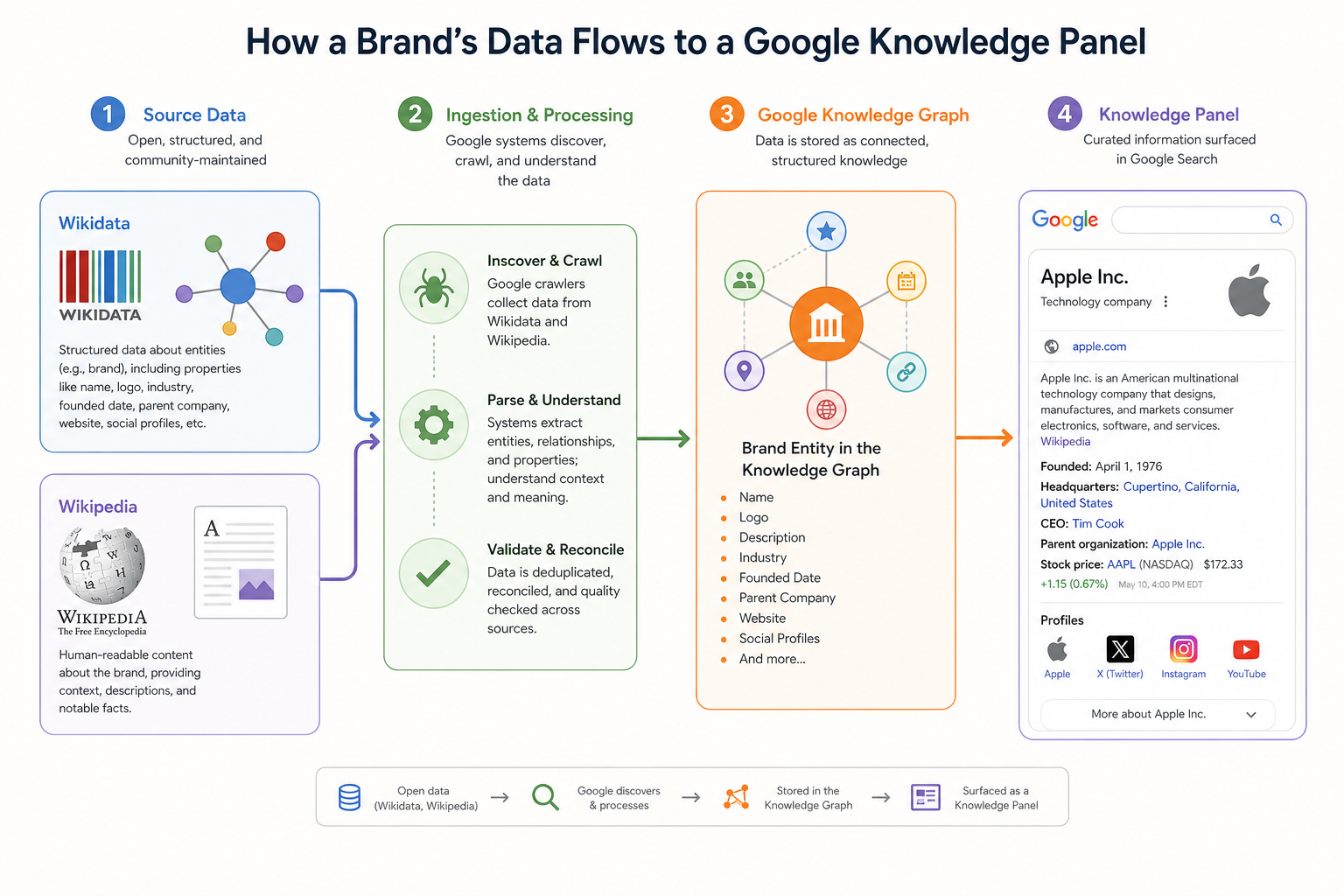
Visual diagram

[ diagram placeholder ]

A flow chart showing how a brand's data flows from Wikidata and Wikipedia into the Google Knowledge Graph, resulting in a Knowledge Panel.

Exercise

Find your brand's (or a client's) Google Knowledge Graph ID using the Google APIs Explorer. Once found, search for that brand on Wikidata and list three missing 'Properties' that would clarify the brand's industry or location to an AI model.

Key takeaways

  • Entity analysis shifts the focus from keywords to distinct, relational concepts.
  • The Triple-Node framework covers Wikidata, Wikipedia, and the Google Knowledge Graph.
  • Wikidata is the primary structured data source for most AI and LLM models.
  • A Wikidata entry requires specific properties like 'instance of' (P31) to be effective.
  • Wikipedia provides the 'notability' signal that search engines use for trust.
  • You do not always need a Wikipedia page to have a Knowledge Graph ID (MID).
  • Google's 'resultScore' in the API indicates confidence in an entity's uniqueness.
  • The 'sameAs' property in Schema.org is the primary tool for entity reconciliation.
  • Auditing 'aliases' in Wikidata ensures the brand is recognised by multiple names.
  • Knowledge Panels must be claimed to provide the brand direct control over entity data.

Lesson Quiz

Pass at 70%.

1. What is the primary difference between Wikidata and Wikipedia for an entity audit?
2. Which Wikidata property is essential for defining what a brand actually 'is' (e.g., a company)?
3. What does a Google Knowledge Graph ID starting with '/g/' typically indicate compared to '/m/'?
4. If a brand has no Wikipedia page, how can it still build entity trust?
5. What does the 'resultScore' in the Google Knowledge Graph API represent?
6. Which tool would you use to see the 'history' of an entity's narrative changes?
7. What is 'entity reconciliation'?
8. Why is the 'official website' (P856) property crucial in Wikidata?
9. When auditing a Knowledge Panel, what does the absence of a 'Claim this knowledge panel' button suggest?
10. How do LLMs use Wikidata for 'Visibility'?
Create a free account to save progress and earn a certificate.