Resourcing and Roles

Learn how to map AI Visibility tasks to specific professional roles, bridging the gap between traditional SEO team structures and the requirements of generative engine optimisation.

12 min read
Foundations

Introduction

Transitioning from traditional SEO to AI Visibility (AEO/GEO) requires more than just new tools; it requires a reallocation of human capital. While the core disciplines of content, technical, and outreach remain relevant, the specific tasks they must perform have evolved. In this lesson, we will deconstruct the AI Visibility workflow and assign responsibilities across the modern marketing team to ensure no part of the 'answer engine' ecosystem is neglected.

The Three Pillars of Resourcing

Successful AI Visibility strategies depend on synchronising three distinct areas of expertise. Without clear role definition, tasks such as 'Schema markup for LLMs' or 'Brand citation monitoring' often fall through the cracks.

1. The Technical Pillar: The Data Architect

In traditional SEO, the technical lead focuses on crawlability and indexability. In AI Visibility, the role evolves into that of a 'Data Architect'. Their primary objective is to package brand information into machine-readable formats that Generative AI models can consume with high confidence.

Key Responsibilities:

  • Advanced Schema Implementation: Moving beyond basic breadcrumbs to complex Speakable, FactCheck, and Dataset schemas.
  • API Management: Ensuring site data is accessible via protocols that LLMs use for real-time information retrieval.
  • Knowledge Graph Integration: Connecting on-site entities to external nodes (like Wikidata or DBpedia) to reinforce brand authority.

2. The Content Pillar: The Subject Matter Expert (SME)

AI models value 'information gain'—new, unique information that hasn't been scraped a million times before. This moves the content role away from 'generalist copywriter' toward 'Subject Matter Expert' or 'Curator'.

Key Responsibilities:

  • Entity-First Authoring: Writing content that clearly defines relationships between concepts, making it easier for AI to extract 'facts'.
  • Niche Insight Injection: Adding proprietary data, unique case studies, and primary research that provide the 'missing link' in current AI training sets.
  • Direct Answer Optimisation: Crafting concise, authoritative summaries for complex queries to capture 'Position Zero' in AI-generated overviews.

3. The Outreach Pillar: The Authority Broker

Traditional link building is becoming 'Citation Building'. The goal is no longer just a hyperlink for PageRank, but a mention in high-authority datasets and platforms that AI models use as 'ground truth' sources.

Key Responsibilities:

  • Citation Management: Ensuring the brand is accurately reflected across secondary authorities like Reddit, Quora, and industry-specific wikis.
  • Digital PR for Mentions: Securing placements in top-tier publications that are frequently cited by Perplexity, Gemini, and Claude.
  • Review Ecosystem Governance: Managing the flow of third-party sentiment, as LLMs use review data to gauge sentiment and reliability.

Worked Example: A Professional Services Firm

Consider a mid-sized legal firm specialising in Intellectual Property. Here is how they would resource an AI Visibility project:

  1. Technical Role (IT Manager/Tech SEO): They implement LegalService schema and ensure all attorney profiles are linked to their specific Bar Association IDs via sameAs properties. They also optimize the site's internal search to ensure the LLM crawler can map the site structure logically.
  2. Content Role (Senior Partner + Content Editor): The partner provides a monthly 'IP Trend Analysis' (the unique data). The editor formats this into a 'TL;DR' summary at the top of the page, specifically designed for LLMs to scrape as a definitive answer.
  3. Outreach Role (PR Lead): Instead of chasing guest posts on generic blogs, they focus on getting the firm’s partners quoted on high-authority legal news sites and ensure the firm has a verified, active presence on professional forums where AI models regularly 'learn' about legal authority.

Skills Gap Analysis

When resourcing, you must identify where your current team lacks the necessary 'AI-ready' skills. Use the following checklist to evaluate your team:

  • Prompt Engineering: Can the team use AI to audit their own content for 'hallucination risks'?
  • Structured Data Expertise: Does the technical lead understand JSON-LD beyond the basic level?
  • Data Literacy: Can the team analyse 'Share of Model' reports rather than just standard keyword rankings?

Overcoming Friction in Traditional Teams

A common challenge is 'siloing', where the content team doesn't understand why the technical team is asking for specific formatting. To overcome this, create a 'Shared Visibility Matrix' where every piece of content is assigned a 'Technical Validator' and an 'Authority Specialist'. This ensures that a blog post isn't just written, but is also technologically accessible and externally validated.

Putting it into Practice

To begin resourcing your AI Visibility strategy, follow these steps:

  1. Audit Existing Roles: Map your current team members to the three pillars (Technical, Content, Outreach).
  2. Identify the Gaps: Determine if you need external consultants for specific tasks like advanced Knowledge Graph work.
  3. Update Job Descriptions: Incorporate 'AI Visibility' into the KPIs of your digital marketing staff. For example, a Content Manager's success should be measured by 'Inclusion in AI Overviews' alongside traditional traffic metrics.
  4. Establish a Feedback Loop: Schedule a monthly 'AI Visibility Sync' where all three pillars share data on what brand mentions are appearing in LLM responses and how technical or content changes influenced those results.
  5. Pilot a Single Entity: Pick one product or service and apply the full resourced workflow to it before scaling across the entire organisation.

Visual diagram

[ diagram placeholder ]

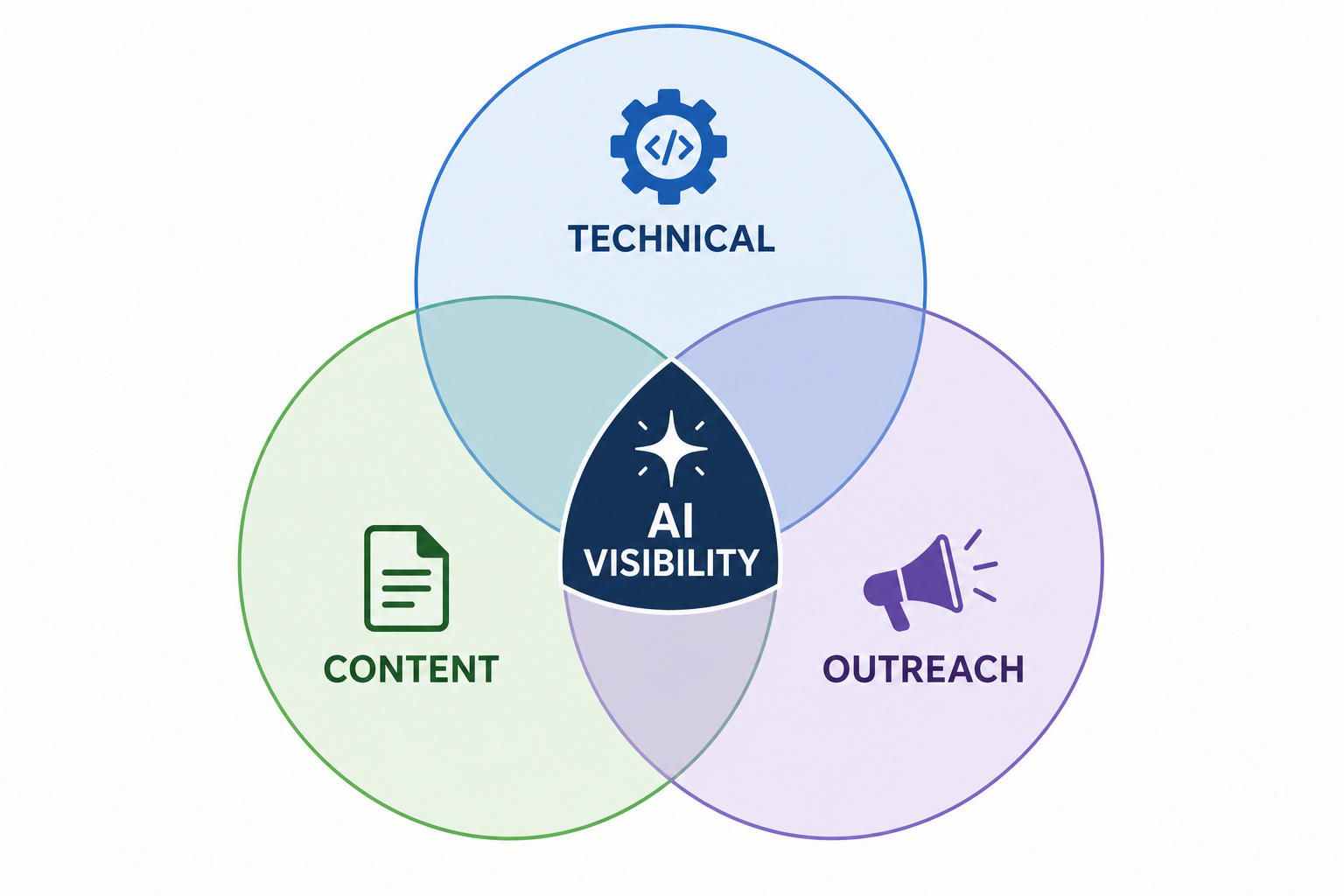
A Venn diagram showing the overlap of Technical, Content, and Outreach roles, with 'AI Visibility' at the central intersection where all three meet.

Exercise

Identify one key service on your website and assign three specific tasks to three different roles (Technical, Content, and Outreach) that would improve its visibility in AI search results.

Key takeaways

  • AI Visibility requires a shift from keyword-based roles to entity-based roles.
  • The Technical Role focuses on 'Machine Readability' and advanced Schema implementation.
  • Content creators must prioritise 'Information Gain' and unique data over generic summaries.
  • Outreach must transition from link building to digital PR and citation management.
  • Subject Matter Experts (SMEs) are critical for providing the 'ground truth' that AI models seek.
  • Technical leads act as 'Data Architects' ensuring LLMs can easily parse site information.
  • Authority Brokers manage the brand's presence in high-trust external datasets.
  • A shared visibility matrix helps breakdown silos between technical and creative teams.
  • KPIs must evolve to include 'Share of Model' and AI Overview presence.
  • Resourcing should begin with a skills gap analysis focused on data literacy and prompt engineering.

Lesson Quiz

Pass at 70%.

1. What is the primary objective of the 'Data Architect' in AI Visibility?
2. In the context of AI Visibility, what does 'Information Gain' refer to?
3. Which role is responsible for managing the brand's presence on Reddit and Quora for AI training purposes?
4. Why is 'Subject Matter Expert' involvement more critical in AEO than traditional SEO?
5. What is a 'Shared Visibility Matrix' used for?
6. Which of these is a 'Technical' task for AI Visibility?
7. Which platform is an Authority Broker likely to focus on for AI citations?
8. What should be a new KPI for a Content Manager in an AI-first strategy?
9. What property in Schema helps connect a brand to an external authority like Wikidata?
10. The shift from traditional SEO to AI Visibility is best described as moving from:
Create a free account to save progress and earn a certificate.