Introduction
Transitioning a strategy from traditional SEO to AI Visibility is not a cost-free exercise. It involves navigating a landscape of competing priorities, technical trade-offs, and ethical risks. As an AI Visibility Practitioner, your role is to guide clients through these decisions, ensuring that the pursuit of 'answer engine' dominance does not inadvertently damage core site performance, brand reputation, or legal standing. This lesson focuses on identifying high-risk areas and establishing a framework for balanced decision-making.
The Three Tensions of AI Visibility
When developing a strategy, you will encounter three primary areas of conflict. Recognising these early prevents mid-campaign pivot failures.
1. Contextual Density vs. User Experience
AI models thrive on highly structured, dense, and context-rich information. However, human readers often prefer concise, scannable content.
- The Risk: Over-optimising for crawler ingestion can lead to 'keyword-dense' or 'entity-stuffed' pages that frustrate human users, increasing bounce rates and reducing conversions.
- The Strategy: Use technical layers (like hidden Schema.org markup) to satisfy AI needs while maintaining a streamlined visual design for users.
2. Information Openness vs. Proprietary Value
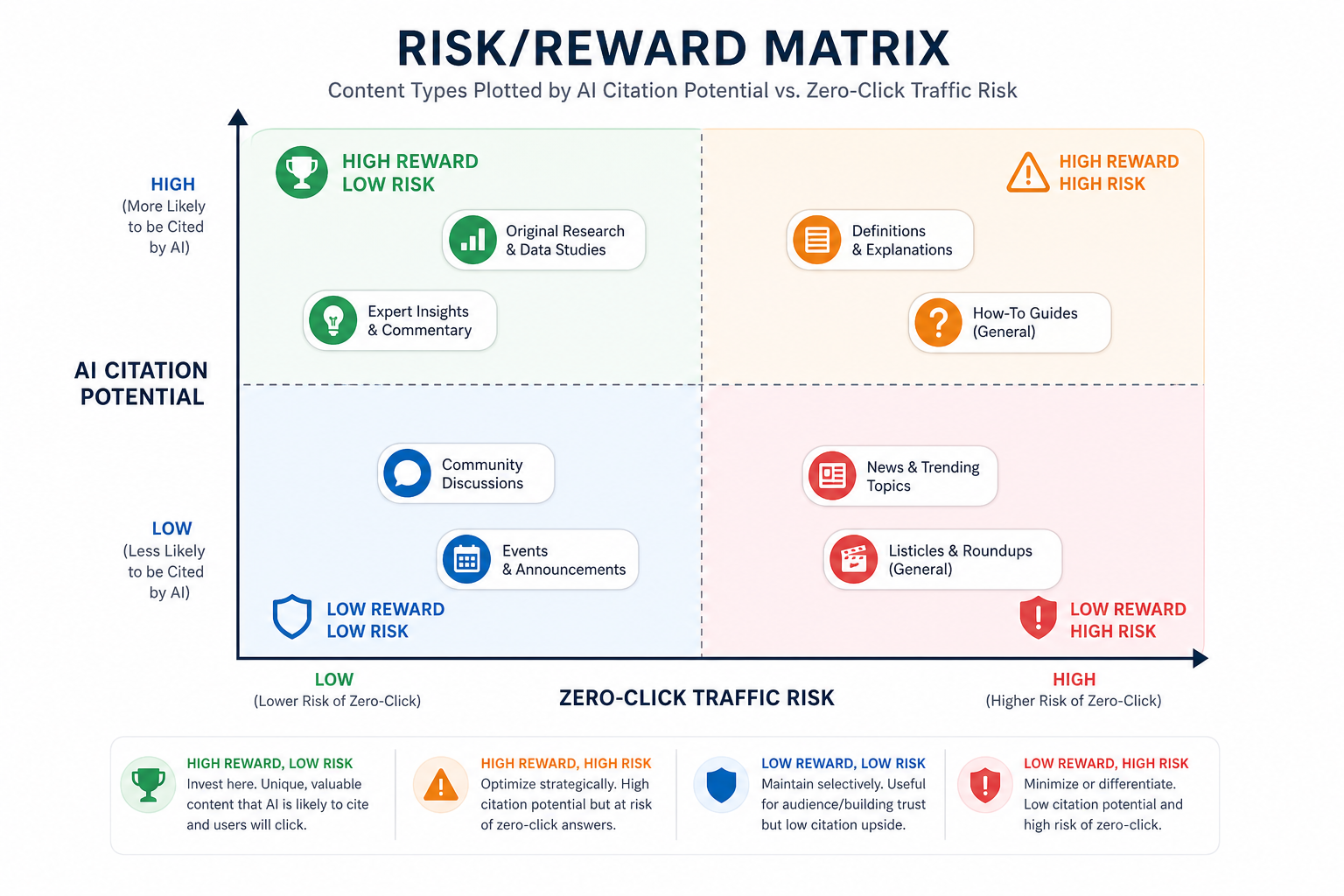
To be cited by Large Language Models (LLMs), your data needs to be accessible. However, making data easily 'scrapable' risks competitor theft or the LLM providing the answer without a click-through.
- The Risk: You may experience a 'zero-click' trap where the AI provides your proprietary insights to the user, and the user never visits your site.
- The Strategy: Gated high-value tools or deep datasets while providing 'executive summary' versions in open formats (JSON-LD, high-level summaries) to secure the citation without giving away the full commercial value.
3. Agility vs. Brand Consistency
LLM outputs are unpredictable. Attempting to manipulate them via rapid content iterations (GEO - Generative Engine Optimisation) can lead to fragmented brand messaging.
- The Risk: Frequent changes to tone or factual framing to capture 'AI attention' can dilute brand trust.
- The Strategy: Establish a 'Brand Delta'—a set of non-negotiable brand guidelines that content must adhere to, regardless of what the AI algorithms seem to prefer at a given moment.
Managing Hallucination Risks
One of the most significant risks in AI Visibility is the 'Secondary Hallucination.' This occurs when an AI engine correctly identifies you as a source but then incorrectly synthesises your data with other, lower-quality sources.
Mitigation Steps:
- Factual Hardening: Ensure all statistics, dates, and claims are wrapped in
FactCheckschema or specific Microdata. - Entity Resolution: Use SameAs links in your Schema to point to authoritative third-party sources (like Wikidata or LinkedIn profiles) to prevent the AI from confusing your brand with another similarly named entity.
- Proactive Monitoring: Use tools to track how LLMs describe your brand. If a hallucination becomes a recurring trend, update your site's 'About' and 'FAQ' sections with explicit 'not-to-be-confused-with' statements.
The Cannibalisation Audit
When we optimise for AI snapshots (like Google’s SGE or Perplexity’s citations), we risk cannibalising our organic search traffic.
Step-by-Step Audit Process:
- Identify High-Intent Keywords: Filter your top 20 keywords currently driving conversion traffic.
- Simulate the Search: Run these through AI-driven search engines.
- Assess the 'Answer Gap': If the AI provides a full answer that negates the need for a click, you must pivot the content to offer 'secondary value' (e.g., a downloadable template, a deep-dive calculator, or personal consultation) that a text-based answer cannot replace.
Worked Example: The Financial Advisor
Client: A boutique UK-based financial consultancy specialising in inheritance tax.
Conflict: The client wants to rank in AI summaries for "How to reduce inheritance tax UK."
Risk Assessment:
- Technical Risk: Providing a step-by-step guide might satisfy the query entirely within the AI interface, losing the lead.
- Compliance Risk: The AI might misinterpret specific tax thresholds, citing the client as the source for outdated or illegal advice.
The Strategy Adjustment: Instead of a generic guide, we create a 'Dynamic 2024 Inheritance Tax Calculator' Schema. The content provided to the AI focuses on the complexity and the risks of doing it alone, mentioning specifically that "Calculations vary based on individual domicile status." This forces the AI to cite the consultant as the authority on the complexity, driving the user to the site for the actual calculation. To mitigate hallucination, we include a 'Last Verified' date prominently in the metadata.
Technical Trade-offs: Robbins.txt and Beyond
You must decide whether to allow AI crawlers (like GPTBot or CCBot) full access.
- Full Access: High visibility, high risk of content being used to train competitors.
- Partial Access: Blocking certain directories while allowing common headers. Use the
meta name="robots" content="noarchive"or specific AI-user agent strings to control the granularity of data ingestion.
Putting it into Practice
To manage risk effectively in your next engagement, follow this checklist:
- Risk Documentation: Create a risk register specifically for AI Visibility. List potential hallucinations and zero-click threats for your top 5 products.
- Update Terms of Service: Ensure your site's TOS explicitly bans the use of your data for training non-consensual commercial AI models (even if enforcement is difficult, it provides legal standing).
- Tiered Content Release: Release data-heavy summaries first. Monitor for AI citations. If the AI provides the answer without a link, adjust the content to include more 'referential' language (e.g., "As detailed in our full report...").
- Schema Consistency: Perform a weekly audit of your JSON-LD to ensure it hasn't drifted from the visual content on the page, as discrepancies can lead to trust penalties from AI models.
- Human-in-the-loop: Never automate the publication of AI-optimised content without a final factual check by a subject matter expert.