Introduction to the 90-Day Visibility Plan
Transitioning from theoretical AI visibility concepts to a practical client engagement requires a structured framework. While traditional SEO often focuses on long-term authority building, AI Visibility and Answer Engine Optimisation (AEO) benefit from tighter, iterative cycles. A 90-day plan serves as the industry standard for demonstrating early value, establishing a baseline, and implementing technical shifts that AI models (LLMs) can ingest and reflect in their outputs. This lesson provides a tactical sequence to move from initial audit to measurable visibility improvements.
The Strategic Framework: Prioritising Action
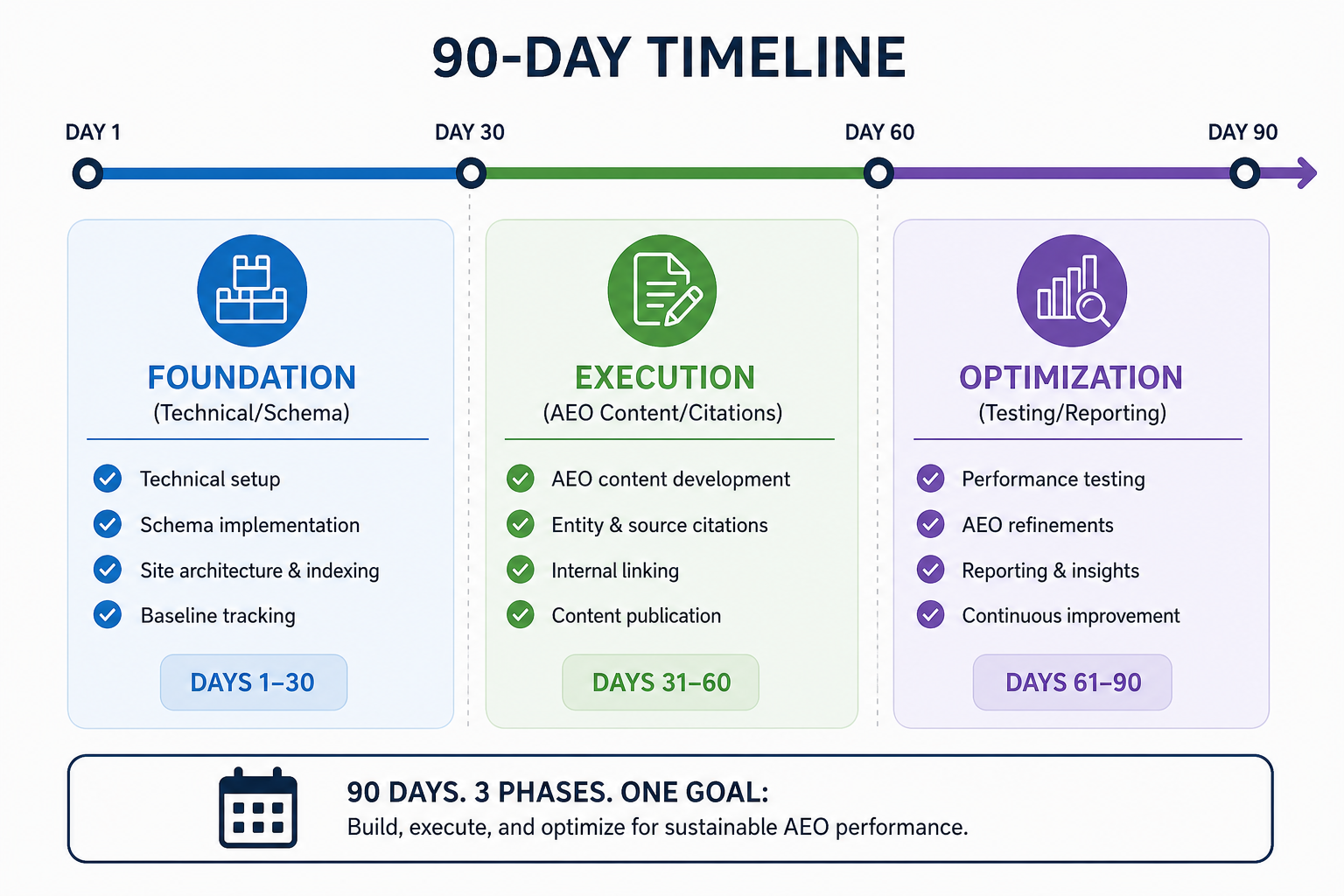
When building a 90-day roadmap, you must balance three competing priorities: technical hygiene (making the site readable for crawlers), narrative control (ensuring the brand is associated with the right topics), and citation growth (earning mentions in the datasets models use). We categorise these into three distinct phases.
Month 1: The Foundational Audit and Schema Sprint
The first 30 days are dedicated to 'visibility readiness'. You cannot influence AI summaries if the foundational data is fragmented or inaccessible.
- Baseline AI Share of Voice (SoV): Use tools to query major LLMs (ChatGPT, Claude, Gemini) for key brand and category terms. Document where the brand is currently cited and where there are 'hallucination risks'.
- Semantic Schema Audit: Beyond standard 'Website' schema, implement advanced 'Organisation', 'Product', and 'FAQ' schema. Use
sameAsattributes to link the site to authoritative external profiles like LinkedIn, Wikipedia, or industry directories. - Entity Mapping: Identify the 10-15 core entities (concepts, products, or people) your client should be synonymous with. Map these to existing URLs and identify content gaps.
Month 2: Narrative Engineering and Knowledge Graph Integration
With the foundation set, Month 2 focuses on content that satisfies the 'Question-Answer-Evidence' loop that AI models prioritise.
- The AEO Content Sprint: Convert top-performing SEO pages into 'Answer-Ready' formats. This means placing a direct, concise answer (under 60 words) at the top of the page, followed by structured evidence (tables, bullet points).
- Citation Mining: Identify the 'Seed Sites' that your target LLMs frequently cite. These are often niche-specific directories, review platforms, or high-authority news sites. Develop a strategy to earn mentions on these specific domains.
- Knowledge Graph Seeding: Update external 'truth sources'. This includes ensuring Google Business Profile, Crunchbase, and relevant LinkedIn company pages have identical, synergetically worded descriptions.
Month 3: Testing, Refinement, and Reporting
The final month of the first cycle is about proving the efficacy of the changes and preparing for the next 90-day sprint.
- Prompt Sensitivity Testing: Re-run the baseline queries from Month 1 using various prompt engineering techniques (e.g., 'What is the best [X] for [Y]?'). Note if the citations have shifted towards your client's site.
- Technical Refinement: Review the Search Console data for 'Snippet' and 'FAQ' performance. If Google is picking up the new schema, there is a high probability LLMs are ingestive the structured data as well.
- Strategic Reporting: Move away from just 'Rankings'. Report on 'Citation Frequency', 'Sentiment Score within LLM responses', and 'Brand Association Accuracy'.
Worked Example: B2B SaaS Platform
Client: 'SecureFlow', a mid-market cybersecurity provider for financial services.
Month 1 Action: The practitioner discovered SecureFlow was often confused with a similarly named plumbing company in LLM outputs. They implemented Organization schema with a description field that explicitly mentioned 'Cybersecurity' and 'SaaS'. They added sameAs links to the client's G2 profile and Crunchbase.
Month 2 Action: SecureFlow had 50 blog posts about 'Data Security'. The practitioner restructured the top 5 into 'Definition' pages (e.g., 'What is Zero Trust Architecture?'). They added a 50-word summary at the top and a comparison table of protocols. They then secured a guest feature on a major cybersecurity podcast that is frequently transcribed and indexed.
Month 3 Action: Re-testing showed that ChatGPT now correctly identified SecureFlow as a software company. The 'Zero Trust' page began appearing as a cited source in Gemini for queries related to financial data regulations. Reach was measured not by traffic alone, but by the presence of the 'SecureFlow' brand name in the generated LLM summaries.
Managing Client Expectations
Visibility in AI is more volatile than traditional organic search. Clients must understand that LLMs have 'knowledge cut-offs' and training cycles. A change made today might not reflect in a model's weights for several months, though 'tools' like Search-Enabled GPTs or Perplexity will show results much faster. Aim for 'Search-Plus-AI' wins to ensure the client sees immediate traffic value while waiting for the LLM's core model to update.
Putting it into Practice
To begin your 90-day plan, follow these steps immediately after onboarding a client:
- Define the 'Golden Queries': 5-10 questions you want the client to be the definitive answer for.
- Audit the 'Entity Profile': Check if Wikipedia, LinkedIn, and the main site agree on who the client is.
- Batch Schema Implementation: Don't do it page-by-page; use templates to deploy structured data across entire categories.
- Establish the Monthly Pulse: Set a date for the 'Prompt Audit' every 30 days to track shifts in how AI perceives the brand.