Prioritisation Frameworks

Master the application of ICE and RICE frameworks specifically for AI Visibility, prioritising high-impact optimisations that align with LLM training cycles and user intent.

12 min read
Foundations

Introduction

Transitioning from theoretical AI visibility to practical implementation requires a robust system for decision-making. In the fast-moving landscape of LLMs (Large Language Models) and Answer Engine Optimisation (AEO), practitioners often face a backlog of hundreds of potential fixes—from structured data overhaul to entity bridging. Without a structured prioritisation framework, marketing teams risk wasting resources on 'vanity' optimisations that do not move the needle on citations or sentiment. This lesson explores how to adapt proven frameworks like ICE and RICE to the unique constraints of AI visibility.

The Challenge of AI Prioritisation

Prioritising for AI models differs from traditional SEO in three distinct ways:

  1. Feedback Loops: Unlike Google’s Search Console which updates daily, LLM knowledge updates can be erratic (depending on crawling frequency and training cut-offs).
  2. Opacity: We cannot always tell exactly which data point caused a model to change its response.
  3. Computation vs. Content: Some fixes are technical (API integrations), while others are rhetorical (changing brand tone to suit LLM summarisation).

To manage this, we use quantitative frameworks to remove bias and focus on high-yield activities.

The ICE Framework for AI Visibility

The ICE framework (Impact, Confidence, Ease) is ideal for smaller teams or agile projects where speed is critical.

1. Impact

In the context of AI visibility, impact is measured by how much a change will likely increase the probability of being cited in a 'zero-click' answer.

  • High Impact: Implementing a Knowledge Graph-compliant schema for a core product line.
  • Low Impact: Tweaking the meta description of a legacy blog post from 2018.

2. Confidence

Confidence reflects our data-backed belief that the intervention will work.

  • High Confidence: Fixing a '404' error on a page frequently cited by Perplexity.
  • Low Confidence: Re-writing content specifically to influence a 'creative' model like Gemini’s personality.

3. Ease

Ease measures the operational effort required. This includes developer time, legal approvals for AI training data usage, and content production.

  • High Ease: Updating a robots.txt file to allow GPTBot.
  • Low Ease: Building an entire custom GPT or RAG (Retrieval-Augmented Generation) pipeline for customer support content.

Formula: (Impact + Confidence + Ease) / 3 = ICE Score.

The RICE Framework: A Data-Driven Approach

For larger client engagements, RICE offers a more granular perspective by introducing 'Reach'.

Reach

How many users will interact with this specific AI response? Estimate this by looking at the search volume for the 'Seed Keywords' that trigger the AI Snapshot or Answer Box. If an AI summary appears for a query with 10,000 monthly searches, the Reach is 10,000.

Impact

Rate on a scale: 3 for massive impact, 2 for high, 1 for medium, 0.5 for low, 0.25 for minimal. For AI visibility, 'Massive Impact' is often defined as gaining the 'Primary Reference' (the first link cited).

Confidence

A percentage (100% = high, 80% = medium, 50% = low). Never go below 50% unless it is a wild experiment; at that point, the task should likely be moved back to a research phase.

Effort

Measured in 'person-months' or 'person-days'.

Formula: (Reach × Impact × Confidence) / Effort = RICE Score.

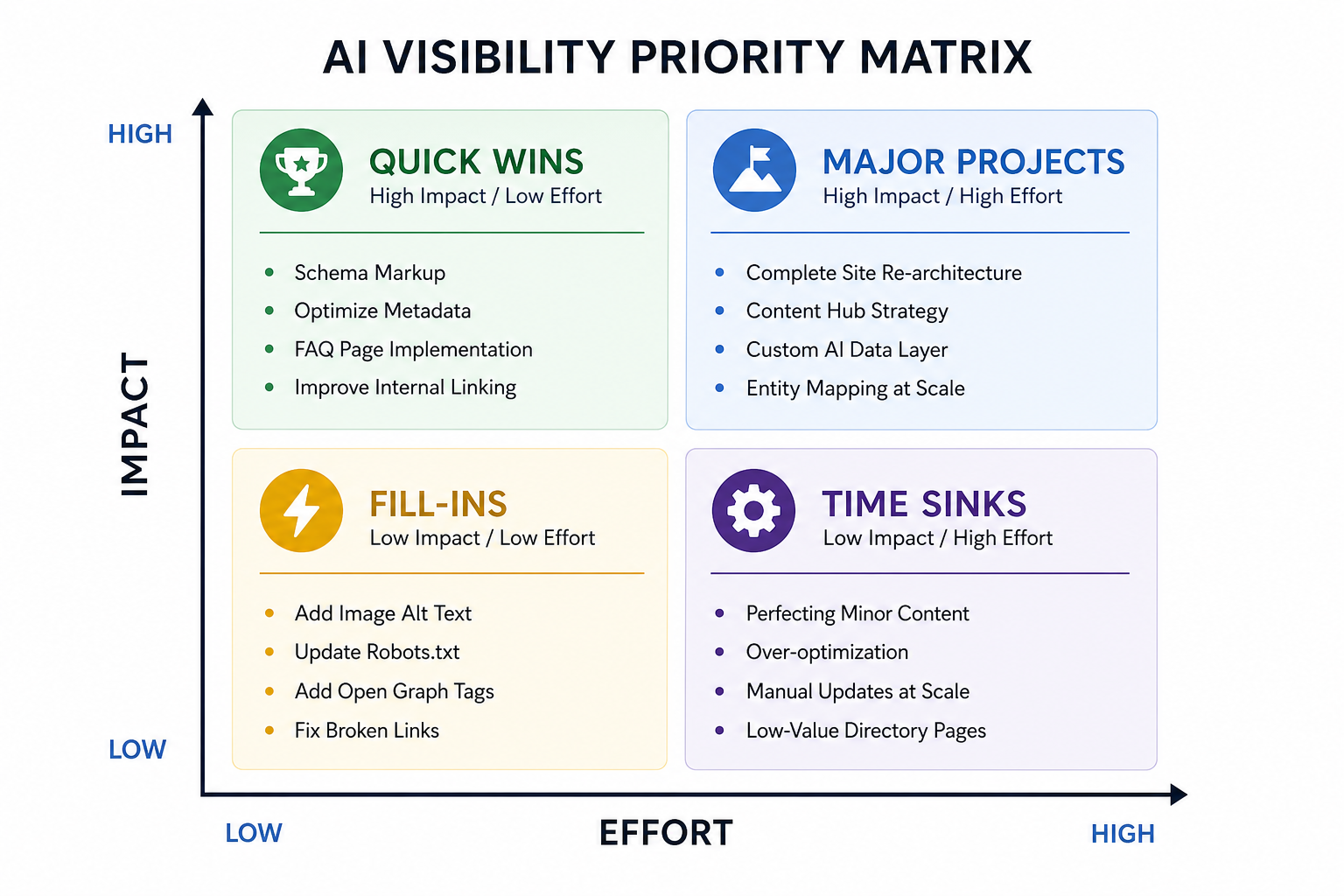
The Effort-Impact Matrix

Also known as the 'Action Priority Matrix', this 2x2 grid helps categorise tasks visually:

  1. Quick Wins (Low Effort, High Impact): Updating Google Business Profiles, fixing schema syntax errors.
  2. Major Projects (High Effort, High Impact): Revamping the entire site architecture to follow a 'Topic Cluster' model that LLMs can easily parse.
  3. Fill-ins (Low Effort, Low Impact): Minor copy tweaks on low-traffic pages.
  4. Thankless Tasks (High Effort, Low Impact): Deep technical overhauls of legacy code that LLM crawlers already ignore.

Worked Example: Prioritising Three AI Visibility Tasks

Let’s look at a hypothetical B2B SaaS client:

Task A: Implement Product Ontology Schema

  • Reach: 5,000 (core product searches)
  • Impact: 2 (High - will improve entity recognition)
  • Confidence: 80%
  • Effort: 2 days
  • RICE Score: (5,000 * 2 * 0.8) / 2 = 4,000

Task B: Write 20 blog posts on 'AI Trends'

  • Reach: 20,000 (Broad topic)
  • Impact: 0.5 (Low - high competition, unlikely to be cited first)
  • Confidence: 50%
  • Effort: 10 days
  • RICE Score: (20,000 * 0.5 * 0.5) / 10 = 500

Task C: Claim and Verify Brand Profiles on Third-Party Review Sites

  • Reach: 8,000 (Brand + Reviews queries)
  • Impact: 3 (Massive - LLMs rely heavily on aggregator sentiment)
  • Confidence: 100%
  • Effort: 1 day
  • RICE Score: (8,000 * 3 * 1.0) / 1 = 24,000

Conclusion: Task C is the immediate priority, followed by Task A. Task B, despite the high reach, has a poor RICE score due to low confidence and high effort.

Putting it into Practice

  1. Audit the Backlog: Gather all AEO and AI visibility recommendations from your initial audit.
  2. Assign Raw Scores: Use a spreadsheet to assign Reach, Impact, Confidence, and Effort.
  3. Calibrate with the Client: Ensure the 'Effort' score reflects the client’s actual internal bandwidth (e.g., if their dev team is locked for 3 months, technical tasks have a higher Effort score).
  4. Visualise: Plot these onto a 2x2 Effort-Impact matrix for the monthly stakeholder report to justify why you are ignoring certain 'buzzword' tasks in favour of foundational ones.
  5. Re-evaluate Monthly: Because LLM capabilities change (e.g., OpenAI releasing a new search crawler), your Confidence scores will need a monthly refresh.

Visual diagram

[ diagram placeholder ]

A 2x2 Matrix showing Effort on the X-axis and Impact on the Y-axis, with specific AI Visibility tasks like 'Schema Markup' in the Quick Wins quadrant and 'Complete Site Re-architecture' in the Major Projects quadrant.

Exercise

Take three current tasks on your SEO to-do list. Assign them a RICE score based on their potential to influence an AI-generated summary (like Google Overviews). Compare the scores to your original priorities.

Key takeaways

  • Prioritisation prevents 'activity trap' where teams do high-effort, low-value AI tasks.
  • ICE is best for agile, rapid decision-making in small marketing teams.
  • RICE is better for large-scale visibility projects requiring data justification.
  • Reach in AI visibility is measured by the search volume of queries triggering AI answers.
  • Confidence scores should be lowered if the tactic relies on unproven LLM behaviour.
  • Impact for AI visibility is defined by the likelihood of achieving 'Primary Citation' status.
  • Effort must include 'Time to Live'—how long it takes an LLM to re-crawl and index changes.
  • A 2x2 Effort-Impact matrix is the best tool for presenting priorities to non-technical stakeholders.
  • Third-party sentiment (reviews, directories) often has higher RICE scores than on-site blogging.
  • Regularly re-score tasks as model updates (e.g., GPT-4 to GPT-5) change what is 'Easy' or 'Impactful'.

Lesson Quiz

Pass at 70%.

1. What does the 'R' in RICE stand for in the context of AI visibility?
2. When using the ICE framework, how is the final score calculated?
3. Which task would likely fall into the 'Quick Win' quadrant of an Effort-Impact matrix?
4. If you have 100% confidence but the reach is zero, what is the RICE score?
5. What is a major difference between prioritising traditional SEO and AI visibility?
6. In the RICE framework, what is the recommended Impact score for a 'Massive' movement in visibility?
7. Why is 'Confidence' a critical metric for AI visibility tasks?
8. A task with high effort and low impact is categorised as a:
9. How should 'Effort' be measured in the RICE model?
10. Which of these would justify lowering a Confidence score for an AEO task?
Create a free account to save progress and earn a certificate.