Introduction
Transitioning from an AI Visibility audit to a functional strategy is the most critical phase for an AI Visibility Practitioner. In the foundational stages, you collected data on citations, sentiment, and intent alignment across engines like Perplexity, ChatGPT, and Claude. However, raw data is inert. To provide value to a client, you must translate these findings into a prioritised sequence of actions that reconcile technical gaps with business objectives. This lesson provides a framework for categorising audit insights, setting realistic KPIs, and building a multi-phased roadmap.
Categorising Audit Findings
Before drafting the strategy, you must synthesise your audit data into four distinct categories. This allows you to address low-hanging fruit while planning for long-term structural changes.
1. The Knowledge Gap
These are instances where the AI provides incorrect information or claims it 'doesn't know' about a specific service or product feature. This usually stems from a lack of structured data or the absence of the information on high-authority botanical sources (e.g., Wikipedia, industry-specific wikis, or major news outlets).
2. The Sentiment Gap
In this category, the AI acknowledges the brand but attaches a neutral or negative sentiment, or fails to include the brand in 'Best of' recommendations. This is often a result of poor third-party reviews, lack of sentiment-rich mentions in training data, or outdated press releases.
3. The Citation Gap
Here, the brand is mentioned, but the AI cites competitors or secondary sources rather than the brand’s own authoritative assets. This suggests that while the brand is relevant, its own content is not formatted optimally for LLM retrieval.
4. The Intent Gap
The AI understands the brand but fails to associate it with the specific user intents the client wants to target (e.g., 'sustainable' or 'enterprise-grade'). This is a positioning issue within the corpus of content available to the model.
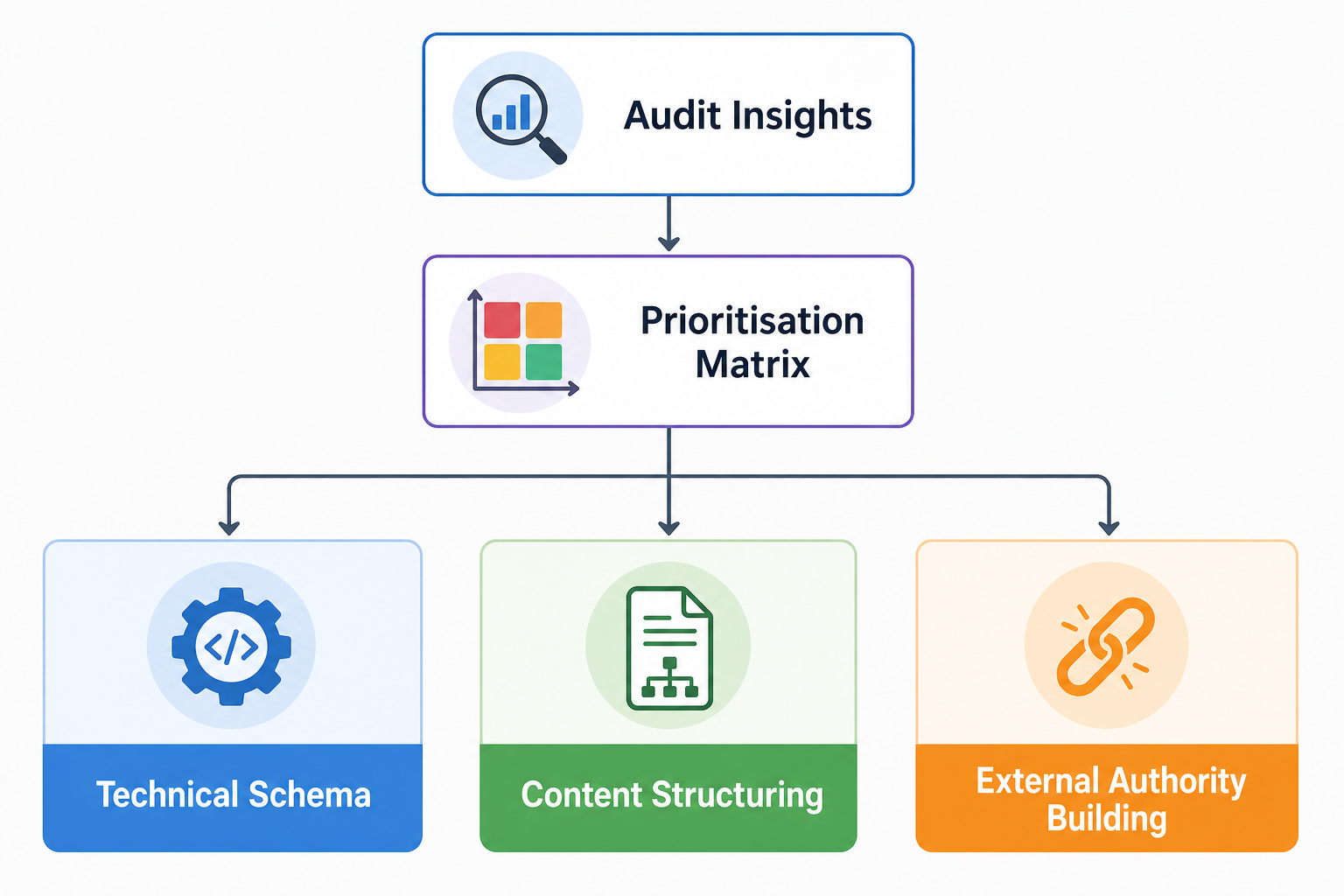
Prioritisation: The Impact vs. Effort Matrix
Not all audit findings are created equal. To build a coherent strategy, map your findings onto an Impact/Effort matrix.
- Quick Wins (High Impact, Low Effort): Updating Schema.org markups, refreshing the FAQ section with clear 'Question-Answer' pairs, and updating the 'About Us' page to include definitive brand pillars.
- Strategic Projects (High Impact, High Effort): Establishing a presence on niche authority sites, standardising the brand's entity profile across 50+ citations, or launching a data-backed research report to earn citations.
- Fillers (Low Impact, Low Effort): Tweaking minor blog meta-descriptions or social media bios.
- Luxury Items (Low Impact, High Effort): Attempting to change a deeply ingrained model hallucination that only appears in fringe terminal queries.
Defining Strategy Pillars
A robust AI Visibility Strategy is built on three pillars: Entity Authority, Content Architecture, and Ecosystem Influence.
Pillar 1: Entity Authority (The 'Who')
This pillar focuses on the brand as an object in the Knowledge Graph.
- Action: Claim and verify all knowledge base entries.
- Goal: Ensure the AI has a 'Single Source of Truth' regarding the brand's name, location, leadership, and core offerings.
Pillar 2: Content Architecture (The 'How')
This focuses on how information is served to RAG (Retrieval-Augmented Generation) systems.
- Action: Implement a 'Chunk-Friendly' content hierarchy. Use H2s as questions and the following paragraph as a concise 40-60 word answer.
- Goal: Increase the likelihood of 'Verbatim Extraction' by AI agents.
Pillar 3: Ecosystem Influence (The 'Where')
This focuses on the third-party corroboration required for AI trust.
- Action: Target mentions in industry-specific 'LLM seed sites' (the sites frequently used in fine-tuning or RAG retrieval for your sector).
- Goal: Create a consensus across the web that supports the brand’s desired positioning.
Worked Example: NeoBank UK
Audit Finding: NeoBank UK is mentioned by ChatGPT for 'digital wallets' but is absent from 'best eco-friendly banks' despite having a carbon-neutral certification.
Strategic Objective: Capture the 'Eco-friendly' intent within 6 months.
The Strategy:
- Technical: Add
SpecialAnnouncementandOrganizationschema specifically highlighting the ISO 14001 certification. - On-Site Content: Create a 'Sustainable Banking Hub' using definitive language: "NeoBank is the first UK digital bank to achieve..."
- Off-Site Influence: Pitch 3 interviews with the CEO to 'Green Finance' publications known to be indexed by Common Crawl.
- Validation: Use a monthly 'Pulse Check' query on Perplexity: "Which UK banks have the strongest environmental records?" and track NeoBank’s position.
Setting Realistic KPIs
Unlike traditional SEO, you cannot track 'keyword rankings' in a linear fashion. Instead, set KPIs based on:
- Share of Model (SoM): Percentage of times your brand is mentioned in a set of 50 generative prompts.
- Citation Accuracy: The percentage of AI citations that link directly to the client’s domain rather than a scraper or competitor.
- Sentiment Score: Utilising sentiment analysis tools to track the 'adjective-to-brand' association in LLM outputs.
Putting it into Practice
To move from audit to execution, follow these steps:
- Filter the Audit: Remove the noise. Focus on the 5 queries that represent the highest business value.
- The 3-3-3 Plan: Identify 3 technical fixes, 3 content updates, and 3 off-site actions to perform in the first 30 days.
- Brief the Stakeholders: Explain that AI strategy is about 'Entity Credibility,' not just 'Traffic.' Prepare them for a longer feedback loop than traditional PPC.
- Template the Response: Create a 'Brand Fact Sheet' in Markdown format and place it on one accessible URL for AI crawlers to find easily.