Introduction to Prompt Tracking
As an AI Visibility Practitioner, your ability to provide consistent data depends entirely on the stability of your measurement instruments. In the world of GEO (Generative Engine Optimisation), your 'instruments' are your prompts. Tracking brand visibility at scale is not as simple as checking a keyword on a search engine results page (SERP); it requires managing a matrix of variables including model versions, brand entities, and natural language nuances. This lesson focuses on the transition from ad-hoc prompting to a systemic, enterprise-grade prompt tracking framework.
Without a structured approach, visibility reports become 'noisy'. If a brand mention disappears, was it because of a change in the AI's weightings, or because you slightly altered the prompt phrasing? To provide actionable insights to clients, you must eliminate prompt variability and treat your queries as fixed assets across multiple engines like ChatGPT (GPT-4o), Claude 3.5, and Google Gemini.
The Anatomy of a Tracked Prompt Set
Scaling prompt tracking requires a 'Master Prompt Set'. This is a curated collection of queries that represent the diverse ways a user might discover a client’s product or service. A mature prompt set should be categorised into four primary buckets:
- Direct Brand Queries: "What are the pros and cons of [Brand Name]?"
- Category/Commercial Queries: "Which [Product Category] is best for small businesses in the UK?"
- Problem-Solution Queries: "How do I fix [Specific Technical Issue]?"
- Competitor Comparison Queries: "Compare [Brand Name] with [Competitor A] and [Competitor B]."
For each query, you must maintain a 'Prompt Metadata Record'. This includes the intent, the target persona (if defined in the system prompt), and the 'Gold Standard' answer (what would be the ideal outcome for the brand).
Managing Version Control and 'Drift'
LLMs are not static. Updates to model weights (e.g., GPT-4 vs. GPT-4o) can lead to 'Model Drift', where the same prompt produces significantly different results over time. To manage this at scale, you must implement versioning for your prompts.
- Standardisation: Use a template-based approach. Instead of writing unique queries, use variables like
{brand_name},{location}, and{target_pain_point}. This ensures that the linguistic structure remains identical across different clients and tests. - Snapshotting: When a major model update is released, run your tracked prompt set across both the old and new versions to establish a baseline of change. This allows you to explain to clients why visibility might have dipped or spiked due to architectural changes rather than SEO performance.
Executing Multi-Engine Testing
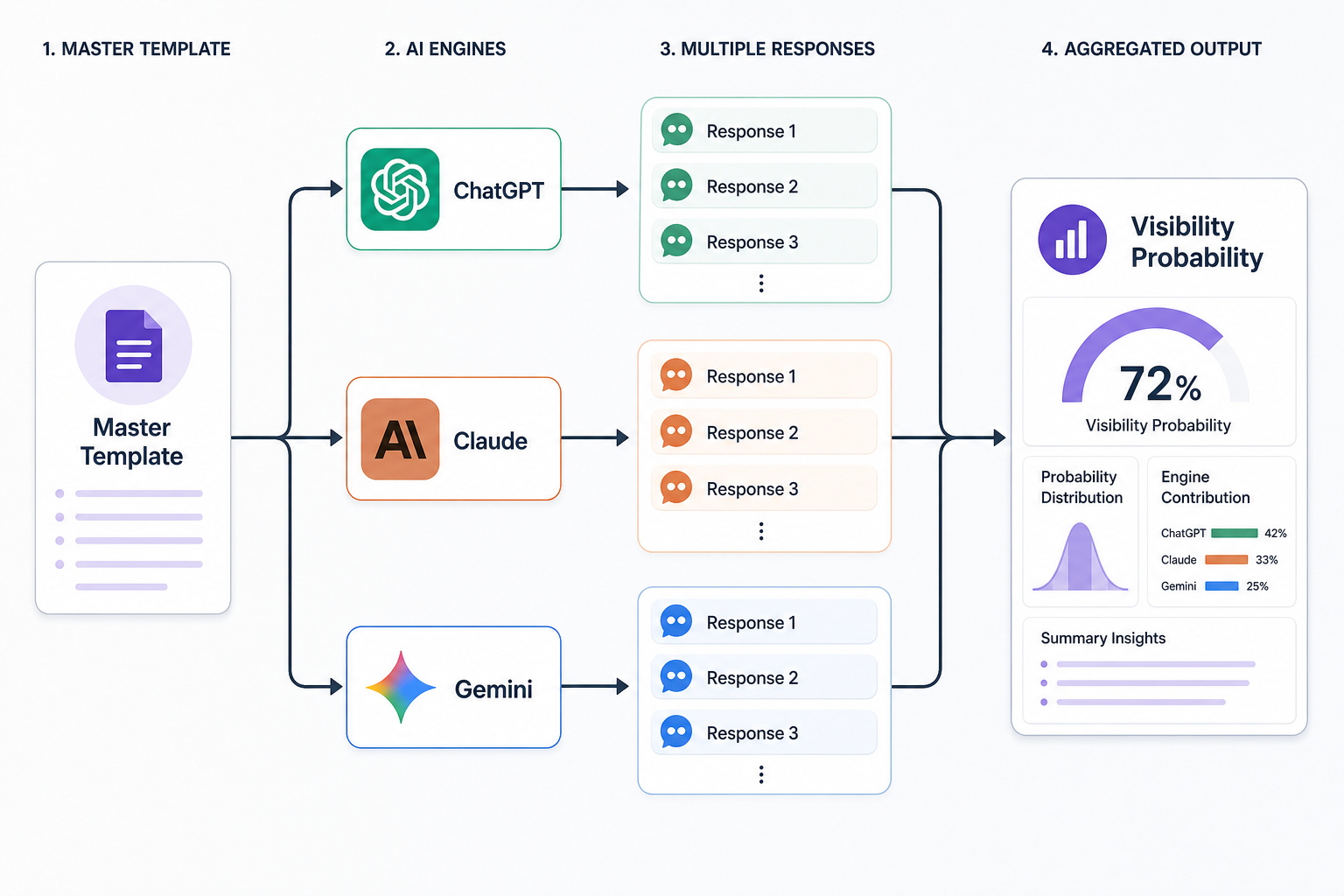
To track at scale, you cannot manually copy-paste queries. Practitioners should use API-based tools or 'batch runners' to execute the prompt set across multiple engines simultaneously. The goal is to capture the 'Response Sentiment' and 'Citation Share' for each.
The Consistency Problem
AI engines are probabilistic, not deterministic. Running a prompt once is not enough for an enterprise-level report. At scale, the recommended workflow is the 'N-of-5' approach: run each prompt five times and calculate the frequency of your brand appearing in the top results. This provides a 'Visibility Probability' score, which is much more reliable than a single snapshot.
Worked Example: Sustainable Footwear Brand
Imagine you are tracking visibility for a sustainable footwear brand, 'EcoStep'.
1. Define the Variable Matrix:
Brand: EcoStepCategory: Sustainable running shoesCore Value: Recycled ocean plastic
2. The Tracked Query Template (Category Level): "I am looking for a new pair of {category}. I care deeply about {core_value}. Which brands should I consider for a marathon in the UK?"
3. Execution across Engines:
- ChatGPT (GPT-4o): EcoStep mentioned in 4/5 runs. Ranked #1.
- Claude 3.5 Sonnet: EcoStep mentioned in 3/5 runs. Ranked #3.
- Google Gemini: EcoStep mentioned in 5/5 runs. Highlighted in 'Google Shopping' integration.
4. Data Consolidation: You record these results in a central 'Visibility Ledger'. The practitioner notices that while ChatGPT likes the 'marathon' angle, Claude focuses more on the 'recycled' aspect. This insight leads to a recommendation: EcoStep needs more content on their site specifically about 'marathon performance' to improve visibility in Claude.
Ethical Considerations and Anti-Gaming
Tracking is not for the purpose of 'spamming' the model. It is about understanding the AI's current perception of the brand. If your brand is not appearing, it is usually a signal of a 'content gap' or a lack of authoritative citations in the training data or RAG (Retrieval-Augmented Generation) sources. Scaling your tracking helps identify these gaps faster than manual searching ever could.
Putting it Into Practice
To move from theory to action, follow these steps in your next client engagement:
- Inventory: Identify 20-50 high-intent queries relevant to the client.
- Template: Transform these into variable-based templates to ensure linguistic consistency.
- Baseline: Run the set across at least three major engines (ChatGPT, Gemini, Claude).
- Frequency: Set a cadence (e.g., monthly) to re-run the exact same templates.
- Audit: Use the results to identify which 'sources' the AI is citing. If they are citing a specific Reddit thread or industry blog consistently, focus your traditional PR/SEO efforts there.
- Report: Provide the client with a 'Visibility Share' percentage based on the N-of-5 probability model.