What to Monitor and Why

Identify which AI visibility metrics require continuous automated tracking versus those best suited for periodic qualitative spot-checks to balance resource allocation effectively.

12 min read
Foundations

Introduction

Transitioning from traditional SEO to AI Visibility Management requires a shift in how we approach monitoring. In the legacy search world, we tracked keywords and backlinks as proxies for visibility. In the age of Answer Engine Optimisation (AEO) and Generative Experience Optimisation (GEO), the volume of data generated by AI platforms is immense, yet much of it is opaque.

To build a sustainable monitoring system, an AI Visibility Practitioner must distinguish between 'Continuous Signals'—those that provide a high-level view of health and performance—and 'Spot-Check Signals'—qualitative nuances that require human analysis. This lesson establishes the framework for deciding what to track, why those metrics matter, and how to structure your reporting to provide actual value to clients rather than just noise.

The Philosophy of Selective Monitoring

AI models like Perplexity, ChatGPT, and Google’s Search Generative Experience (SGE) do not operate on static indices. Their outputs are probabilistic and can change based on prompt phrasing, user history, and real-time data integration. Monitoring everything is impossible; monitoring the wrong things is expensive.

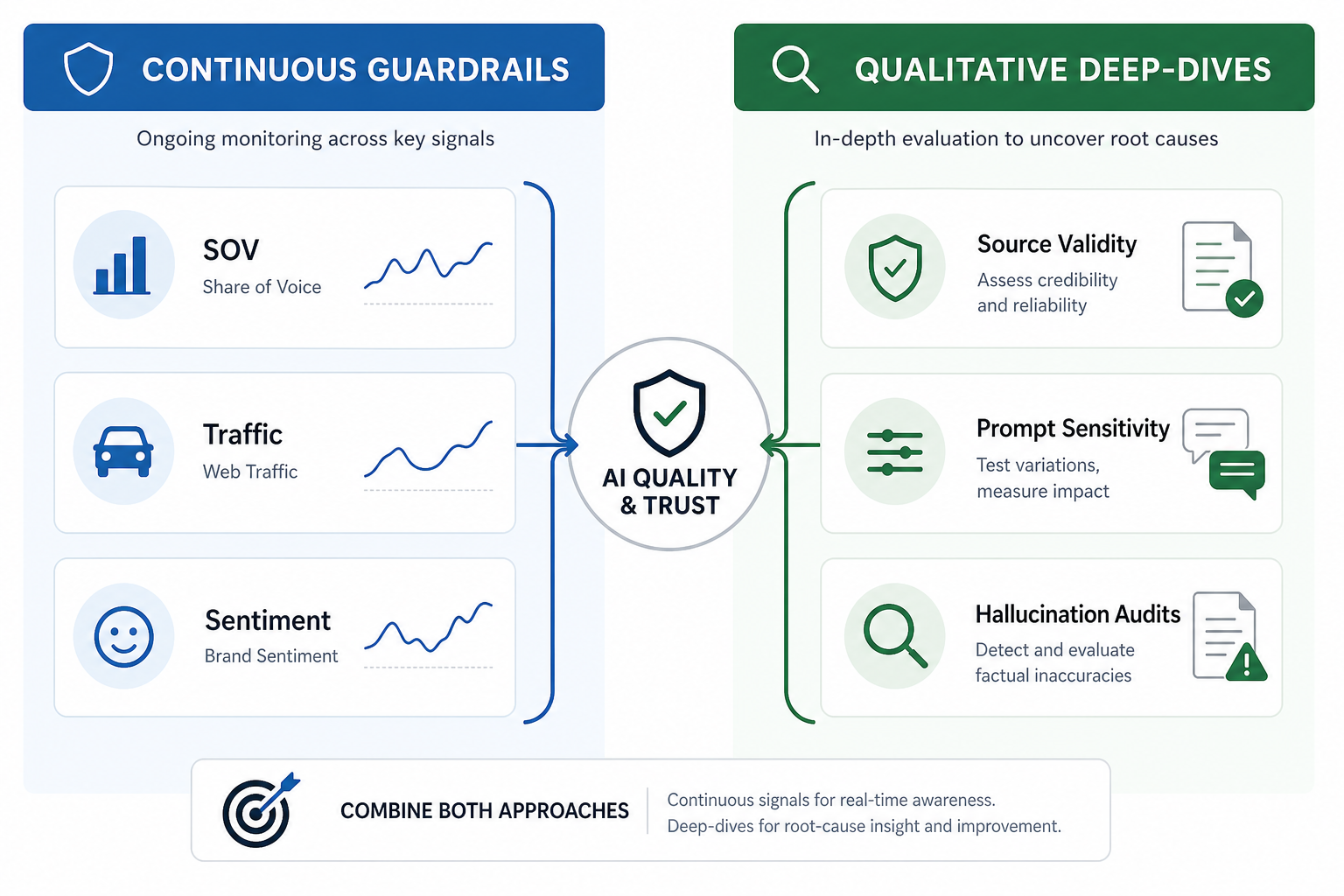
We categorise monitoring into two distinct workflows. Continuous tracking focus on quantitative data that indicates trends, while spot-checks focus on the 'why' behind the shifts. Without the former, you won't know when a problem occurs. Without the latter, you won't know how to fix it.

Continuous Signals: The Quantitative Pulse

These are metrics that should be automated where possible or checked on a weekly basis. They serve as your early warning system.

1. Brand Citation Share (SOV)

This is the most critical continuous metric. In a given category (e.g., "best project management software"), how often is your brand cited relative to competitors? If your Share of Voice (SOV) drops by 10% across multiple prompts, it indicates a loss of authority or an update in the model's source weighting.

2. Referral Traffic from AI Agents

While direct attribution is difficult, monitoring 'referral' traffic in Google Analytics 4 (GA4) from known AI domains (e.g., chatgpt.com, perplexity.ai) provides a baseline of conversion-ready users. A sudden dip in traffic suggests your content is no longer being used as a primary source for 'Learn More' links.

3. Keyword/Topic Attribution

Tracking whether your brand is associated with specific high-value intent keywords within AI responses. For example, if a user asks for a "budget-friendly ERP," does your brand appear in the top three recommendations? Continuous tracking here ensures you maintain your positioning in the 'consideration set'.

4. Sentiment Polarity Trends

AI models condense public opinion. Continuous monitoring should track whether the summary of your brand remains positive or if a sudden influx of negative reviews or news is causing the AI to warn users about your service.

Spot-Check Signals: The Qualitative Deep-Dive

Spot-checking is a manual or semi-automated process performed monthly or quarterly. It involves higher critical thinking and contextual analysis.

1. Citation Accuracy and Narrative Alignment

AI can hallucinate or misrepresent your product features. A monthly spot-check of key product queries ensures the AI isn't attributing features to you that you don't have, or vice-versa.

2. Source Attribution Quality

When an AI cites you, where is it pulling the data from? Is it your official documentation, or a three-year-old Reddit thread? Spot-checking the 'Sources' section of platforms like Perplexity helps you identify if your primary owned assets are being ignored in favour of third-party discussions.

3. Prompt Sensitivity Testing

How does the AI respond to slight variations in tone or constraints? (e.g., "Suggest a tool for experts" vs "Suggest a tool for beginners"). Spot-checks help you understand the boundaries of your brand’s visibility.

4. Competitor 'Moat' Analysis

When a competitor is recommended over you, spot-check the 'Why'. Is the AI citing a specific whitepaper or a recent award? This qualitative insight identifies gaps in your own content strategy.

Worked Example: A B2B SaaS Case Study

Scenario: A cloud-based HR software company, 'PeopleFirst', noticed a decline in demo requests. Traditional SEO rankings were stable.

The Continuous Monitoring Data:

  • Brand Citation Share on Perplexity for "HR software for SMEs" dropped from 25% to 8% over three weeks.
  • GA4 showed a 30% drop in traffic from AI assistants.

The Qualitative Spot-Check Investigation:

  • The practitioner ran 10 manual prompts asking for HR recommendations.
  • Observations: In every response, a competitor was mentioned because of their new 'AI Payroll' feature. The AI was citing a recent industry comparison article on TechCrunch as the primary source.
  • Finding: PeopleFirst had a similar feature, but it wasn't mentioned in the TechCrunch piece, and their own product pages weren't formatted for easy AI extraction (schema was missing).

Action Taken: Update technical schema to highlight the specific feature and launch a PR campaign targeting the third-party tech journals that the AI models were clearly prioritising as authoritative sources.

Determining the Frequency: The Monitoring Matrix

| Metric | Type | Frequency | Tooling | | :--- | :--- | :--- | :--- | | Share of Voice | Continuous | Weekly | Proprietary Trackers / API | | Referral Traffic | Continuous | Daily/Weekly | GA4 / Server Logs | | Sentiment Analysis | Continuous | Monthly | Social Listening Tools | | Source Validity | Spot-check | Monthly | Manual UI Testing | | Competitor Nuance | Spot-check | Quarterly | Detailed Prompt Engineering | | Hallucination Audit | Spot-check | As needed | Manual UI Testing |

Putting it into Practice

  1. Define your 'Vitals': Choose 3-5 high-intent queries that define your business and set up a weekly manual or automated check to see if your brand appears in the AI summary.
  2. Audit your Sources: Once a month, take the top 5 AI responses for your brand and click every citation link. Record how many are 'Owned' (your site) vs 'Earned' (reviews/PR) vs 'Outdated'.
  3. Bridge the Gap: If the continuous data shows a drop, use the spot-check list to find the 'Source of Truth' error. Is it a lack of content, a technical indexing issue, or a sentiment problem?
  4. Report the 'Why', not just the 'What': Do not just tell your client your SOV is 20%. Tell them it is 20% because the AI is favouring independent review sites over their marketing copy.

Visual diagram

[ diagram placeholder ]

A split-view diagram showing 'Continuous Guardrails' on the left (SOV, Traffic, Sentiment) and 'Qualitative Deep-Dives' on the right (Source Validity, Prompt Sensitivity, Hallucination Audits).

Exercise

Select your primary website and identify three 'money queries' (high-value search terms). Use Perplexity or ChatGPT to run these queries and document: 1) Is your brand cited? 2) What is the specific source of that citation? 3) Is the information provided accurate?

Key takeaways

  • Continuous monitoring acts as an early warning system for technical or visibility drops.
  • Spot-checks provide the qualitative 'why' behind the quantitative data.
  • Share of Voice (SOV) is the primary metric for measuring AI market presence.
  • GA4 referral traffic from AI domains is a key indicator of commercially intentful users.
  • AI models prioritising third-party sources requires monitoring 'Earned' media as much as 'Owned'.
  • Sentiment trends in AI summaries can impact brand reputation faster than traditional PR.
  • Prompt sensitivity testing reveals the specific audience segments where your brand is most visible.
  • Hallucination audits are essential to ensure AI is not providing false information about features or pricing.
  • Source attribution audits identify if AI models are ignoring your primary documentation.
  • Effective reporting must link AI visibility metrics to bottom-line business outcomes like demo requests.

Lesson Quiz

Pass at 70%.

1. What is the primary purpose of continuous monitoring in AI visibility?
2. Which of these is considered a 'Spot-Check' signal?
3. Why is 'Share of Voice' (SOV) harder to measure in AI than in traditional Search?
4. In the case study, why did 'PeopleFirst' lose visibility?
5. Which metric provides the best indication of 'conversion-ready' users from AI platforms?
6. What does 'Prompt Sensitivity Testing' help a practitioner understand?
7. If an AI model provides false pricing for your product, which workflow caught this?
8. What is the danger of relying ONLY on continuous automated metrics?
9. When an AI cites a source, what is the practitioner's goal during a 'Source Validity' check?
10. According to the lesson, how often should 'Competitor Moat Analysis' ideally be performed?
Create a free account to save progress and earn a certificate.