Introduction
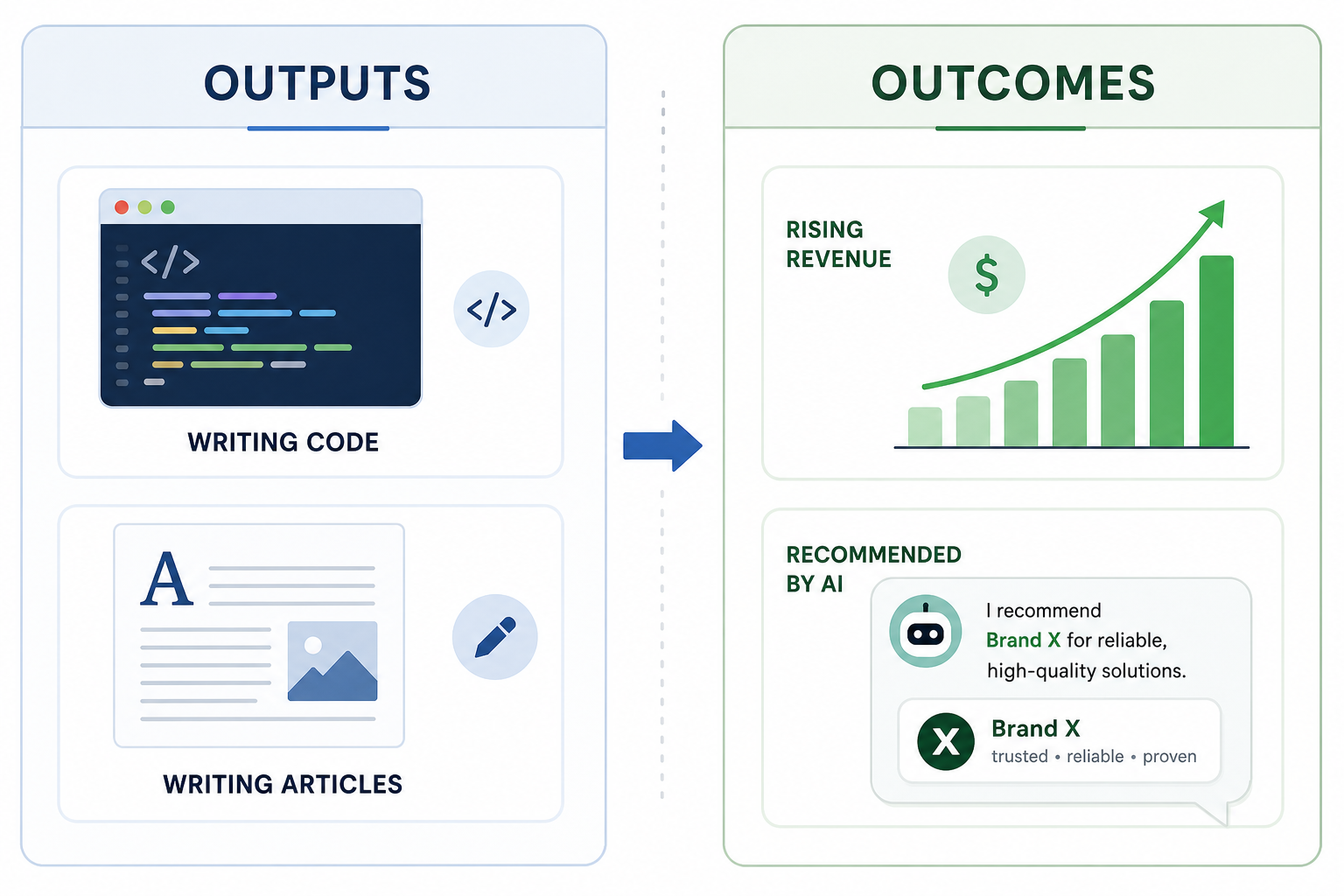
In the traditional SEO landscape, reporting often becomes a volume game. Practitioners list the number of backlinks acquired, keywords tracked, or technical audits completed. However, in the era of Generative Engine Optimisation (GEO) and AI visibility, these are merely 'outputs'—the work you did. In contrast, 'outcomes' are the measurable changes in business performance resulting from that work. For the AI Visibility Practitioner, mastering the distinction between the two is the difference between being viewed as a cost centre and being valued as a strategic partner. This lesson focuses on reframing your reporting to highlight genuine commercial impact within AI ecosystems.
Defining Outputs vs Outcomes
To report effectively, we must first categorise our efforts correctly.
What are Outputs?
Outputs are the direct products of your activity. They are internal, controllable, and typically quantify a volume of work. For example:
- Writing 10 articles optimised for 'Answer Engine' retrieval.
- Implementing Schema.org markup across 50 product pages.
- Submitting a site map to a new AI search crawler.
- Auditing 20 brand mentions for sentiment accuracy.
Outputs are important for internal project management to ensure the team is meeting its deadlines, but they do not guarantee success. You can produce 100 high-quality outputs and still see zero growth in brand citations if the strategy is flawed.
What are Outcomes?
Outcomes are the results of your outputs. They are external, influenced by the market/algorithm, and quantify value. For example:
- A 15% increase in brand mentions within Perplexity's 'Sources' section.
- Inclusion in ChatGPT Plus's 'Search' citations for high-intent commercial queries.
- A reduction in customer support tickets after updating knowledge base content for AI scrapers.
- A measurable lift in organic conversions originating from AI-driven search engines.
The Psychology of the Stakeholder
Clients and senior executives rarely care about 'Title Tag Optimisation.' They care about market share, brand authority, and revenue. When you report outputs, you force the stakeholder to do the cognitive heavy lifting of figuring out why your work matters. When you report outcomes, you demonstrate immediate value.
Consider these two reporting statements:
- Output-led: "We updated the structured data on all product pages to the latest Schema standards."
- Outcome-led: "By updating our product structured data, we secured 'Recommended' status in Google Gemini for 12 key product categories, leading to a 20% increase in referral traffic from AI summaries."
The latter tells a story of success; the former merely describes a chore.
Measuring Success in the AI Era
Tracking AI visibility requires a different toolkit than tracking traditional SERPs. While we still care about traffic, we must now measure 'Citations,' 'Sentiment,' and 'Share of Model (SoM).'
1. Citation Share
Identify your top 50 commercial keywords. Use tools like Perplexity, Gemini, or specialized AI tracking software to see how often your brand is cited as a source compared to competitors. The outcome here is moving from a 5% citation share to a 15% share.
2. Narrative Alignment
Are AI models describing your brand the way you want them to? If your output was 'revising the About Us page,' the outcome is 'AI models now correctly identify us as a UK-based sustainable fashion leader rather than a general retailer.'
3. Footprint Expansion
An output is the number of third-party reviews you managed. The outcome is your brand appearing in 'Best of' lists generated by LLMs, which drives high-intent users to your site.
Worked Example: B2B SaaS Client
Scenario: A cloud-based accountancy software firm wants to increase its visibility for 'best accounting software for small businesses' in AI searches.
The Work (Outputs):
- Published 5 comparison guides (Us vs Competitor).
- Secured 3 niche guest posts on high-authority finance blogs.
- Technical SEO audit to ensure crawlability for GPT-bot.
The Results (Outcomes - How to report them):
- Citation Frequency: "Our brand is now cited in 80% of Perplexity queries for 'accounting software comparison,' up from 30% last quarter."
- Conversion Impact: "Referral traffic from AI-first platforms (ChatGPT, Perplexity) showed a 4.5% conversion rate, which is 2x higher than traditional organic search."
- Brand Authority: "We are now the primary source cited by Gemini for 'UK tax regulations 2024,' positioning the brand as the authoritative voice in the sector."
- Efficiency: "By optimising our FAQ for AI retrieval, we have seen a 12% decrease in manual chat support queries for basic product information."
Moving Beyond the Spreadsheet
Static spreadsheets are where data goes to die. To truly report outcomes, use visualisations that show the correlative relationship between your outputs and the business outcomes. Use a timeline chart where 'Content Sprint (Output)' is marked, followed by a visible climb in 'AI Citation Share (Outcome).'
Common Pitfalls in Reporting
- Reporting Vanity Metrics: Total 'Impressions' in a world where AI synthesises the answer on the SERP can be misleading. Focus on clicks or brand sentiment instead.
- Ignoring the Attribution Gap: It is difficult to track exactly how many people read a ChatGPT response and then manually typed in your URL. Use 'Direct Traffic' and 'Brand Search Volume' as proxy metrics for AI visibility outcomes.
- Lack of Benchmarking: Reporting 50 citations is meaningless unless we know the competitor has 500. Always contextualise outcomes against the competitive set.
Putting it into Practice
- Audit your current report: Highlight every item that is an 'Output' (what you did) in red and every 'Outcome' (what happened) in green.
- Identify the 'So What?': For every red item, ask "So what?" until you reach a commercial outcome. If you can't find one, that work might not be strategic.
- Update your dashboard: Include a section specifically for 'AI Share of Voice' or 'Generative Engine Citations.'
- Speak the language of the C-Suite: In your next meeting, lead with the outcomes. Mention the outputs only if they ask about the process or budget allocation.
- Use Qualitative Evidence: Provide screenshots of AI models citing the brand. This 'social proof' for the client is often more impactful than a bar chart.