Introduction
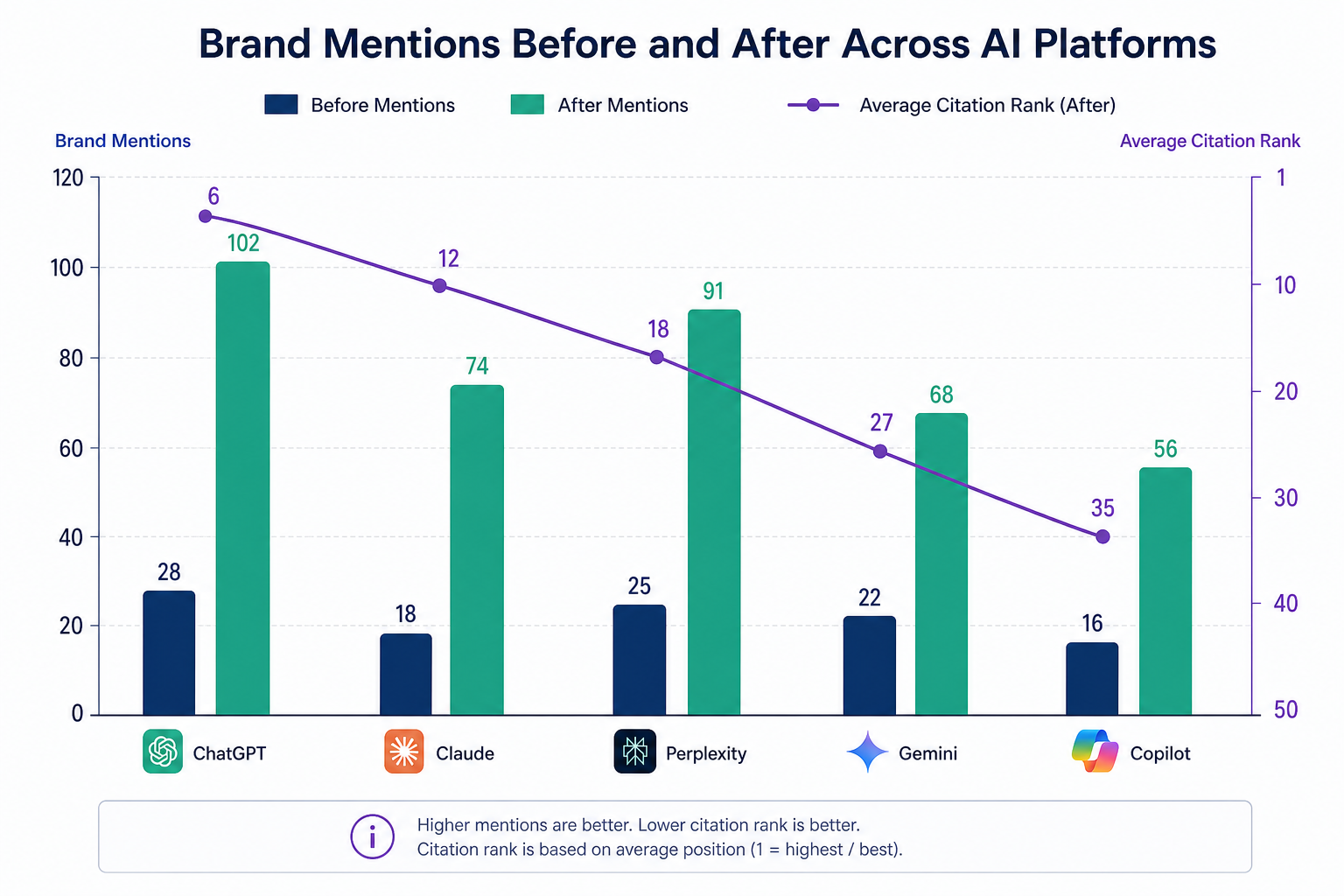
Measuring Citation Lift is the process of quantifying the increase in brand mentions, product recommendations, and authoritative citations within AI-generated responses over a specific period. Unlike traditional SEO, where we might track a single keyword position, Citation Lift measures 'Presence Frequency' and 'Confidence Scores'—indicators of how often and how reliably an AI model references your site as a primary source. This lesson provides a framework for attributing visibility gains to specific optimisations, ensuring you can demonstrate value to clients beyond standard organic traffic metrics.
The Anatomy of a Citation
Before we can measure lift, we must understand what constitutes a citation in the current AI landscape (GEO/AEO). A citation is rarely just a link; it is an endorsement of expertise.
- Direct Footnotes: Numbered links typically found in Perplexity or Google Search Generative Experience (SGE).
- In-text Hyperlinks: Contextual links embedded directly into the prose.
- Entity Association: When an AI mentions your brand name in a list of recommendations without a link, but identifies your brand as a leading entity in that category.
- Source Attribution: Explicit phrases such as "According to [Brand Name]..."
To measure lift effectively, you must track all four types, as they directly influence the user's perception of your brand as an authority.
Establishing a Measurement Framework
To measure Citation Lift, you cannot rely solely on the Google Search Console. You need a multi-faceted approach that combines manual auditing with automated tracking tools.
1. Defining the Baseline
Select a set of 50-100 'High-Intent' prompts relevant to your client's niche. Use a mix of:
- Informational: "How do I [Process]?"
- Commercial: "Best [Product] for [Use Case]?"
- Comparative: "[Brand A] vs [Brand B] for [Specific Need]."
Document the 'Share of Voice' (SoV) at the start of your campaign. If your brand is mentioned in 5 out of 100 responses, your baseline is 5%.
2. Isolating Variables
To attribute lift accurately, implement changes in batches. For example, focus on Schema Markup in Month 1 and Expert Source Interviews in Month 2. By staggered implementation, you can correlate spikes in citations with specific technical or content actions.
3. Measuring 'Density' and 'Rank'
Citation Lift isn't just about presence; it's about prominence. We use two internal metrics at SeenAndCited:
- Citation Order: Is the brand the 1st or 5th source cited? (Upper-tier citations have higher CTR).
- Sentiment Alignment: Is the AI citing you as a positive example or a warning? (e.g., "While [Brand] is popular, it lacks [Feature].")
Worked Example: The ‘SaaS Efficiency’ Campaign
The Client: A B2B Project Management Tool. The Goal: Increase citations for "Project management for remote engineering teams."
Baseline (Week 0):
- Brand Mentions: 2/20 tested prompts (10%).
- Citation Rank: Average position 4th.
- Primary Sources cited: Competitors and generic tech blogs.
The Action: The team implemented 'Expert Quote' blocks within five high-performing blog posts and updated the Article Schema to include reviewedBy properties linking to the LinkedIn profiles of the CTO and Head of Engineering.
The Result (Week 8):
- Brand Mentions: 9/20 tested prompts (45%).
- Citation Rank: Average position 1.8.
- Citation Lift: +350% in mention frequency.
Analysis: The AI began using the specific expert quotes as 'Direct Footnotes' because the structured data verified the source's authority, making the brand a more 'confident' choice for the model's output.
Technical Tracking Methods
Log File Analysis
While many AI bots (like GPTBot or CCBot) are used for training, others like 'PerplexityBot' or 'OAI-Search' are used for real-time retrieval. Monitor your server logs for these User-Agents. An increase in crawl frequency from RAG-based (Retrieval-Augmented Generation) bots often precedes a lift in citations, as it indicates the AI has updated its index with your latest content.
Referral Traffic Mapping
Use UTM parameters or specific segments in GA4 to isolate traffic coming from openai.com, perplexity.ai, and google.com (SGE referrals). If you see a rise in 'Direct' traffic alongside a rise in AI citations, it often indicates 'Dark AI Social'—where users copy/paste AI recommendations into their browsers.
The Reliability Metric: Confidence Scores
LLMs operate on probability. When measuring lift, ask the LLM (via API or playground): "On a scale of 1-10, how confident are you that [Brand] is a top choice for [Use Case]?" While not a public metric, tracking this 'internal' confidence via consistent prompting can show whether your E-E-A-T (Experience, Expertise, Authoritativeness, Trustworthiness) efforts are working. A lift from a 4/10 to an 8/10 confidence score is a massive win for long-term visibility.
Common Pitfalls in Measurement
- The Hallucination Trap: Measuring a citation that doesn't exist. Always verify that the link provided by the AI is functional and leads to your site.
- Volatility: AI responses change based on temperature settings and model updates. Always take multiple snapshots of the same prompt over 48 hours to find the 'Stable Citation Rate'.
- Echo Chambers: If you only test prompts that include your brand name, you aren't measuring lift; you are measuring brand recognition. Focus on 'Unbranded' prompts to see true GEO growth.
Putting It Into Practice
To begin measuring Citation Lift for your clients, follow these immediate steps:
- Identify 20 Core Prompts: Select the questions your target audience asks most frequently.
- Audit the Baseline: Record who is currently being cited for those 20 prompts and in what order.
- Implement One Change: Choose either Schema enhancement, technical speed (for faster RAG retrieval), or expert-led content updates.
- Re-Audit in 21 Days: AI models like Gemini and Perplexity refresh their retrieval indices more frequently than old LLM training sets. Three weeks is the 'sweet spot' for seeing initial lift.
- Calculate the Lift Percentage: (New Mentions - Old Mentions) / Old Mentions * 100. This is your primary KPI for reporting.