Attribution for AI-Driven Traffic

Master the frameworks for identifying, segmenting, and reporting traffic originating from AI assistants and generative search engines using UTM parameters and server logs.

12 min read
Foundations

Introduction to AI Attribution

As search evolves from a list of links into a synthesized dialogue, the traditional linear model of attribution is fracturing. When a user asks ChatGPT for a product recommendation or Perplexity for a technical guide, the resulting click-through to your website is no longer categorised under standard 'Organic Search' in legacy analytics platforms. To prove the ROI of AI Visibility optimisation, practitioners must move beyond passive observation and implement active tracking frameworks. This lesson focuses on the technical and strategic methodologies required to attribute traffic to AI-driven sources accurately.

The Breakdown of Traditional Attribution

Standard analytics packages like Google Analytics 4 (GA4) often bucket traffic from AI assistants into 'Direct' or 'Referral' with generic hostnames. This lack of granularity creates two major risks for the practitioner:

  1. Under-reporting the value of AI content strategies.
  2. Inability to distinguish between high-intent AI queries and casual direct visits.

To address this, we must look at three distinct layers of attribution: Referral Headers, UTM Link Injection, and Server-Side User Agent Analysis.

Identifying AI User Agents and Referrers

Not all AI interactions are invisible. Many major platforms send specific referrer strings that allow for immediate segmentation.

Known Referrer Strings

  • OpenAI (ChatGPT): chatgpt.com or chat.openai.com (though mobile apps often strip this to 'Direct').
  • Perplexity: perplexity.ai.
  • Google Gemini: Often integrated into Search Console data as part of Google Search, but standalone interactions may show as gemini.google.com.
  • Claude (Anthropic): Generally harder to track via referral, often appearing as Direct or Referral from claude.ai.

Using GA4 Custom Channel Groupings

To manage this, you should create a 'GenAI' or 'AI Assistant' Custom Channel Group in GA4. Define rules where the Source matches regex patterns like .*(openai|perplexity|bing|gemini|claude).*. This moves these sessions out of the catch-all 'Referral' bucket and into a dedicated category for reporting.

UTM Injection and the 'Citation Gap'

The 'Citation Gap' occurs when an AI engine uses your content to form an answer but fails to provide a clickable link, or the user ends their journey at the AI interface. While we cannot track the latter (zero-click) accurately without third-party visibility tools, we can control how our links appear when they are cited.

Strategic UTM Implementation

When providing data to AI engines—via sitemaps, API feeds, or schema-rich pages—ensure that your canonical links are clean, but monitor the specific landing pages AI engines prefer. If an AI engine crawls a page and presents a link, it will typically use the URL found in the og:url or canonical tag.

Pro Tip: For specific 'AI-targeted' landing pages or data feeds, consider appending utm_medium=ai_citation. While search engines like Google might ignore this for ranking, AI synthesizers often preserve the full string when citing sources in footnote links.

The Role of Search Console in AI Attribution

Google Search Console (GSC) remains the primary source for identifying impressions from 'AI Overviews' (AIO). Currently, Google does not provide a specific filter for AIO traffic within GSC; it is aggregated with standard Web Search results. However, we can use 'Position' and 'CTR' anomalies to infer AIO presence.

  • AIO Indicators: High impressions but lower-than-average CTR for a top-3 position often indicates that the user's intent was satisfied by the AI summary, and only a minority clicked through to your site.
  • Branded vs. Non-Branded: AI assistants are highly proficient at responding to 'Best [Product]' queries. A sudden spike in traffic for long-tail, conversational keywords is a primary indicator of AI-driven referral success.

Worked Example: Attributing a Perplexity Lead

Let’s look at a hypothetical scenario for a B2B SaaS client.

  1. The Query: A user asks Perplexity, "What is the most secure project management tool for UK law firms?"
  2. The Source: Perplexity crawls several review sites and the client's 'Security Compliance' page.
  3. The Click: The user clicks the [3] citation in the Perplexity response.
  4. Tracking: Your GA4 shows a session with source perplexity.ai and medium referral.
  5. Goal Tracking: The user spends 4 minutes on the site and downloads a PDF whitepaper.
  6. Analysis: By looking at the 'Landing Page' report filtered for the perplexity.ai source, you identify that your technical documentation—not your sales pages—is the primary entry point for AI users.

Action: You decide to add a specific CTA (Call to Action) targeted at AI-referred users on your documentation pages, increasing the conversion rate from these technical visits by 15%.

Server Log Analysis: The 'Hidden' AI Traffic

When AI bots crawl your site (like GPTBot or OAI-SearchBot), they don't always trigger a JavaScript-based analytics tag. To understand how often AI engines are 'learning' from your site, you must inspect your server logs.

  • Identify Crawl Frequency: Are AI bots visiting your key commercial pages weekly or monthly? High crawl frequency often precedes a boost in AI visibility.
  • Identify Content Gaps: If bots are hitting 404 pages, it suggests the AI engine is trying to find structured data that is no longer there, potentially leading to 'hallucinations' about your brand.

Putting it into Practice

To move from passive to active attribution, follow this implementation checklist:

  1. Configure GA4 Filters: Set up a Custom Channel Group named 'AI Search' using the regex (openai|perplexity|bing|gemini|anthropic) in the Source field.
  2. Monitor GSC Patterns: Create a spreadsheet tracking CTR for your top 20 high-value keywords. Look for 'compression'—where position remains stable but CTR drops—suggesting an AI Overview is dominant.
  3. Analyse Referrer Strings: Once a month, export your 'Referrer' report and search for 'ai', 'chat', or 'bot'. You will often find niche AI assistants that are growing in popularity within specific industries.
  4. Landing Page Optimization: Identify the top 5 pages receiving AI traffic. Ensure these pages have 'quick-conversion' elements (newsletter signups or lead magnets) near the top of the page, as AI-referred users often seek specific, fast answers.
  5. Audit the Citation Path: Use a tool like Perplexity yourself to ask questions about your brand. Click the links they provide. Observe the landing experience. Is the information congruent with what the AI stated?

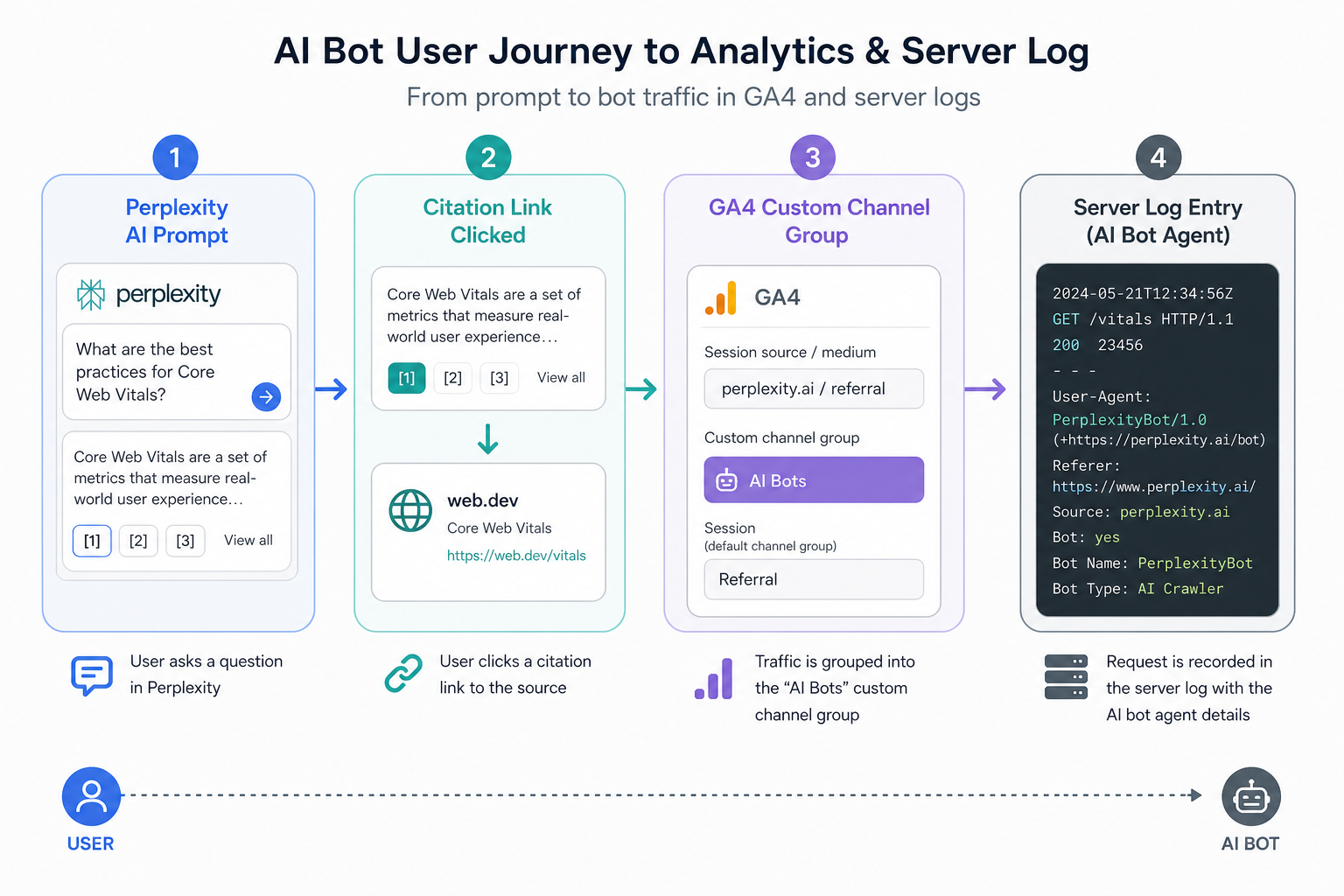
Visual diagram

[ diagram placeholder ]

A flowchart showing a user journey from an AI prompt in Perplexity, through the citation link, into a GA4 custom channel group, and ending in a server log entry for a specific AI bot agent.

Exercise

In your Google Analytics 4 account, go to 'Reports' > 'Acquisition' > 'Traffic Acquisition'. Filter the search bar for 'perplexity' or 'openai'. Identify the top landing page for this traffic and suggest one content improvement to increase the conversion rate for these specific visitors.

Key takeaways

  • Traditional attribution buckets AI traffic into 'Direct' or generic 'Referral', obscuring its true value.
  • Custom Channel Grouping in GA4 is essential for isolating GenAI-specific traffic sources.
  • Known referrer strings like chatgpt.com and perplexity.ai can be targeted via regex filters.
  • AI Overviews in Google Search Console are currently merged with standard web search data.
  • High impressions with low CTR on top-ranked keywords often indicate an AI-generated summary is present.
  • UTM parameters should be tested in canonical or Open Graph tags to see if AI assistants pass them through.
  • Server logs provide insights into AI bot crawling patterns that JavaScript analytics cannot see.
  • AI-referred users are often high-intent but seek specific, technical answers rather than broad sales pitches.
  • The 'Citation Gap' refers to the loss of traffic when an AI engine satisfies a user query without a click.
  • Regular audits of brand queries in AI assistants are necessary to verify the accuracy of the landing pages being cited.

Lesson Quiz

Pass at 70%.

1. Which GA4 feature is most effective for separating AI-driven traffic from general site referrals?
2. If a keyword has a high impression count in GSC but a lower than expected CTR for position 2, what does this likely indicate?
3. Which of the following is a known referrer for ChatGPT?
4. Why would you check server logs to measure AI visibility?
5. What is the 'Citation Gap' in AI Visibility?
6. When defining a regex for AI traffic in GA4, which pattern would capture both Perplexity and OpenAI?
7. Which of these is a strategic way to encourage UTM tracking in AI citations?
8. What is the limitation of Google Search Console regarding Gemini (AI Overview) data?
9. Which type of content is most likely to be cited by AI assistants for B2B queries?
10. If you notice high traffic from 'Direct' after an AI brand mention, what is a likely cause?
Create a free account to save progress and earn a certificate.