Mapping Existing Authority Signals

Learn to audit and categorise a brand's authority footprint across search, social, and knowledge graphs to identify gaps in AI engine trust and attribution.

12 min read
Foundations

Introduction to Authority Mapping

In the realm of AI Visibility and Generative Engine Optimisation (GEO), authority is no longer just about backlinks or PageRank. AI models—including Large Language Models (LLMs) like Claude, GPT-4, and Gemini—derive their 'understanding' of a brand's authority from a massive corpus of diverse data signals. To improve a client's visibility, you must first inventory their existing authority footprint. This process, Mapping Existing Authority Signals, involves systematically identifying and categorising every digital trace that reinforces a brand’s legitimacy, expertise, and trustworthiness.

Mapping these signals allows us to see the brand through the lens of an AI training set. We aren't just looking for SEO metrics; we are looking for evidence of citation, professional association, and recurring mentions in high-quality contexts.

The Three Dimensions of Authority Signals

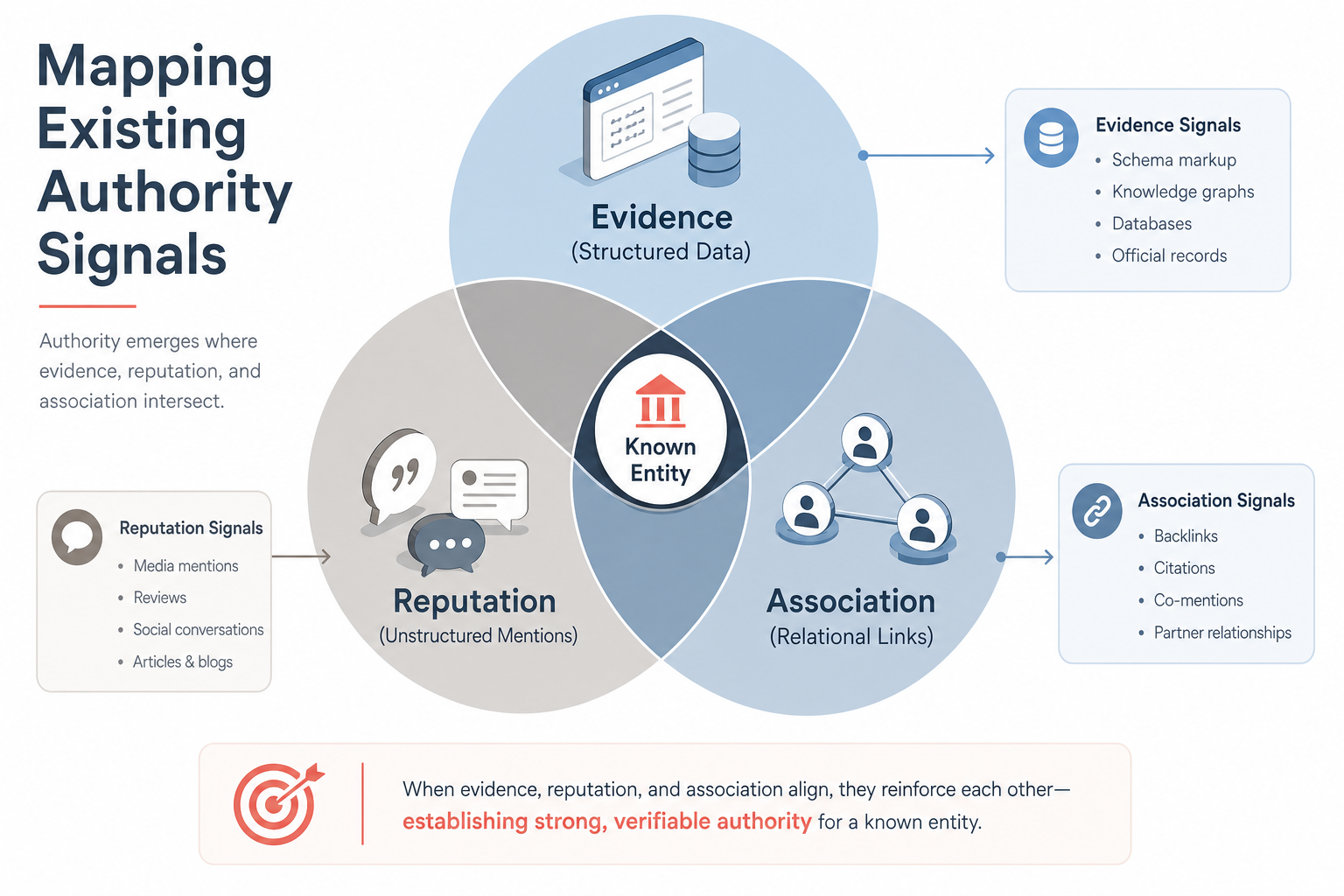
When conducting an authority mapping exercise, we categorise signals into three distinct buckets: Structured, Unstructured, and Relational.

1. Structured Signals (The Knowledge Graph)

Structured signals are the easiest for AI to digest. They consist of data formatted in a way that machines can parse without ambiguity.

  • Schema Mark-up: Does the site use Organization, Person, Product, or FAQ schema correctly?
  • Wikidata and Wikipedia: Is there an existing entry or a mention in a reliable secondary source that could justify an entry?
  • Google Knowledge Panel: What facts does Google already 'know' and display as certainty?
  • Professional Registries: For UK brands, this includes Companies House, FCA registers, or industry-specific bodies like the Law Society or GMC.

2. Unstructured Signals (Contextual Mentions)

These are the references to your brand found in prose across the web. LLMs excel at extracting meaning from these.

  • Earned Media: Coverage in reputable news outlets (The Guardian, FT, industry journals).
  • Academic Citations: Mentions in white papers, Google Scholar, or educational (.ac.uk) domains.
  • Expert Quotes: Instances where brand representatives are quoted as subject matter experts (SMEs).
  • Discussion Forums: How the brand is discussed on Reddit, Quora, and niche technical forums.

3. Relational Signals (Entity Association)

Authorty is often defined by the 'company you keep'. Relational mapping identifies which high-authority entities the brand is consistently associated with.

  • Partnerships: Official collaborations with established market leaders.
  • Co-occurrence: How often the brand name appears in the same paragraph as its primary category keywords (e.g., 'Cloud Security' + 'Brand X').
  • Social Proof: Endorsements from verified influencers or recognised industry veterans.

Step-by-Step: The Authority Inventory Process

To map these signals effectively, follow this four-step methodology.

Step 1: Entity Name Normalisation

Before searching, list all variations of the brand name, parent companies, and key personnel (CEOs, Founders). AI models often struggle with 'aliasing'—recognising that 'Acme Corp' and 'Acme International' are the same entity. Mapping these variants ensures your audit is comprehensive.

Step 2: The Digital Footprint Audit

Use advanced search operators (Dorks) to find mentions that don't necessarily link back to the site. Links are 'nice to have', but for AI visibility, an unlinked citation on a high-authority site is nearly as valuable.

  • "Brand Name" -site:brandwebsite.com (Finds external mentions)
  • "Expert Name" + "Brand Name" (Finds authority association)
  • intext:"Top 10 [Category]" (Finds inclusion in listicles)

Step 3: Knowledge Base Verification

Search for the brand on Wikidata and OpenCorporates. Check if the brand appears in the Perplexity or Google Gemini 'Sources' for a given category query. If the AI is already citing the brand, note the specific URL it uses as its 'truth' source.

Step 4: Sentiment and Tone Analysis

Mapping authority isn't just about quantity; it's about the 'nature' of the authority. Is the brand cited as a 'disruptor', a 'reliable incumbent', or a 'cautionary tale'? Note the prevailing descriptors used by third-party sources.

Worked Example: mapping a Mid-sized SaaS Firm

Client: 'Securify-IT', a UK-based cybersecurity firm specialising in ISO 27001 compliance.

1. Structured Signals Found:

  • Valid Organization and Service schema on their homepage.
  • A Companies House entry under 'Securify-IT Limited'.
  • No Wikipedia page, but a founder has a profile on an industry-recognised 'Top 40 Under 40' site.

2. Unstructured Signals Found:

  • Mentioned in a TechCrunch article from 2022 about UK startups.
  • Quote from the CTO in a ComputerWeekly feature on data privacy.
  • Several threads on Reddit's /r/cybersecurity complaining about their previous pricing model (a negative authority signal).

3. Relational Signals Found:

  • Listed as a 'Silver Partner' on the Microsoft Azure Marketplace.
  • Consistently mentioned alongside competitors like Vanta and Drata in comparison blogs.

Inventory Result: The brand has strong 'Expertise' (CTO quotes) but weak 'Trust' (Reddit complaints) and 'Prominence' (No Knowledge Panel). The strategy should focus on resolving sentiment and securing more tier-one press mentions.

Challenges in Mapping Authority

A primary challenge is Attribution Decay. This happens when a brand is mentioned but not clearly identified as the source of a specific insight. During your mapping, flag any 'ghost mentions'—content that discusses the brand's unique research or products without explicitly naming them. These represent lost authority that can be reclaimed through better PR or content formatting.

Another challenge is Conficting Signals. If a defunct LinkedIn page says the brand has 50 employees but the website says 500, AI models may flag this inconsistency, lowering the 'Trust' score. Your map must highlight these discrepancies for correction.

Putting it into Practice

To apply this in a client engagement, follow these immediate actions:

  1. Create an Authority Spreadsheet: Columns should include Source Name, URL, Category (Structured/Unstructured/Relational), Authority Tier (1-3), and Key Entity Mentioned.
  2. Audit the 'About Us' Page: Ensure every claim (e.g., "Founded in 2010") is evidenced by an external third-party source identified in your map.
  3. Map the People: Don't just map the brand. Map the digital footprints of the C-suite. Their individual authority often 'bleeds' into the brand's entity in the eyes of LLMs.
  4. Identify the Gap: Once the map is complete, identify which pillar is weakest. If you have no structured data, your first task is technical. If you have no external mentions, your task is PR-led.

Visual diagram

[ diagram placeholder ]

A Venn diagram showing the overlap between Evidence (Structured Data), Reputation (Unstructured Mentions), and Association (Relational Links), with 'Known Entity' at the center.

Exercise

Select a client or a brand you use. Use the search operator '"Brand Name" -site:brandwebsite.com' to find the top 5 external mentions. Categorise each as Structured, Unstructured, or Relational, and note if the mention is positive, neutral, or negative.

Key takeaways

  • Authority in AI visibility goes beyond traditional backlinks to encompass all digital mentions.
  • Signals are categorised into Structured, Unstructured, and Relational types.
  • Entity Name Normalisation is a critical first step to avoid missing unlinked brand mentions.
  • Structured signals include Schema.org mark-up and entries in public registries like Companies House.
  • Unstructured signals consist of earned media, academic citations, and expert quotes.
  • Relational signals focus on the types of entities and topics the brand is frequently associated with.
  • LLMs use 'aliasing' to connect different versions of a brand name into a single entity profile.
  • Sentiment analysis of authority mentions is vital for identifying trust-related visibility issues.
  • The authority of key personnel (CEOs/Founders) directly informs the brand's overall entity strength.
  • Mapping reveals 'Attribution Decay' where brand insights are shared without proper attribution.

Lesson Quiz

Pass at 70%.

1. What is 'Entity Name Normalisation' in the context of authority mapping?
2. Which of these is considered a 'Structured Signal'?
3. Why are 'Unstructured Signals' important for LLMs?
4. What is 'Attribution Decay'?
5. How does mapping 'Relational Signals' help building AI visibility?
6. Which tool or source is most relevant for auditing 'Prominence' in the UK?
7. What should an authority map highlight regarding the brand's C-suite?
8. When finding negative sentiment during an audit, what is the practitioner's role?
9. A brand has many mentions but no Knowledge Panel. What does this indicate?
10. What is the primary goal of the 'Authority Spreadsheet' created in this lesson?
Create a free account to save progress and earn a certificate.