Identifying Authority Gaps

Master the methodology for auditing brand authority across Large Language Models by identifying thematic and reputational gaps compared to market leaders.

12 min read
Foundations

Introduction

In the context of AI Visibility, authority is not merely an assessment of backlinks or domain rating. It is a measure of how Large Language Models (LLMs) perceive a brand’s expertise, reliability, and influence within a specific knowledge domain. An 'Authority Gap' occurs when a brand is objectively capable or expert in a subject, yet generative engines either ignore the brand, attribute its expertise to a competitor, or fail to mention it in high-intent conversational queries.

Identifying these gaps requires a shift from traditional keyword-based rank tracking to entity-based relationship mapping. This lesson explores the tools and logic required to benchmark your brand against peers, pinpointing exactly where your digital footprint fails to satisfy the 'Confidence Score' thresholds required for AI citation.

The Three Pillars of Authority Gaps

To identify where your brand lags, you must audit against three primary dimensions of authority within AI ecosystems:

  1. Topical Overlap Gap: Does the LLM associate your brand with the same core sub-topics as the market leader?
  2. Citation Velocity & Recency Gap: Is your brand mentioned in recent, high-authority datasets (news, research, forums) at the same rate as competitors?
  3. Entity Association Gap: When the AI links a solution to a problem, which brands are 'co-located' in its latent space? If Company A and Company B are always mentioned together but Company C is absent, Company C has an association gap.

Step 1: Defining the Competitive Entity Set

Before searching for gaps, you must define who the AI considers your peers. Note that these may differ from your traditional business competitors. In AI visibility, a peer might be a news site or a non-profit that dominates the information space for your keywords.

Action: Use a prompt like "Which organisations are the primary authorities on [Your Niche] as of 2024?" to identify the AI's internal leaderboard for your sector.

Step 2: The Multi-LLM Benchmarking Process

LLMs are trained on different data slices. A brand might have high authority in OpenAI’s GPT-4o but lag in Google Gemini or Perplexity. Conduct a cross-engine audit using a consistent set of prompts:

  • Informational: "Explain the current state of [Topic]."
  • Commercial: "Which companies provide the most reliable [Service]?"
  • Comparative: "Compare [Competitor A] and [Competitor B] for [Use Case]."

Document the 'Probability of Citation'. If you appear in 1/10 queries while a peer appears in 8/10, your gap is quantified at 70%.

Step 3: Identifying Sub-Topic Blind Spots

Often, a brand is recognised for its primary product but ignored for high-value sub-topics.

Worked Example: 'GreenCloud' SaaS

  • Scenario: GreenCloud is an industry leader in cloud security but wants to move into AI-governance.
  • The Audit: Using Perplexity, the consultant finds that when asking about 'Cloud Security Audits', GreenCloud is cited 90% of the time. When asking about 'AI Ethics Frameworks', GreenCloud is cited 0% of the time, while competitors like Microsoft and Anthropic dominate.
  • The Gap: The authority gap is focused specifically on the 'Ethics' and 'Governance' sub-entities. GreenCloud lacks historical data presence in the training sets for these specific terms.

Step 4: Analysing Sentiment and Attribution Depth

It is possible to be mentioned frequently but lack 'Depth of Authority'. If a competitor is cited with specific data points (e.g., "According to Company X's 2023 report...") while your brand is merely listed in a bulleted list of providers, you have an attribution depth gap. This suggests that while the AI knows you exist, it does not trust your first-party data enough to quote it specifically.

Step 5: Mapping the 'Source Feed' Gap

LLMs rely on a hierarchy of sources. If your competitors are frequently featured in The Financial Times, Scientific American, or high-traffic GitHub repositories, and your brand is confined to its own blog, the AI perceives a validation gap. You must identify which 'Seed Sites' the LLM uses as ground truth for your industry and check your presence within them.

Putting it into Practice

To identify and close your authority gaps, follow this workflow:

  1. Extract the Entity List: List the top 5 brands cited for your 10 most valuable industry queries.
  2. Calculate the Citation Share: Run 50 prompts across three LLMs. Record how many times your brand is cited vs. the top performer.
  3. Thematic Analysis: Use a spreadsheet to categorise prompts where you are absent. Are you missing from 'How-to' queries or 'Best of' queries?
  4. Audit Source Citations: When competitors are cited, look at the footnote or source link. Is it coming from a Wikipedia page, a specific news outlet, or a Reddit thread? Map these sources as your 'Target Influence List'.
  5. Gap Prioritisation: Focus first on the 'Association Gaps' where you are missing from comparison queries featuring your direct competitors. This is high-intent traffic you are losing in real-time.

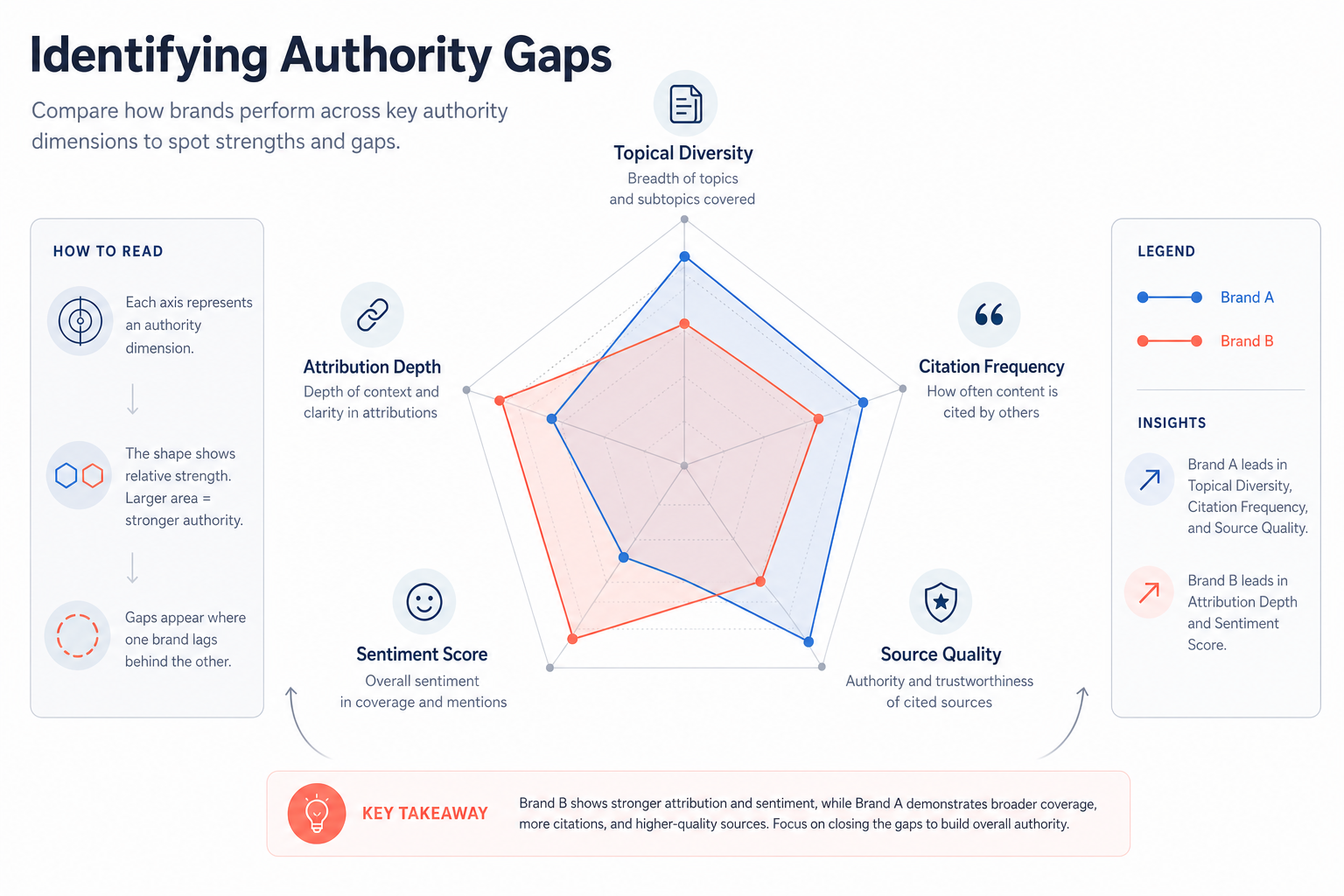
Visual diagram

[ diagram placeholder ]

A radar chart comparing two brands across five dimensions: Topical Diversity, Citation Frequency, Source Quality, Sentiment Score, and Attribution Depth.

Exercise

Select a niche you work in and prompt Perplexity or Gemini with 'What are the top 5 most innovative companies in [Niche] in 2024?'. If your brand (or client) is missing, ask the LLM 'Why is [Your Brand] not included in this list?'. Document the reasons provided as your primary authority gaps.

Key takeaways

  • Authority in AI environments is an assessment of an entity's proximity to a topic within a latent space.
  • Authority gaps are often sub-topic specific; a brand can be an authority in one area and a ghost in another.
  • The competitive set for AI visibility includes any entity the LLM cites, not just direct business competitors.
  • Probability of Citation is a key metric for quantifying authority gaps.
  • AI models may have different authority rankings based on their specific training data and fine-tuning.
  • A brand's presence in 'Seed Sites' (high-authority domains) directly influences its AI perceived authority.
  • Attribution depth refers to whether an AI quotes your specific data or just mentions your name.
  • Association gaps occur when you are excluded from queries that group your competitors together.
  • Solving an authority gap requires getting mentioned by the third-party sources the LLM already trusts.
  • Regular benchmarking across multiple models is necessary to catch shifts in model perception after updates.

Lesson Quiz

Pass at 70%.

1. What is an 'Authority Gap' in the context of AI Visibility?
2. Why might a brand's AI competitors differ from its business competitors?
3. What metric is used to quantify the frequency of being mentioned across a set of prompts?
4. Which gap type is present if a brand is ignored in queries comparing multiple competitors?
5. What does 'Attribution Depth' signify?
6. Which of these is a concrete step to identify sub-topic blind spots?
7. If an LLM cites a competitor's research paper, what kind of gap does this highlight?
8. Why should you audit authority gaps across multiple different LLMs?
9. When an AI lists a source in a footnote, what should an AI Visibility Practitioner do?
10. What is the primary goal of the 'Putting it into Practice' section in this lesson?
Create a free account to save progress and earn a certificate.