Building Authority Acquisition Plans

Learn how to architect data-led authority acquisition plans that target LLM training sets, high-clout citations, and partnership networks to close visibility gaps in AI-generated answers.

12 min read
Foundations

Introduction

Transitioning from traditional SEO link building to AI-centric authority acquisition requires a shift in mindset. In the world of Generative Engine Optimization (GEO), a backlink is no longer just a vote of confidence for PageRank; it is a signal of factual reliability and contextual relevance for Large Language Models (LLMs). This lesson focuses on constructing a strategic Authority Acquisition Plan (AAP) designed to bridge the gap between your current digital footprint and the 'ideal' profile required to trigger citations in AI models like Perplexity, ChatGPT (SearchGPT), and Google Gemini.

The Shift: From Domain Authority to Citation Clout

Traditional outreach often prioritises Domain Authority (DA) or Domain Rating (DR). While these metrics correlate with visibility, AI agents prioritise 'Fact-Checking Significance' and 'Thematic Hubs'. Building authority for AI visibility means securing mentions in the sources that LLMs specifically weight within their RAG (Retrieval-Augmented Generation) pipelines. These include industry-leading wikis, primary research databases, high-authority news outlets, and niche-specific documentation sites.

Identifying the Gap

Before launching an outreach campaign, you must perform a 'Citation Gap Analysis'.

  1. Select Seed Queries: Identify 20-50 'Head' and 'Long-tail' queries where your brand is currently absent from AI responses.
  2. Audit the Citations: Use tools to extract the sources being cited for these queries. Which competitors or third-party publishers are appearing consistently?
  3. Map the Sources: Categorise these sources into 'Primary' (News, Wiki, Academic), 'Secondary' (Industry blogs, Review sites), and 'Tertiary' (Social proof, Forums).

Strategising Outreach Targets

Your acquisition plan should be tiered to address different layers of the AI's knowledge retrieval system.

1. The Knowledge Layer (Non-Negotiables)

To get into the base training data or high-level RAG retrieval, you need presence on high-consensus platforms:

  • Wikipedia & Wikidata: Still the gold standard for factual grounding. While difficult to edit, focusing on providing primary data that editors can use is key.
  • Niche-Specific Wikis: For technical sectors (e.g., Fandom for entertainment, GitHub for dev tools), these are primary scrapers for LLMs.
  • Industry Directories: Trusted associations (e.g., The Law Society, RIBA) carry immense weight in verifying a brand's existence and authority.

2. The Current Affairs Layer (The Recency Signal)

Generative engines with internet access (like Perplexity) prioritise recent, reputable news.

  • Targeting 'Source Sites': Aim for outlets that are frequently indexed in Google News and have a high 'Freshness' score. A mention in a Reuters or Bloomberg article is worth more than a hundred guest posts on low-traffic blogs because LLMs treat news wires as 'Ground Truth'.

3. The Peer Analysis Layer (The Contextual Signal)

AI agents look for consensus. If five different independent review sites list 'Brand X' as the best tool for project management, the LLM will synthesise this into its answer.

  • Partnership Outreach: Instead of just links, seek 'Co-occurrence' mentions. Your brand name should appear in the same paragraph as your primary keywords and competitors on trusted third-party sites.

Developing the Content Hook

AI models cannot be 'fooled' by low-quality content; they are built to summarise. To acquire authority, your outreach assets must be 'Summarisability Pro'.

  • Proprietary Data: Conduct a survey or study. Provide a 'Key Findings' section. LLMs love structured data and statistics.
  • The 'Whitepaper' Strategy: Host deeply technical PDFs. Modern AI engines can parse these files and directly cite them as an authoritative source for complex technical queries.
  • Frameworks and Naming: Create a unique framework (e.g., 'The 4-Step Visibility Matrix'). If other sites adopt your terminology, you become the definitive source for that concept.

Worked Example: A B2B SaaS Authority Plan

Scenario: A mid-sized CRM provider, 'ClientPipe', wants to appear in 'Best CRM for Small Businesses' AI responses.

  1. Gap Analysis: Analysis shows Perplexity cites Forbes Advisor, PCMag, and three specific Reddit threads.
  2. The Play:
    • Phase 1 (Validation): Secure a partnership with a small business trade association to be listed in their vetted member directory.
    • Phase 2 (Consensus): Launch a Digital PR campaign titled 'The State of Small Business Sales 2024' featuring original data. Target journalists at Forbes and PCMag with a summary of the data.
    • Phase 3 (Community): Engage in relevant Reddit communities (r/smallbusiness), not with spam, but by providing helpful answers that link to the original research on ClientPipe’s site.
  3. Result: The LLM now sees a validated entity, cited by news giants, supported by community sentiment.

Putting it into Practice

To build your plan, follow these steps:

  1. Audit current visibility: Use a tool (or manual prompts) to see who is cited for your top 5 target keywords.
  2. Identify 5 'Authority Hubs': These are sites appearing in every AI response for your niche.
  3. Create a 'Data Asset': Produce one piece of original research, a calculator, or a framework that these hubs would find valuable.
  4. Execute Tiered Outreach: Prioritise the high-consensus sites first to establish the 'truth' of your brand, followed by broader PR for reach.
  5. Monitor 'Authoritative Citations': Track not just links, but how many AI prompts now include your brand name in their output.

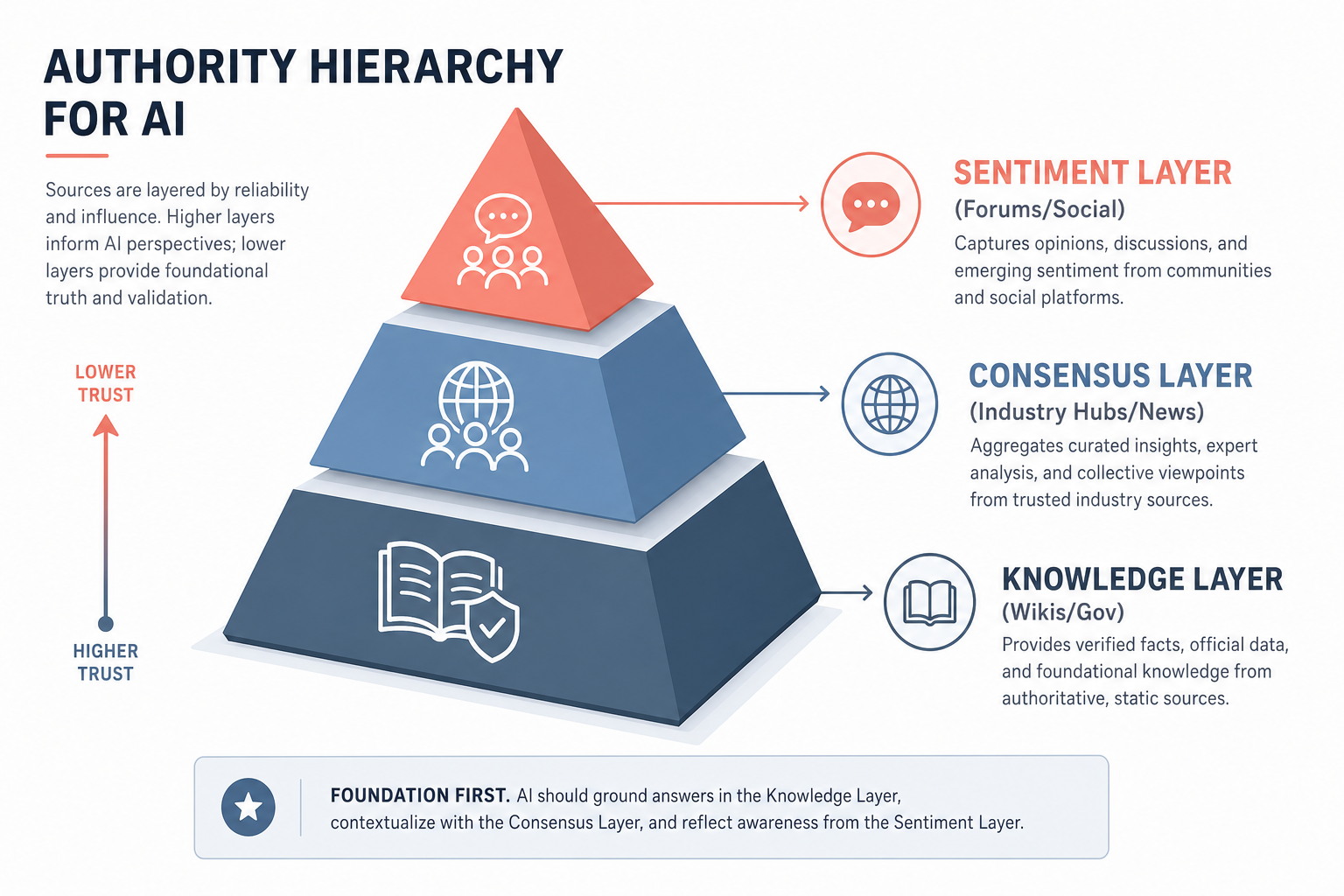
Visual diagram

[ diagram placeholder ]

A pyramid diagram showing the 'Authority Hierarchy for AI' with 'Knowledge Layer (Wikis/Gov)' at the base, 'Consensus Layer (Industry Hubs/News)' in the middle, and 'Sentiment Layer (Forums/Social)' at the top.

Exercise

Take your primary target keyword and enter it into Perplexity and Gemini. List the first three unique websites cited by each. Compare these lists to find overlapping 'Authority Hubs' and write a 100-word pitch for a data-driven guest post or mention on the top overlapping site.

Key takeaways

  • AI authority is about 'Fact-Checking Significance' rather than just PageRank or link quantity.
  • A Citation Gap Analysis is essential to identify which sources the LLMs currently trust for your keywords.
  • Knowledge Layer targets like Wikidata and industry associations provide the base 'Ground Truth' for models.
  • Freshness matters; Perplexity and SearchGPT prioritise recent mentions in high-authority news outlets.
  • Consensus is key: AI models look for multiple independent sources saying the same thing about your brand.
  • Proprietary data and original research are the most effective 'hooks' for AI-centric outreach.
  • Summarisability is a content requirement; use structures that are easy for LLMs to parse and cite.
  • Co-occurrence (mentions near keywords) is as important as the hyperlink itself for AI context.
  • Niche-specific wikis and technical documentation are high-priority targets for B2B and technical sectors.
  • Shift your reporting from 'Link Count' to 'AI Citation Frequency' to measure success accurately.

Lesson Quiz

Pass at 70%.

1. In the context of AI visibility, what is a 'Citation Gap'?
2. Which type of site is considered part of the 'Knowledge Layer' for LLM grounding?
3. Why is 'co-occurrence' important for AI Authority Acquisition?
4. What makes a piece of content 'Summarisability Pro'?
5. Which engine primarily focuses on 'Freshness' and recent news in its citations?
6. How does 'Consensus' impact AI-generated responses?
7. What is the primary benefit of hosting a 'Technical Whitepaper' for AI visibility?
8. When moving from traditional SEO to AI Authority, what metric should be deprioritised?
9. What is an 'Authority Hub' in this context?
10. A brand appears in Reddit threads but not in news articles. Which layer of authority is missing?
Create a free account to save progress and earn a certificate.