Introduction
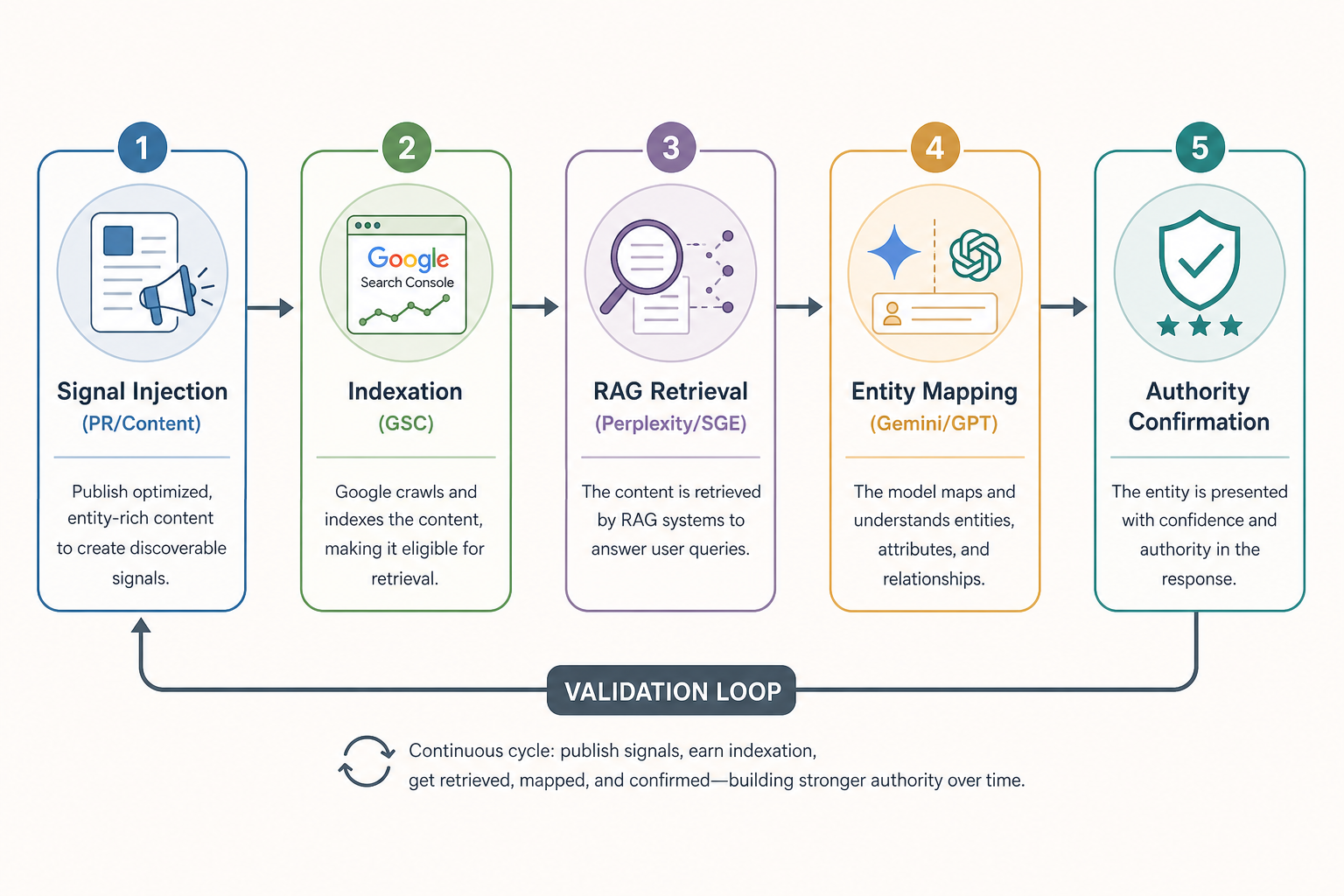
Validation is the pivot point where speculative SEO/AEO strategy meets measurable performance. In the context of AI Visibility, Authority Analysis isn't merely about checking a backlink profile; it is about confirming that generative engines like Perplexity, Gemini, and SearchGPT have registered your entity as a credible source for specific knowledge domains. Because these systems rely on a 'Knowledge Graph' rather than just a linear index, validation requires a multi-faceted approach to track how signals move from external publication to model inclusion. This lesson provides the technical steps to verify that your authority-building efforts—such as expert citations, high-quality whitepapers, and brand mentions—are being processed and surfaced by AI engines.
The Lag Time of LLM Updating
Before measuring success, you must understand the update cycles of different AI surfaces. Unlike traditional Google Search, which can update rankings in minutes, AI visibility often operates on three distinct timelines:
- RAG-Immediate Surfaces (Real-time): Tools like Perplexity or Google’s Search Generative Experience (SGE) use Retrieval-Augmented Generation. They fetch live web data. Validation here can happen within 24–48 hours of content indexation.
- Model Fine-tuning (Mid-term): Proprietary models may undergo incremental fine-tuning. Signals here might take weeks to influence the model’s internal weights regarding your brand’s authority.
- Core Foundation Updates (Long-term): Major model releases (e.g., GPT-4 to GPT-5). Your long-term authority building aims to ensure your data is part of the 'training set' for the next generation of models.
For most practitioners, validation focuses on RAG-Immediate Surfaces, as these are the primary drivers of current AI-led traffic.
Step 1: Tracking Citation Attribution
The most direct validation of authority is the 'Citation Rate.' In AI engines, being mentioned is secondary to being cited as the source of a claim. Use the following methodology to validate:
- Specific Inquiry Testing: Query the AI with a complex question your newly published authority content answers. Example: 'What are the emerging regulatory risks for ESG reporting in the UK for 2025?'
- Source Counting: In the response, check if your domain appears in the footnotes or 'Sources' panel.
- Attribution Value: Does the AI credit your brand for a unique data point (e.g., 'According to [Brand Name]...') or merely list you as one of many secondary links?
Step 2: Semantic Connectivity Mapping
You need to validate that the AI has 'grouped' your brand with the correct industry authorities. This is known as checking your 'Vector Neighbourhood.'
- The 'Who Else' Test: Ask the AI, 'Who are the leading experts in [X niche]?' or 'Which companies are pioneers in [Y technology]?'
- Validation Metric: If your brand appears alongside established incumbent authorities, the AI has successfully mapped your new signals into the correct semantic cluster.
- Gap Analysis: If you are missing, look at the sources the AI does mention. Are they citing your competitors' whitepapers or news mentions? Use this to pivot your next authority push.
Step 3: Verified Entity Status in Navigational Queries
A key authority signal is how an AI responds to brand-direct queries. Perform a 'Brand Health Check' on AI surfaces:
- Direct Search: 'Who is [Client Name]?'
- Authority Validation: Look for the inclusion of 'Evidence of Experience.' Does the summary mention the specific awards, certifications, or high-authority collaborations you recently promoted?
- Knowledge Panel Accuracy: For Gemini/SGE, verify if the AI is pulling data from updated sources like LinkedIn, Crunchbase, or your newly implemented Schema.org markup.
Worked Example: Validating a FinTech Client’s Authority
Scenario: A mid-sized FinTech firm published an 'Annual Payment Security Report' to establish authority in cybersecurity. They secured three guest posts on Tier-1 financial news sites and updated their local entity Schema.
Validation Process:
- Week 1 (Technical Check): Verified that the report URL was indexed using Google Search Console. Checked that the news sites used 'dofollow' or 'mention-only' links.
- Week 2 (AEO Surface Check): Quoted a specific statistic from the report into Perplexity: 'What percentage of cross-border payments were flagged for fraud in 2024?'
- Observation: Perplexity answered correctly but cited a competitor.
- Optimization: The team updated the report’s OpenGraph tags and created a dedicated 'Data & Statistics' summary at the top of the page for easier LLM parsing.
- Week 3 (Re-Validation): The same query now returned the client as the primary citation. When asked 'Who provides the best data on payment fraud?', the client’s name appeared in the top 3 results.
Measuring 'Sentimental Authority'
Validation isn't just about presence; it's about the sentiment of the authority. Use the following prompt to validate how the AI perceives your brand's standing:
- "Compare the authority and reliability of [Client Name] vs [Competitor A] and [Competitor B] in the field of [Niche]. Provide evidence for your assessment."
If the AI highlights your 'Recent whitepapers' or 'Expert leadership,' your signals have been validated. If it describes your brand as 'Less established' or 'Emerging,' the signals are likely scattered or lack sufficient secondary-source corroboration (mentions on 3rd party sites).
Technical Validation via API (For Advanced Practitioners)
If you are managing large enterprise accounts, manual querying isn't enough. You can validate authority at scale using the OpenAI or Claude API:
- System Prompt: 'You are an objective auditor of industry authority.'
- User Prompt: Provide a list of 50 industry keywords and ask the model to list the top 5 authoritative sources for each.
- Data Analysis: Calculate your brand's 'Share of Model Voice' (SoMV). If your SoMV increases over a 3-month period, your authority improvements are valid.
Putting it into Practice
- Baseline First: Before starting an authority campaign, record your brand's presence in 10 core industry queries on Claude and Perplexity.
- Signal Deployment: Execute your PR, guest posting, and Schema updates.
- Verification Cycle: Schedule a 'Visibility Audit' every 14 days following the first signal deployment.
- The Footnote Test: Aim for a 20% increase in citation frequency in RAG-driven answers within the first 60 days.
- Documentation: Keep a 'Citation Log' of which specific assets (e.g., a specific blog post or a specific press release) the AI is choosing to cite most often. This informs which types of authority signals are most effective for your specific niche.