What Counts as Authority for AI

Explore how AI models define and measure authority beyond domain ratings, focusing on mentions, reviews, structured data, and the concept of 'entity trust' in modern search.

15 min read
Foundations

Introduction to AI-Driven Authority

In traditional SEO, authority was largely a numbers game focused on the volume and quality of inbound hyperlinks. While backlinks remain relevant, Large Language Models (LLMs) and Generative Search Experience (GSE) systems have shifted the focus toward 'Entity Authority'. For an AI, authority is the statistical probability that your brand or website is the most trustworthy source for a specific topic, verified across multiple independent data points. This lesson explores the specific signals AI models weigh as trust and how to audit them for your clients.

The Evolution: From Backlinks to Entity Mentions

For an AI model like GPT-4 or Gemini, an authoritative entity is one that appears consistently in high-quality training data. While search engines use a link graph, AI models use a 'Knowledge Graph'.

Digital Citations (Unlinked Mentions)

An AI model can identify your brand without a hyperlink. If a major industry publication discusses your strategy but fails to link back to you, a traditional SEO tool might ignore it. However, the AI notes the association between your brand name and the specific niche topic. In the AI era, being 'talked about' in the right contexts is often as valuable as being 'linked to'.

Semantic Co-occurrence

Authority is now calculated by proximity. If your brand name frequently appears in sentences alongside established authorities (e.g., 'Analyst firms like Gartner and [Your Brand]'), the AI builds a relationship of trust. This is known as semantic co-occurrence. Your goal is to map out who the 'seed' authorities are in your niche and ensure your brand is mentioned in the same breath.

The Core Pillars of AI Trust

To move from a 'site' to an 'authority entity', you must secure signals across four main pillars:

1. Expert Review and Feedback Loops

AI models are increasingly refined through Reinforcement Learning from Human Feedback (RLHF). This means human evaluators rate the quality of responses. If these evaluators (or the users interacting with the AI) consistently flag your data as helpful, your authority grows. Conversely, high-quality, long-form user reviews on third-party platforms (Trustpilot, G2, Google Business Profiles) act as external verification of your claims.

2. Structured Data and Schema Markup

Structured data is the bridge between human-readable text and the AI's internal database. By using Schema.org markup (specifically Organization, Person, and Author), you explicitly tell the AI who you are. The more nodes you connect—linking an author to their social profiles, their published books, and their speaking engagements—the higher the 'authoritativeness' score assigned to that entity.

3. Knowledge Graph Inclusion

Being part of a Knowledge Graph (like Google’s or Wikidata) is the gold standard for AI authority. This provides a persistent ID for your entity. AI models use these graphs to fetch facts. If you are not in the graph, the AI has to 'guess' based on probabilistic text, which leads to lower visibility in generative summaries.

4. Technical and Accuracy Signals

AI models prioritising factual accuracy will cross-reference your content against 'gold standard' sets. If your technical data or statistics match those found in peer-reviewed journals or official government databases, the AI views your domain as a reliable source of truth.

Worked Example: The Fintech Challenger

Imagine a new fintech startup, 'ApexPay', trying to establish authority for 'International B2B Payments'.

  • Traditional Approach: Buying links from finance blogs.
  • AI Authority Approach:
    1. Founder Profiling: Ensuring the CEO has a complete LinkedIn profile, a Wikipedia entry (if applicable), and authored articles on reputable sites like Forbes or Bloomberg. This links the Brand Entity to a Trusted Person Entity.
    2. Comparison Inclusion: Securing mentions in 'Top 10 Payment Gateways' lists on high-authority sites like PCMag or TechRadar, even if those lists use 'no-follow' links.
    3. Schema Alignment: Implementing FinancialService schema that clearly defines the geographical areas served and cross-references the official regulatory license numbers.
    4. Community Validation: Encouraging detailed, long-form reviews on Reddit and G2 that use specific keywords like 'lower FX rates' and 'API integration'.

Auditing Authority for AI

When conducting a client audit, use the following checklist to evaluate their AI Trust signals:

  • Brand Sentiment: Is the brand mentioned positively or neutrally in the training set?
  • Citation Velocity: Is the brand being mentioned more frequently over the last 6 months?
  • Entity Clarity: Does a search for the brand result in a Knowledge Panel or a clear, unambiguous summary?
  • Association Mapping: Which other entities is the brand currently associated with in search results?
  • Author Credibility: Do the site's authors have 'SameAs' links in their schema to external proof of expertise?

Putting it into Practice

  1. Identify Your Seed Entities: Make a list of the top 5 companies and 5 people who are undisputed authorities in your niche.
  2. Conduct a Gap Analysis: Use a tool (or manual search) to see how many times your brand is mentioned on the same page as these seed entities.
  3. Clean Your Data: Ensure your Google Business Profile, LinkedIn Page, and 'About Us' page are perfectly aligned. Discrepancies in dates, addresses, or mission statements create 'entity noise' that lowers trust.
  4. Nurture Third-Party Proof: Shift 20% of your link-building budget toward securing unlinked mentions and high-quality reviews on industry-specific platforms.
  5. Monitor AI Output: Periodically ask an LLM (Claude, GPT, Gemini) to "Describe the reputation of [Brand Name] in the context of [Industry]." This provides a baseline of what the model currently 'knows' about your authority.

Visual diagram

[ diagram placeholder ]

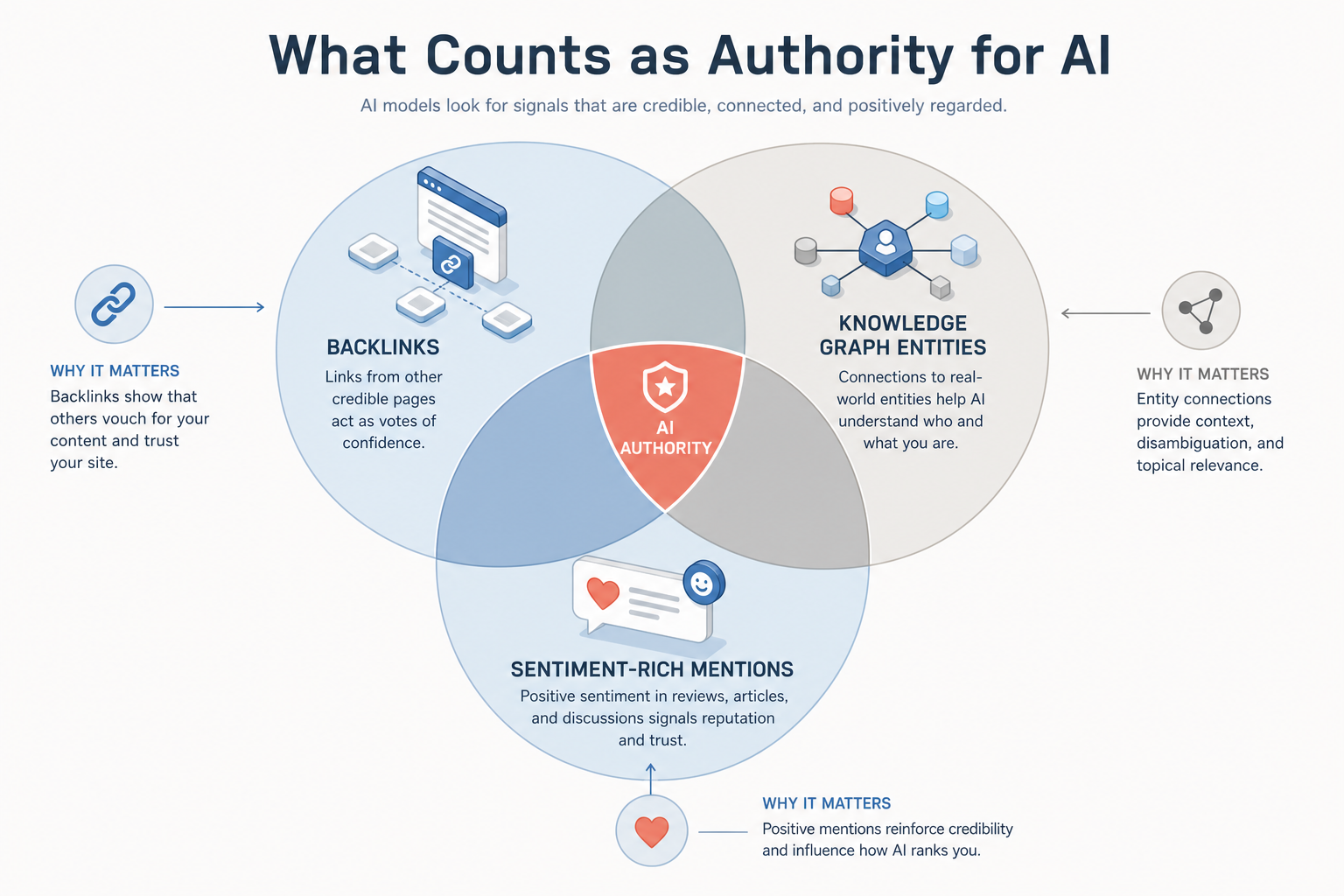
A Venn diagram showing the overlap of Backlinks, Knowledge Graph Entities, and Sentiment-rich Mentions, with 'AI Authority' at the centre.

Exercise

Find a client's top three competitors and ask Claude or ChatGPT: 'Compare the authority and reputation of [Client] vs [Competitors] in the [Niche] industry.' Note which specific awards, reviews, or partnerships the AI cites for each.

Key takeaways

  • Authority in AI is based on entity trust, not just backlink volume.
  • Unlinked mentions (digital citations) are high-value signals for LLMs.
  • Semantic co-occurrence associates your brand with established industry leaders.
  • Structured data acts as a formal declaration of your entity's attributes.
  • Knowledge Graph inclusion provides the most stable form of AI authority.
  • Reinforcement Learning from Human Feedback (RLHF) impacts how models perceive brand trust.
  • Factual accuracy against 'gold standard' data sources improves domain reliability scores.
  • Author authority is verified via 'SameAs' schema and cross-platform consistency.
  • Third-party reviews provide the external validation AI models use to verify claims.
  • Consistency across all digital touchpoints reduces 'entity noise' and increases trust.

Lesson Quiz

Pass at 70%.

1. How does an AI model primarily view a brand mention without a hyperlink?
2. What is 'Semantic Co-occurrence' in the context of AI authority?
3. Which schema type most directly helps an AI identify the 'nodes' of a brand's authority?
4. Why is 'Entity Noise' harmful to AI visibility?
5. What role does RLHF play in determining authority?
6. True or False: A link from a high-DR site with no topical relevance is less valuable for AI authority than a mention on a relevant, lower-DR site.
7. What is the primary benefit of being included in a Knowledge Graph like Wikidata?
8. How should a practitioner audit 'Author Authority' for a client?
9. Which of these is a concrete step to 'clean' entity data?
10. In AI-driven search, what does 'Citation Velocity' refer to?
Create a free account to save progress and earn a certificate.