Auditing Content for AI Consumption

Master the technical and semantic evaluation of content to ensure it is easily parsed, understood, and cited by Generative Engine Optimization (GEO) systems and LLMs.

12 min read
Foundations

Introduction to AI Content Auditing

For decades, SEO was about helping a crawler index a page for keyword matching. In the era of AI Visibility, the requirement has evolved. We are no longer just indexing pages; we are feeding a Large Language Model (LLM) information that it must synthesise, attribute, and trust. Auditing content for AI consumption involves evaluating how well a machine can extract facts, maintain the context of those facts, and identify the source for citation. This lesson covers the framework for assessing content through the lens of 'extractability' and 'citable signal'.

The Extraction Readiness Framework

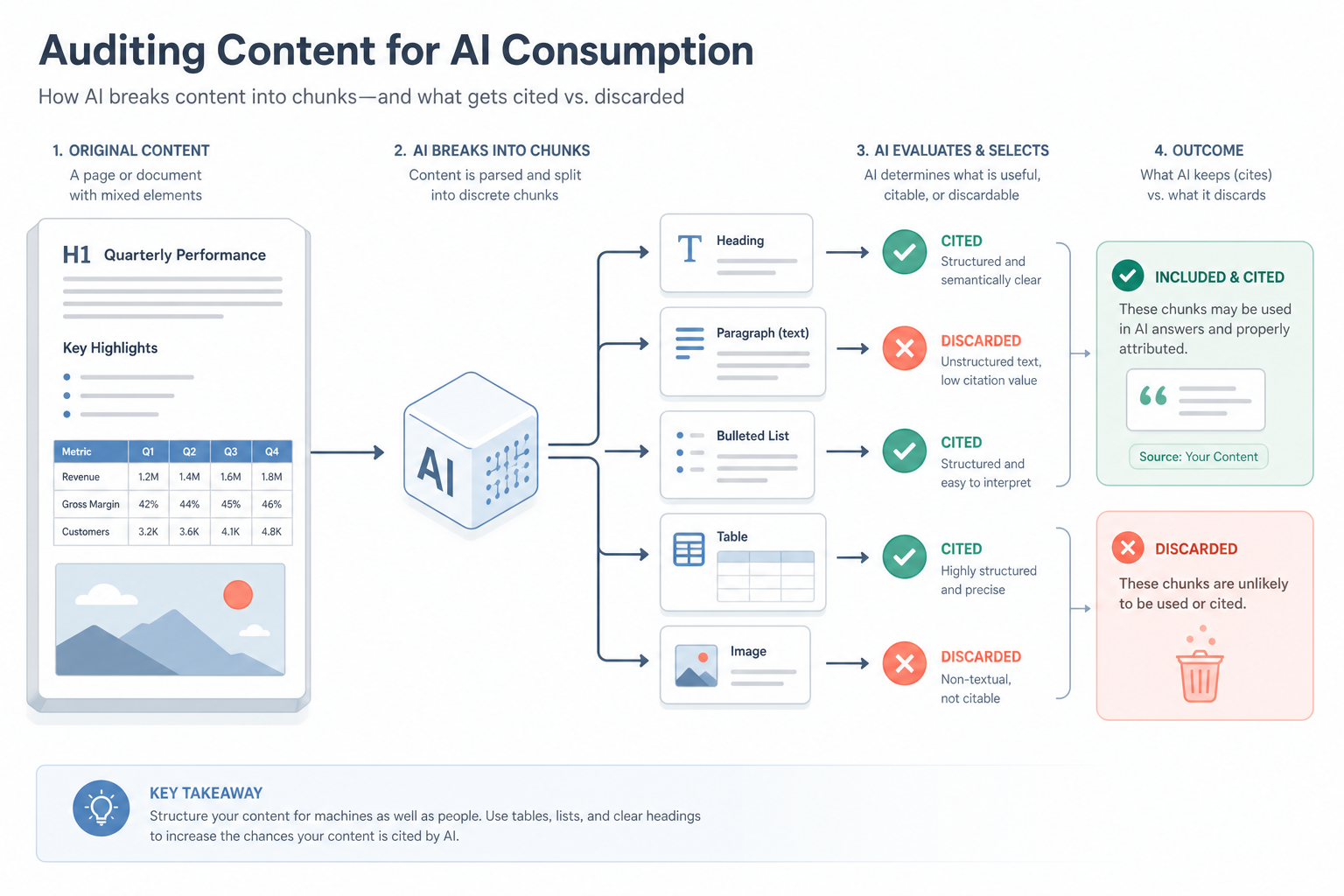
When an AI model or a RAG (Retrieval-Augmented Generation) system processes your content, it effectively breaks it down into chunks. If your content is a single, undifferentiated wall of text, the AI may fail to associate specific claims with your brand. An audit must evaluate three core pillars:

  1. Semantic Clarity: Is the language unambiguous? Does it use industry-standard terminology that maps to known entities in knowledge graphs?
  2. Structural Hygiene: Does the HTML structure assist or hinder the identification of key claims? (e.g., are lists actually <ul> tags or just paragraphs with dashes?)
  3. Data Factuality: Are claims supported by specific figures, dates, or references that an LLM can identify as a 'high-value' extraction point?

Auditing for Entity Density

A central component of AI consumption is Entity Recognition. AI systems look for 'entities' (places, people, organisations, concepts) and the relationships between them.

Step-by-Step Entity Audit:

  • Identify Core Entities: Use tools like Google’s Natural Language API or OpenCalais to see what entities the machine extracts from your top-performing pages.
  • Assess Salience: Salience scores (0.0 to 1.0) tell you how central an entity is to the text. If your target service has a low salience score despite being mentioned, your content is likely too diluted with 'fluff' or off-topic filler.
  • Check for Disambiguation: Ensure the content distinguishes between similar concepts. For example, if you mention 'Python', does the surrounding context make it clear whether you mean the snake or the programming language?

Structural Signal Evaluation

AI systems, particularly those using RAG like Perplexity or Gemini, often prioritise information found in specific structural elements. During an audit, you must check for the following:

1. The 'Citation Trap' Check

In AI-generated answers, the system often pulls the answer from a specific table or list. If your content presents comparative data (e.g., pricing or features) in an image rather than an HTML table, you are invisible to the AI. Audit all key data points to ensure they are text-based and correctly tagged.

2. Header-to-Paragraph Cohesion

LLMs use headers to create a mental map of content. Audit your H2s and H3s. Do they contain keywords that reflect the intent of the paragraph below? A header like 'Our Process' is weak. A header like 'The Five-Step AI Integration Process for UK Retailers' provides much stronger context for an LLM.

3. Bullet Point Efficiency

Lists are highly 'extractable'. Audit for list density. High-value information (benefits, steps, requirements) should almost always be in a list format to increase the likelihood of being pulled into an AI summary box.

Assessing Authoritativeness and Citability

For an AI to cite you, it must perceive your content as the 'source of truth'. This is often linked to the E-E-A-T (Experience, Expertise, Authoritativeness, Trustworthiness) framework but with a technical twist.

  • Primary Data Verification: Audit the presence of unique data. Does the page contain original research, surveys, or case studies? AI models are trained to look for 'unique information gain'.
  • Transparency Signals: Ensure every article has a clear author with a linked bio. Bio pages should include Schema.org 'Person' markup and links to other authoritative sources (LinkedIn, Wikipedia, or academic citations).
  • Reference Integrity: Outbound links to high-authority sources in your niche act as 'neighbourhood signals'. They tell the AI that your content exists in a reliable part of the internet ecosystem.

Worked Example: Auditing a B2B Software Guide

Imagine we are auditing a 2,000-word guide on "Cloud Security for Finance".

  • Observation: The guide uses the term "our solution" 15 times but only mentions the product name "FinVault" twice.

  • AI Impact: The LLM may attribute the benefits described to a generic category rather than the specific brand when generating an answer.

  • Audit Recommendation: Increase entity density by replacing vague pronouns with the brand or product entity.

  • Observation: A critical compliance checklist is presented as a high-quality infographic.

  • AI Impact: The AI cannot see the text inside the image easily, missing the chance to use those requirements as a source for a "What are the compliance needs?" query.

  • Audit Recommendation: Replicate the infographic data in a formatted HTML list or table beneath the image.

Avoiding 'AI-Repellent' Content

Certain content styles are effectively 'invisible' or 'repellent' to AI synthesis tools:

  • Overly Flowery Language: Metaphors and idioms confuse LLMs. If you describe a feature as "cutting edge and sharp as a tack," the AI might misinterpret the physical properties of the product.
  • Non-Text Elements: Reliance on iFrames, JavaScript-heavy toggles, or PDFs for core information. While some LLMs crawl PDFs, they are often processed with lower priority than native HTML.
  • Vague Proxies: Using words like "This," "It," or "They" at the start of paragraphs instead of naming the subject. This causes 'coreference resolution' issues during chunking.

Putting it into Practice: The Content Extraction Audit

  1. Crawl for Structure: Use a tool like Screaming Frog to export all H1-H3 headers and check for logical flow and entity inclusion.
  2. Test with LLMs: Take a 400-word chunk of your high-value content and paste it into ChatGPT or Claude with the prompt: "Extract the three most important facts from this text and attribute them to a specific entity."
  3. Refine the Attribution: If the LLM fails to attribute the facts to your brand, you need to tighten your entity-brand associations.
  4. Schema Alignment: Check that the ‘About’ and ‘Mentions’ nodes in your Schema.org markup align with the entities found in your text. Consistency across the code and the prose is key to AI trust.

Visual diagram

[ diagram placeholder ]

A flowchart showing a content block being broken into chunks by an AI, where structured elements (tables/lists) are successfully cited while unstructured text and images are discarded.

Exercise

Select a key service page on your site. Copy the text into a document and remove all CSS/Images. Read through the text and highlight every instance where your brand name appears. If it appears fewer than 3 times per 500 words, rewrite one section to replace generic pronouns with your brand/entity name to improve AI attribution.

Key takeaways

  • AI visibility requires content to be extractable and citable, not just indexed.
  • The Extraction Readiness Framework focuses on semantic clarity, structure, and factuality.
  • Entity density involves ensuring your brand and key concepts have high salience scores.
  • Data presented in images or non-text formats is often 'invisible' to AI citation engines.
  • Headers (H2s-H3s) must be descriptive and context-rich to help LLMs chunk data correctly.
  • Bullet points and HTML tables increase the likelihood of being featured in AI-generated responses.
  • Unique information gain is a primary signal that AI models look for when selecting sources.
  • Vague pronouns (it, they, this) can break the context during AI text chunking.
  • Authoritarian signals must be backed by Person Schema and links to external credible profiles.
  • Successful AI auditing involves testing content chunks directly in LLMs to check for attribution.

Lesson Quiz

Pass at 70%.

1. What is the primary goal of auditing content for AI consumption?
2. Which of these elements is most likely to be ignored by an AI trying to provide a factual answer?
3. In the context of AI auditing, what does 'Salience' represent?
4. Why are vague pronouns like 'it' or 'this' problematic for AI visibility?
5. Which header would be most effective for an AI-first content strategy?
6. What is 'Unique Information Gain'?
7. How does Schema.org markup assist in an AI audit?
8. When auditing authoritativeness, what should author bio pages ideally contain?
9. What is a 'Citation Trap' in the context of this lesson?
10. If an LLM identifies your content but attributes it to a generic category, what should you do?
Create a free account to save progress and earn a certificate.