Auditing Authority and Entity Signals

Develop a systematic framework for evaluating brand authority and entity strength within the Knowledge Graph to improve AI-driven visibility and trust signals.

15 min read
Foundations

Introduction

In the era of Generative Engine Optimisation (GEO) and AI-led search, visibility is no longer solely about keyword placements or backlink counts. Instead, Large Language Models (LLMs) and search engines prioritise entities—unambiguous, uniquely identifiable nodes of information. Auditing authority and entity signals is the process of assessing how well an AI understands who you are, what you do, and whether you can be trusted. This lesson provides a rigorous framework for evaluating these digital signals to ensure your brand is perceived as a primary source of truth.

The Shift from Keywords to Entities

Traditional SEO focused on strings (keywords). Modern visibility focuses on things (entities). An entity-based audit checks the 'connectedness' of a brand across the web. LLMs do not simply crawl pages; they synthesise information from massive datasets including Common Crawl, Wikipedia, and structured databases like Wikidata. If your entity signals are fragmented, contradictory, or absent, the AI will either ignore your brand or hallucinate incorrect information about it.

The Three Pillars of Entity Auditing

  1. Uniqueness: Is the entity clearly defined and distinct from competitors with similar names?
  2. Connectivity: Is the entity linked to high-authority nodes (e.g., industry bodies, major publications, government databases)?
  3. Consistency: Does the data (NAP: Name, Address, Phone; or core offerings) match across the entire digital ecosystem?

Step 1: Mapping the Knowledge Graph Presence

The first step of your audit is to determine if the entity already exists in major knowledge bases.

Google Knowledge Graph Audit

Search for the brand using its name. Check for a Knowledge Panel. If it exists, use the Google Knowledge Graph Search API to find the @id. This ID is the unique identifier (e.g., kgmid:/g/11bcdefg) that you should use in your structured data to 'claim' the entity.

Wikidata and Wikipedia

Check if the brand or its key personnel have Wikidata entries or Wikipedia pages. While not every SME qualifies for a Wikipedia page, every established brand should ideally have a Wikidata item. Wikidata provides the structured backbone for many LLMs. If the data there is outdated (e.g., listing a former CEO), this is a critical audit failure.

Step 2: Evaluating Schema.org Implementation

Schema markup is the 'contract' you sign with an AI to define who you are. A superficial audit just checks if Schema is present; an intermediate audit checks for relational density.

  • Organization Schema: Does it include sameAs links to high-authority social profiles and directories?
  • Person Schema: Are the founders or C-suite executives linked to the organisation using worksFor or founder properties?
  • Entity Links: Are you using about and mentions properties in your blog posts to link your content to established entities (e.g., mentioning a specific technology and linking to its Wikidata ID)?

Step 3: Assessing Digital Citations and E-E-A-T

AI models are trained on the 'consensus' of the web. If 50 high-authority sites say Company A is a leader in 'Ethical Fashion', the LLM will treat that as a fact.

The Citation Audit Checklist

  • Consistency of Narrative: Is the brand described the same way on LinkedIn, Crunchbase, and its own website?
  • Sentiment of Mentions: Use a sentiment analysis tool to check how the brand is discussed on forums like Reddit or industry-specific boards. LLMs are sensitive to 'reputation' data.
  • Association with Quality: Is the brand mentioned alongside its competitors in 'Best of' lists? If you are missing from these lists, the AI ignores you during comparative prompts.

Worked Example: Auditing 'GreenGrid Solutions'

Scenario: A mid-sized B2B SaaS company, GreenGrid Solutions, provides AI-driven energy management. Despite great SEO, they are rarely mentioned in ChatGPT or Perplexity when users ask for 'best energy management software'.

The Audit Findings:

  1. Entitity Confusion: A search reveals a 'Green Grid' non-profit and a 'GreenGrid' construction firm. The SaaS company has no unique Knowledge Graph ID.
  2. Broken Links: Their Wikidata entry still lists a physical office they moved out of three years ago.
  3. Schema Gaps: Their Organization schema is basic. It lacks sameAs links to their Crunchbase profile and their award citations.
  4. C-Suite Invisibility: The CEO has no personal brand presence, and the Person schema is missing from the team page.

Resolution Plan:

  • Update Wikidata with the correct headquarters and latest funding round.
  • Implement advanced Organization schema with a knowsAbout property specifically targeting 'Energy Management Systems' and 'AI Optimization'.
  • Secure mentions in three high-authority trade journals to create 'expert peer' signals.

Step 4: Assessing Authorial Authority

LLMs increasingly look for the 'Author' entity to verify the reliability of a claim.

  • Authorship Audit: Do your content creators have clear bios?
  • Off-site Footprint: Does the author contribute to other reputable sites?
  • Social Proof: Are the author’s LinkedIn or X profiles linked via sameAs in the Article Schema?

Putting it into Practice

To conduct a mini-audit for a client or your own brand, follow these steps:

  1. Search the GKG: Use a tool like the 'Entity Explorer' to see if your brand has a Knowledge Graph node.
  2. Audit 'sameAs': List every platform your brand is on. Ensure the URL structure is identical across all profiles (e.g., all using https and the same trailing slash settings).
  3. Identify the 'Authority Gap': Find a competitor who is being cited by AI. Compare their 'Digital Footprint' to yours. Are they on Wikipedia? Do they have 10x more citations from educational (.edu) or government (.gov) sites?
  4. Validate Schema: Use the Schema Markup Validator. Look specifically for the mentions field. If you aren't connecting your content to known entities, you are writing in a vacuum.

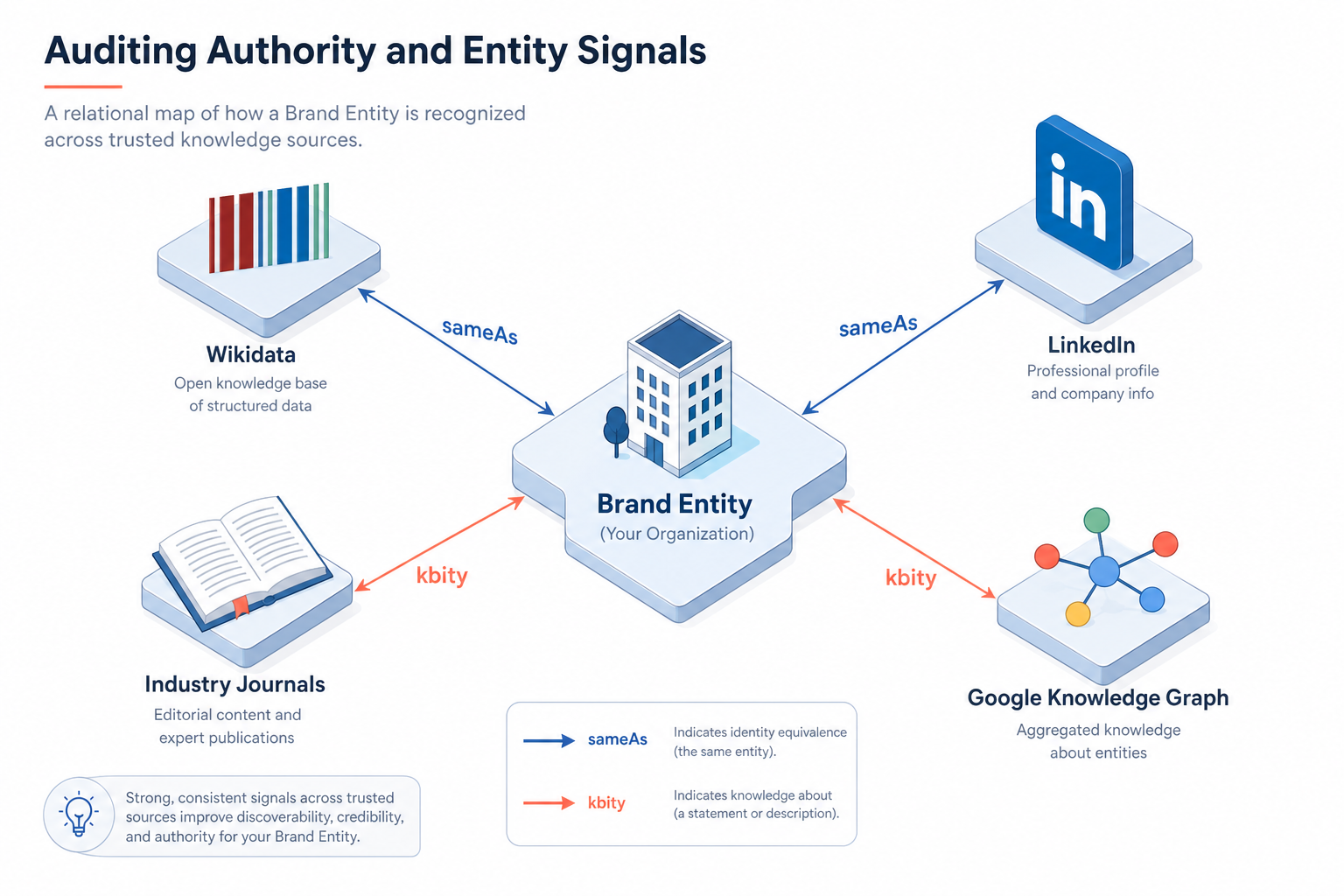
Visual diagram

[ diagram placeholder ]

A relational map showing a central 'Brand Entity' node connected via 'sameAs' and 'kbity' links to Wikidata, LinkedIn, industry journals, and the Google Knowledge Graph.

Exercise

Identify a brand you work with and find their Google Knowledge Graph ID using a free API explorer tool. Then, verify if their Organization schema includes at least three 'sameAs' links to external authoritative profiles, and identify one missing high-value citation source.

Key takeaways

  • AI visibility relies on being a recognised entity rather than just ranking for keywords.
  • The Google Knowledge Graph (GKG) ID is a crucial 'anchor' for your digital identity.
  • Wikidata acts as a primary source for many LLM training datasets and must be kept accurate.
  • Schema.org markup should focus on 'relational density' through properties like sameAs and knowsAbout.
  • Consistent NAP (Name, Address, Phone) data is still vital for local and corporate entity verification.
  • LLMs assess authority by evaluating the consensus of mentions across high-authority third-party sites.
  • Human authors are entities too; their off-site reputation influences the trust of the content they write.
  • Entity confusion occurs when multiple brands have similar names and lack unique identifiers.
  • Comparative AI prompts (e.g., 'What are the top 5...') rely on your brand appearing in industry lists.
  • Auditing for E-E-A-T requires looking beyond your own domain to the broader digital ecosystem.

Lesson Quiz

Pass at 70%.

1. What is the primary difference between a 'string' and an 'entity' in the context of AI visibility?
2. Which database is most frequently used as a structured data source for LLM training?
3. Why is the 'sameAs' property important in Organization Schema?
4. What should you do if an audit reveals 'entity confusion' with a similarly named competitor?
5. In an entity audit, what does 'relational density' refer to?
6. Which Schema property is best for asserting that a brand is an expert in a specific field?
7. An LLM refuses to recommend a brand. According to the lesson, what is a likely cause?
8. What is a 'Knowledge Graph ID' (kgmid)?
9. How does 'Person' schema contribute to a brand's authority?
10. During an audit, you find the company is mentioned on Reddit in a negative context. Why does this matter for AI visibility?
Create a free account to save progress and earn a certificate.