Building a Monitoring Cadence

Establish practical daily, weekly, and monthly workflows to track AI visibility without succumbing to data fatigue, ensuring actionable insights for client reporting and strategy.

12 min read
Foundations

Introduction

Building a monitoring cadence is the bridge between theoretical AI engine optimisation (AEO) and sustainable client results. In the fast-moving landscape of LLMs and Generative Engine Optimisation (GEO), data changes rapidly. However, checking Perplexity or Gemini every hour is not a strategy; it is a distraction. A robust monitoring cadence ensures that you identify significant shifts in brand sentiment and citation share while maintaining the bandwidth to actually implement improvements.

This lesson outlines the tiered approach required for an AI Visibility Practitioner, moving from rapid daily checks to deep-dive monthly strategic reviews. By the end of this lesson, you will be able to manage AI visibility as a repeatable, scalable service offering for your clients or internal stakeholders.

The Three-Tiered Cadence Framework

A successful monitoring rhythm balances reactive responses with proactive planning. We divide activities into three distinct buckets: Operational (Daily), Analytical (Weekly), and Strategic (Monthly).

1. Daily: The 'Health Check' (15 Minutes)

Daily monitoring is not about comprehensive data collection; it is about risk mitigation and identifying immediate volatility.

Key Activities:

  • Brand Sentiment Pulse: Run a quick query on a primary engine (e.g., ChatGPT with Search or Perplexity) regarding the client's headline brand name + 'reviews' or 'latest news'. You are looking for 'hallucination spikes' or sudden negative sentiment shifts.
  • Automated Alert Review: Check notifications from monitoring tools (like Brand24 or custom Google Search Console triggers) for sudden drops in clicks from 'AI Overviews' (SGE).
  • Competitor Launch Watch: Briefly scan the news for any major announcements from competitors that might trigger a shift in how AI engines categorise the industry.

Standard Operating Procedure (SOP): If no major 'Red Flag' is found within 15 minutes, stop. Do not get sucked into infinite prompting.

2. Weekly: The 'Performance Pulse' (1-2 Hours)

Weekly rhythm allows you to see patterns that daily checks miss, without the lag of a monthly report.

Key Activities:

  • Keyword Group Tracking: Track a sample of 20-50 high-intent keywords across different AI engines. Is the client being cited? Are they in the top 3 'sources'?
  • Format Audit: Observe if the AI engines are changing the way they present information for your niche. For example, is Gemini suddenly prioritising 'Comparison Tables' over 'Bullet Points' for your target queries?
  • Source Attribution: Identify which specific third-party sites (e.g., Reddit, niche forums, industry journals) the AI engines are pulling from most frequently for your client’s topics.
  • Query Log Review: If using a tool that tracks 'Share of Model' (SoM), review the week-on-week change.

3. Monthly: The 'Strategic Deep-Dive' (4-6 Hours)

This is where you translate data into the next month’s content and technical roadmap.

Key Activities:

  • Comprehensive Citation Share Report: Mapping out exactly what percentage of brand mentions in AI responses belong to the client vs. competitors.
  • Entity Relationship Mapping: Using tools or manual testing to see if the 'knowledge graph' associations for the brand have evolved. Is the brand now more strongly associated with 'Sustainable' or 'Budget-friendly'?
  • Content Gap Analysis: Identifying common questions the AI engines are answering using competitor data where the client is currently invisible.
  • Technical Infrastructure Review: Checking Schema.org implementation and site speed (Core Web Vitals) to ensure the technical foundation for AI crawling remains optimal.

Worked Example: A B2B SaaS Client

Let’s look at a hypothetical scenario for 'LuminaPay', a mid-market payroll software provider.

The Strategy:

  • Daily: The practitioner checks the query 'Is LuminaPay reliable?' on Perplexity. On Tuesday, they notice a new Reddit thread from a disgruntled ex-employee appearing in the 'Sources' list. Because it was caught daily, the practitioner can immediately advise the PR team to address the thread.
  • Weekly: Assessing 'Best payroll software for UK SMEs'. LuminaPay has dropped from the first cited source to the fourth. The practitioner notes that the AI is now citing a new government guide on payroll legislation.
  • Monthly: The practitioner synthesises these findings. They see that over four weeks, AI engines are increasingly citing 'compliance' features. The monthly report recommends a shift in content production from 'User Experience' to 'Regulatory Compliance' to regain the top citation spot.

Tools and Documentation

You cannot manage this cadence in your head. You require a Visibility Tracker. This is typically a spreadsheet or dashboard containing:

  1. The Query Bank: A categorised list of prompts (Informational, Transactional, Comparison).
  2. The Engine Split: Columns for ChatGPT, Claude, Gemini, and Perplexity.
  3. The Sentiment Score: A simple 1-5 scale of how the brand is portrayed.
  4. The Citation Count: How many times the client's URL or brand name appears in the footnotes/sources.

Avoiding 'Prompt Fatigue'

A common mistake for practitioners is 'over-prompting'—running 50 variations of the same query manually. To prevent this:

  • Use Static Seed Prompts: Use the exact same phrasing every week to ensure data consistency.
  • Use Incognito/Clean Profiles: AI responses are personalised. Ensure you are monitoring the 'neutral' view, not your own history.
  • Automate the Mundane: Use APIs or specialized AI tracking software where budget allows to handle the bulk scraping of responses.

Putting it into Practice

To implement this cadence starting tomorrow, follow these steps:

  1. Define your 'Vital Few' Queries: Identify the 5 most important questions a customer asks before buying. These are your Daily and Weekly check-ins.
  2. Set a 'Threshold for Action': Decide what constitutes a 'crisis'. A 5% drop in citation share might be weekly noise; a 25% drop is a monthly strategic emergency.
  3. Calendarise the Review: Block out 'AI Visibility Audit' on your Friday afternoon for weekly checks and the first Tuesday of the month for the deep dive.
  4. Standardise the Reporting: Create a simple template that translates 'AI sources' into 'Business impact' for your client. Do not just show them screenshots; show them the trend lines.

By following this rhythm, you transition from being a reactive 'checker' to a proactive 'practitioner' who anticipates AI shifts before they impact the client’s bottom line.

Visual diagram

[ diagram placeholder ]

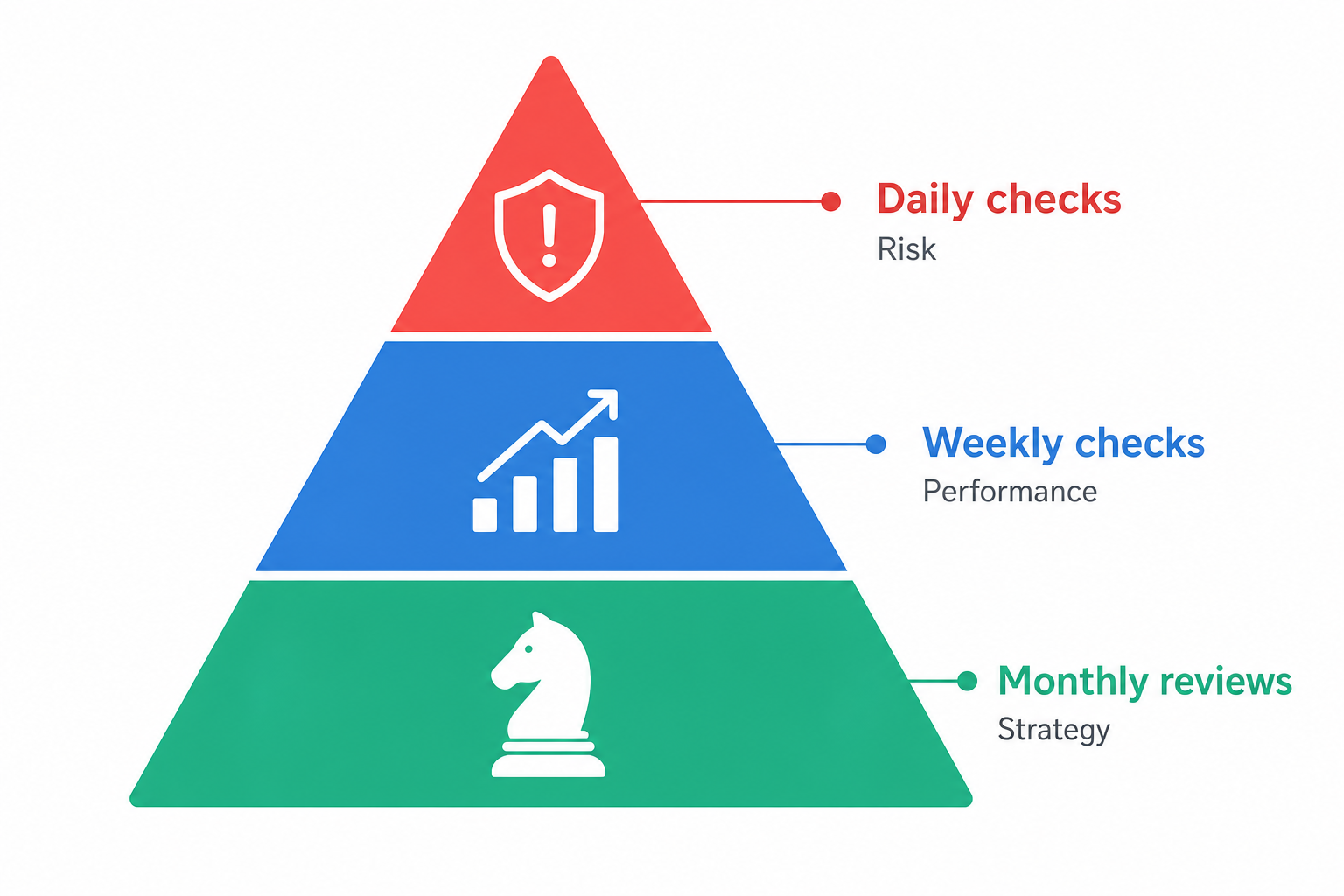
A pyramid diagram showing Daily checks at the narrow top (Risk), Weekly checks in the middle (Performance), and Monthly reviews at the broad base (Strategy).

Exercise

Select one 'money' keyword for a client. Use the same prompt on Perplexity and Gemini once a day for 3 days. Record the top 3 sources cited each day in a spreadsheet and note if the order or the specific URLs change.

Key takeaways

  • Daily checks should focus on high-risk brand sentiment and sudden hallucinations.
  • Weekly monitoring identifies trends in citation share and changes in AI response formats.
  • Monthly reviews are for deep-dive entity mapping and strategic content planning.
  • Data consistency requires using static 'seed prompts' to avoid query variance.
  • Practitioners must distinguish between 'noise' (minor phrasing changes) and 'signals' (loss of citations).
  • Monitoring multiple engines (ChatGPT, Claude, Gemini, Perplexity) is essential as their sources vary.
  • The 'Threshold for Action' prevents overreacting to minor algorithmic fluctuations.
  • Documenting third-party sources (like Reddit or niche blogs) helps identify future backlink/PR targets.
  • AI visibility is inherently volatile; a structured cadence provides stability for client reporting.
  • Always use 'clean' or incognito sessions to avoid personalised AI bias in results.

Lesson Quiz

Pass at 70%.

1. What is the primary goal of a 'Daily Health Check' in AI visibility?
2. Why should you use 'Static Seed Prompts' for weekly monitoring?
3. In the 'Weekly Pulse', what does 'Format Audit' refer to?
4. Which activity is best suited for a 'Monthly Strategic Deep-Dive'?
5. What is 'Prompt Fatigue' in the context of AI monitoring?
6. If you notice a 5% weekly drop in citation share, what is the best initial action?
7. Why is it important to track 'Source Attribution' weekly?
8. What should be included in a Visibility Tracker spreadsheet?
9. What is the 'neutral view' in AI monitoring?
10. How does a practitioner use the results of a Monthly Review?
Create a free account to save progress and earn a certificate.