Earning New Citations

Master the strategic content shifts and authority-building tactics required to convert high-value brand mentions into verifiable citations within AI-driven search results.

12 min read
Foundations

Introduction to Earning AI Citations

In the era of Generative Engine Optimisation (GEO), the metric of success is shifting from mere organic rankings to 'citation density'. Unlike traditional backlinks, which rely on a hyperlink for SEO value, AI citations are derived from an LLM's confidence in your brand as a source of truth for a specific query. Earning these citations requires a dual-track strategy: producing 'high-probability' content structures that models can easily parse, and establishing the third-party corroboration that signals authority to the model's training data and retrieval systems.

To earn new citations, practitioners must move beyond generic blogging. We focus on 'Information Gain'—the inclusion of unique data, perspectives, or findings that are not currently present in the top-performing search results. When your content provides the most concise or unique answer to a complex query, you increase the likelihood of the AI synthesising your brand as the primary reference.

The Hierarchy of Citation Probability

Not all content is equally 'citeable' by an LLM. To earn new citations, your content must align with the way Retrieval-Augmented Generation (RAG) systems operate. These systems look for:

  1. Direct Declarative Sentences: Statements like "Our study found that X results in Y" are more likely to be extracted than "It might be argued that Y is an outcome of X."
  2. Structural Clarity: Data formatted in lists, tables, and short paragraphs with clear headers acts as an 'anchor' for the model's extraction layer.
  3. Unique Entities: Introducing and defining specific proprietary methodologies (e.g., the 'SeenAndCited Framework') forces the model to cite you as the originator of that entity.
  4. Verified Data points: Original statistics, survey results, and benchmark data provide the 'hard facts' that AI engines crave to ground their generative responses.

Strategic Content Moves: The 'Proprietary Insight' Model

To earn a new citation, you must provide value that the model cannot find elsewhere. If three competitors all state that "SEO is important for business," the LLM will aggregate that information without attributing it to a specific source. However, if your brand releases a whitepaper stating "SEO for AI Overviews increases CTR by 14% compared to standard SERPs," you have created a unique, citeable fact.

Step 1: Identifying Knowledge Gaps

Use tools to identify 'no-answer' or 'generic-answer' queries in your niche. If the AI provides a vague response, there is a citation opportunity. Conduct original research or synthesise internal data to fill that gap.

Step 2: Optimising for Synthesis

Write your findings using the 'Inverse Pyramid' style. The most citeable fact should appear in the first paragraph. Use schema markup (specifically Dataset or Article schema) to help the model identify the core claims of the page. This increases the chance of being cited in the 'sources' carousel or as a superscript citation.

Authority Moves: Third-Party Corroboration

AI models do not just read your website; they evaluate the web's consensus about you. Earning citations often happens indirectly through 'Source Seeding'.

Digital PR for AI

Instead of chasing high-DA links for the sake of PageRank, target publications that are known sources for GPT or Claude's training data. This includes industry-leading journals, Wikipedia, and high-authority news sites. A mention in The Financial Times or TechCrunch carries significantly more weight in an AI's 'latent space' than twenty guest posts on minor blogs.

The 'Expertise Echo'

Ensure your subject matter experts (SMEs) are cited across different platforms. When an LLM sees a name associated with a topic on LinkedIn, a podcast transcript, and an industry whitepaper, it builds a 'Knowledge Graph' entity. When a user asks about that topic, the model is more likely to cite the expert's home site as the definitive source.

Worked Example: B2B SaaS Case Study

The Client: A cloud security firm providing 'Zero Trust' solutions. The Problem: They are mentioned in general lists but never cited in AI explanations of 'How to implement Zero Trust'.

The Strategy:

  1. Content Move: Created a 'Zero Trust Implementation Framework' using a specific 7-step numbered list. They included a unique metric: the 'Lateral Movement Resistance Score'.
  2. Authority Move: They pitched the framework to three major cybersecurity news outlets. One outlet published the 7-step list in full.
  3. Result: Within six weeks, ChatGPT and Perplexity began using the 7-step list as a summary for implementation queries, citing the client's original blog post as the source for the 'Lateral Movement Resistance Score'.

Technical Enablers for Citations

Beyond the words on the page, certain technical elements act as 'citation magnets':

  • Citeable Quotes: Highlight pull-quotes in your CSS. LLMs often pick up these distinct blocks of text.
  • TL;DR Summaries: Include a 'Key Findings' box at the top of long-form content. This is a direct invitation for an RAG system to scrape and cite.
  • NID (Named Entity Disambiguation): Use SameAs schema to link your brand to its social profiles and Wikipedia page, ensuring the AI correctly attributes multiple mentions to a single entity.

Putting it into Practice

  1. Audit current citations: Use a tool or manual prompts to see who the AI currently cites for your top three keywords.
  2. Identify the 'Unique Fact': Determine what information your competitors are missing. Is it a price point? A percentage? A specific 'how-to' step?
  3. Publish and Structure: Create a page dedicated to this unique fact. Use H2 headers that mirror the intent of the user query (e.g., 'What is the average cost of X?').
  4. Seed the Claim: Share the findings on high-authority platforms to create a 'consensus' that the AI can verify.
  5. Monitor: Track changes in AI responses over 30-60 days to see if your unique fact begins to appear with a citation link.

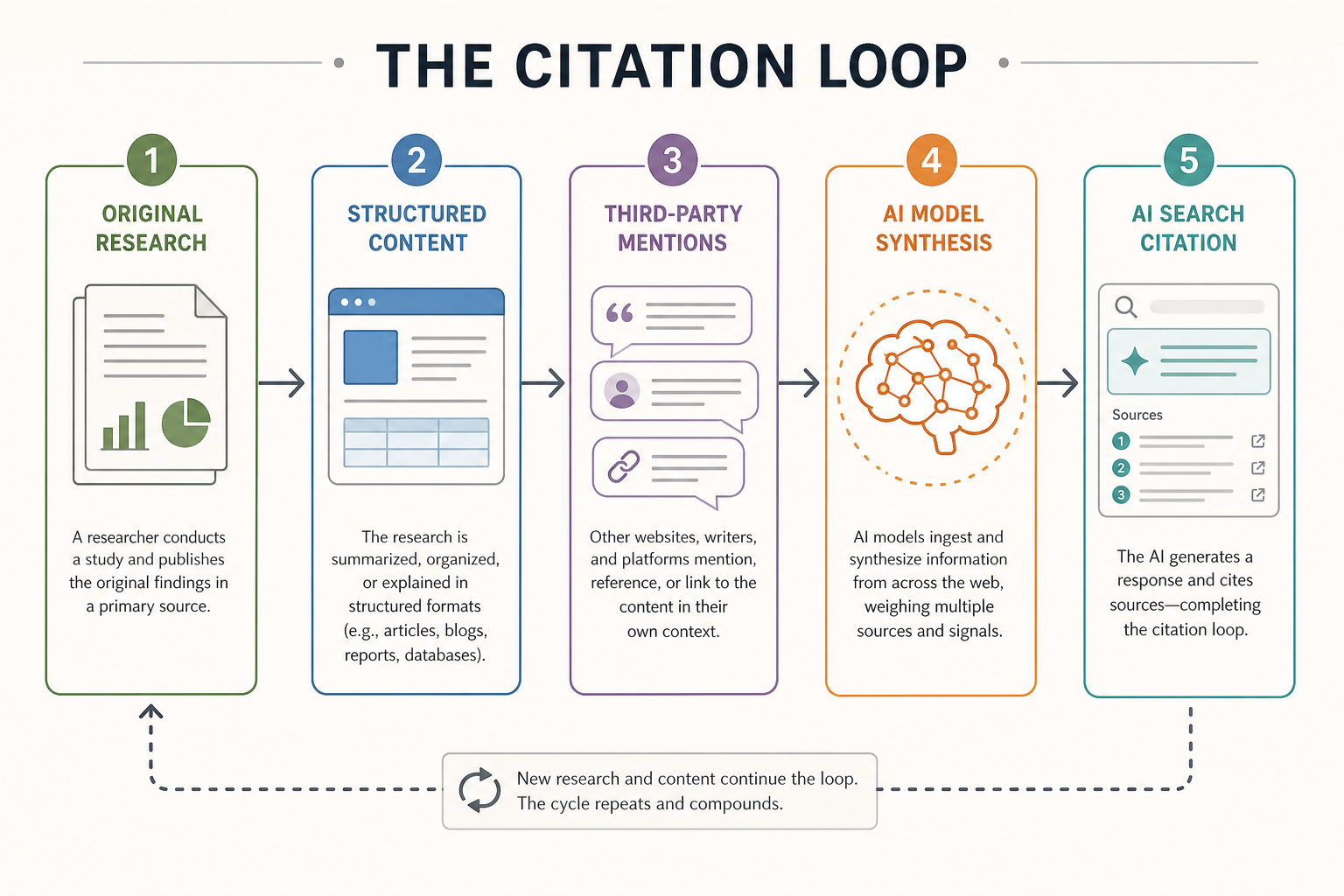
Visual diagram

[ diagram placeholder ]

A flowchart showing the 'Citation Loop': from Original Research to Structured Content, then Third-Party Mentions, leading to AI Model Synthesis and finally the AI Search Citation.

Exercise

Identify a 'How-to' query related to your brand. Rewrite the core instructions into a clear, 5-step numbered list with one unique proprietary tip, then add a 'TL;DR' summary box at the top of the existing page to encourage AI extraction.

Key takeaways

  • AI citations depend on 'Information Gain'—providing unique data not found in existing training sets.
  • RAG systems prioritise structured data like tables, lists, and declarative sentences.
  • Direct, assertive language is more citeable than passive or hedge-worded text.
  • Original research and proprietary metrics are the strongest magnets for new citations.
  • Citations are often earned via the 'Expertise Echo'—consistent mentions across multiple high-authority domains.
  • Schema markup (Dataset/Article) helps LLMs parse and attribute specific claims to your brand.
  • Targeting niche industry publications is more effective for AI visibility than broad, low-quality backlinking.
  • The 'TL;DR' section of a whitepaper acts as a primary extraction point for generative engines.
  • Establishing a named entity (a unique framework or tool) forces the AI to cite the creator.
  • Regularly monitoring AI responses is essential to verify if new content strategy is triggering citations.

Lesson Quiz

Pass at 70%.

1. What is 'Information Gain' in the context of AI citations?
2. Which content structure is most likely to be cited by an LLM in a summary?
3. Why are 'Proprietary Metrics' effective for earning citations?
4. What is the primary role of Digital PR in the AI Visibility context?
5. In the 'Inverse Pyramid' style of writing, where should the most citeable fact go?
6. Which schema type is most beneficial for a page containing original research figures?
7. What does the term 'Expertise Echo' refer to?
8. Which of these is a 'declarative sentence' that an AI is likely to cite?
9. How do 'TL;DR' summaries help in AI Citation earning?
10. Why is 'SameAs' schema important for AI attribution?
Create a free account to save progress and earn a certificate.