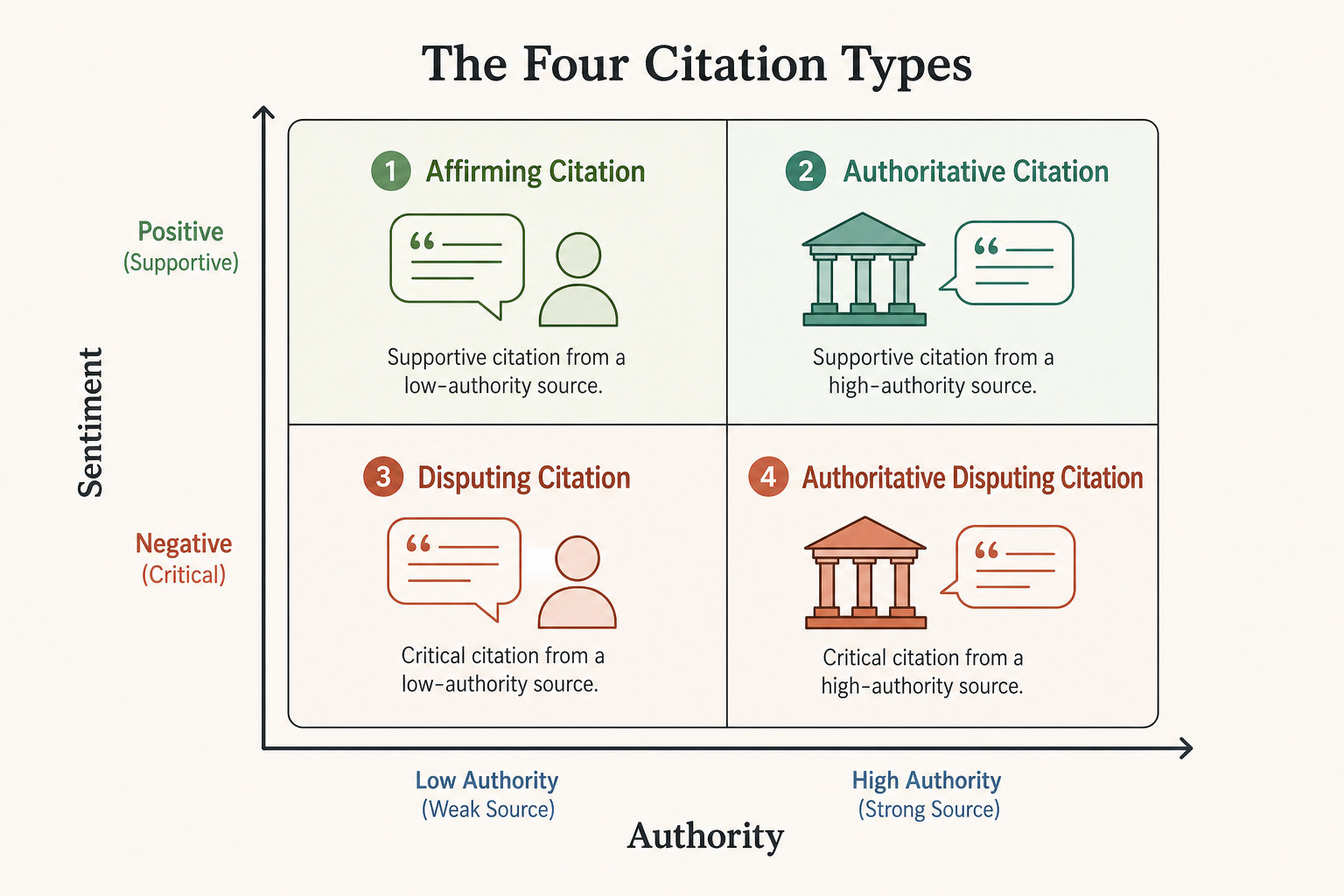
Introduction to Citation Classification
In the era of AI-powered search engines—such as Google Search Generative Experience (SGE), Perplexity, and Claude—the presence of a citation is no longer the sole metric for success. For an AI Visibility Practitioner, the challenge lies in the qualitative assessment of how your brand is being referenced. Not all citations are equal; some merely acknowledge your existence, while others actively drive conversion or, conversely, harm your reputation.
By classifying citations into four primary categories—Branded, Neutral, Comparative, and Negative—practitioners can move beyond vanity metrics and begin to influence the specific context in which Large Language Models (LLMs) present their brand. This lesson provides a framework for auditing these citations, understanding the underlying LLM logic, and applying these insights to client reporting.
1. Branded (Positive) Citations
Branded citations are the 'Gold Standard' of AI visibility. These occur when the LLM identifies your client as a definitive authority or the primary solution to a specific user query.
Characteristics:
- The brand name appears in a bolded or highlighted context.
- The citation originates from a high-authority source that explicitly praises the brand's features.
- The AI response uses affirmative language (e.g., 'The most reliable software for...').
Example: If a user asks, 'How do I automate UK payroll correctly?', and the LLM responds, 'Sage is widely regarded as the most compliant tool for UK SMEs,' followed by a link to Sage's knowledge base, this is a Branded Citation.
Practitioner Action: Reinforce these by ensuring the cited source remains up-to-date and deep-linking to secondary pages to create a 'cluster' of authority.
2. Neutral Citations
Neutral citations are common in informational queries where the AI provides a list or a factual definition without expressing a preference. While good for reach, they offer lower conversion potential than branded mentions.
Characteristics:
- The brand is mentioned as part of a general list.
- The citation link points to a dictionary definition, a news mention, or an industry directory.
- The language is clinical and objective (e.g., 'Companies in this space include X, Y, and Z').
Example: A query for 'What is a CRM?' leads to a response: 'A CRM helps companies manage relationships. Examples of CRM providers include Salesforce, HubSpot, and Pipedrive.'
Practitioner Action: Optimize the metadata of the cited page to include more 'differentiators' (e.g., 'cheapest', 'fastest', 'best for startups') to nudge the AI toward a more specific, comparative classification in the future.
3. Comparative Citations
Comparative citations occur when the AI evaluates your client against competitors. These are high-intent signals that suggest the user is in the 'consideration' phase of the buyer journey.
Characteristics:
- The citation is accompanied by a list of 'Pros and Cons'.
- The LLM uses relational data to rank the brand (e.g., 'While X is cheaper, Y offers more security features').
- Links often point to third-party review sites or comparison articles.
Example: 'Which is better for small teams: Slack or Microsoft Teams?' The AI cites a Reddit thread and a TechRadar review. Slack is cited for 'UX and ease of use,' while Teams is cited for 'Office 365 integration.'
Practitioner Action: Audit the third-party sources (the 'cited agents'). If a review site is providing outdated info that the AI is repeating, the intervention must happen at the source website, not your own site.
4. Negative Citations
These are citations where the AI warns the user or mentions your brand in a context that could discourage interaction. This is often caused by 'hallucinated' data or real public relations crises reflected in the training data.
Characteristics:
- Prefaced by phrases like 'Users often complain about...' or 'Historical issues with...'.
- Links to forum threads, trust-pilot reviews with low scores, or news articles about scandals.
- Omission from a list where the brand logically belongs (a 'negative by exclusion').
Example: In response to 'Is Brand X sustainable?', the AI cites a 2018 news article about a supply chain audit failure, ignoring the brand’s 2023 sustainability report.
Practitioner Action: This requires 'Sentiment Correction.' You must flood the index with newer, high-authority structured data and white papers that address the criticisms directly to provide the LLM with updated 'ground truth'.
Worked Example: The Boutique Hotel Audit
Client: 'The Riverside Inn', a luxury boutique hotel in Norfolk. Query: 'Best places to stay in Norfolk for a romantic weekend.'
The LLM Response:
- 'The Victoria at Holkham is praised for its proximity to the beach [Link 1].'
- 'The Riverside Inn offers scenic views but some guests find it noisy due to the nearby pub [Link 2].'
- 'For a budget option, consider The Premier Inn [Link 3].'
Classification Analysis:
- Link 1 (Competitor): Branded/Positive. Strong authority.
- Link 2 (Client): Mixed/Negative. The citation highlights a specific drawback (noise).
- Link 3 (Competitor): Neutral/Categorical.
Strategy: The practitioner identifies that [Link 2] is a TripAdvisor review from 2021. The hotel has since installed triple glazing. The practitioner must now generate new content (a blog post on 'Quiet retreats in Norfolk') and encourage new reviews focusing on 'peace and quiet' to shift this citation from Negative to Branded.
Putting it into Practice: Your Citation Audit Checklist
To effectively classify and act on citations for a client, follow these steps:
- Extraction: Use an AI visibility tool or manual prompting to identify the top 50 citations for your client's core keywords.
- Sentiment Assignment: Label each citation (Branded, Neutral, Comparative, Negative).
- Source Analysis: Identify the 'Source Domain.' Is the AI citing your own site, a news site, or a social platform?
- Identification of Gaps: Where is the client cited as 'Neutral' when they should be 'Branded'?
- Intervention Plan: Create targeted content or schema updates to address 'Negative' citations and bolster 'Comparative' advantages.
- Verification: Re-run the queries after 30 days to see if the LLM's classification has shifted based on your content injections.