How AI Engines Choose Citations

Master the specific signals used by ChatGPT, Perplexity, and Gemini to select and verify sources in a generative search environment.

12 min read
Foundations

Introduction

Unlike traditional Google Search, which focuses on ranking a list of documents based on a complex web of backlinks and metadata, AI engines like ChatGPT (OpenAI), Perplexity, and Gemini (Google) act as synthesizers. Their goal is to identify a small subset of the most reliable or relevant sources to present a single, coherent answer. In this lesson, we explore the mechanics of source selection, moving beyond basic SEO to understand the 'Search Augmented Generation' (SAG) and 'Retrieval-Augmented Generation' (RAG) processes that dictate which websites get the coveted citation slot.

The Architecture of Citation Selection

AI engines do not 'search' the web in the way humans do via a keyboard. Instead, they utilise a process known as Retrieval-Augmented Generation (RAG). When a user submits a prompt, the engine performs the following internal steps:

  1. Deconstruction: The engine breaks the query into core intents and entities.
  2. Retrieval: It searches a vector database or an integrated search engine (like Bing for ChatGPT) for the top 5–20 most relevant 'chunks' of text.
  3. Synthesis: The LLM (Large Language Model) reads these chunks and selects the ones that most accurately answer the user's specific prompt.
  4. Verification and Citation: The AI attributes specific claims to the sources it actually used in the final response.

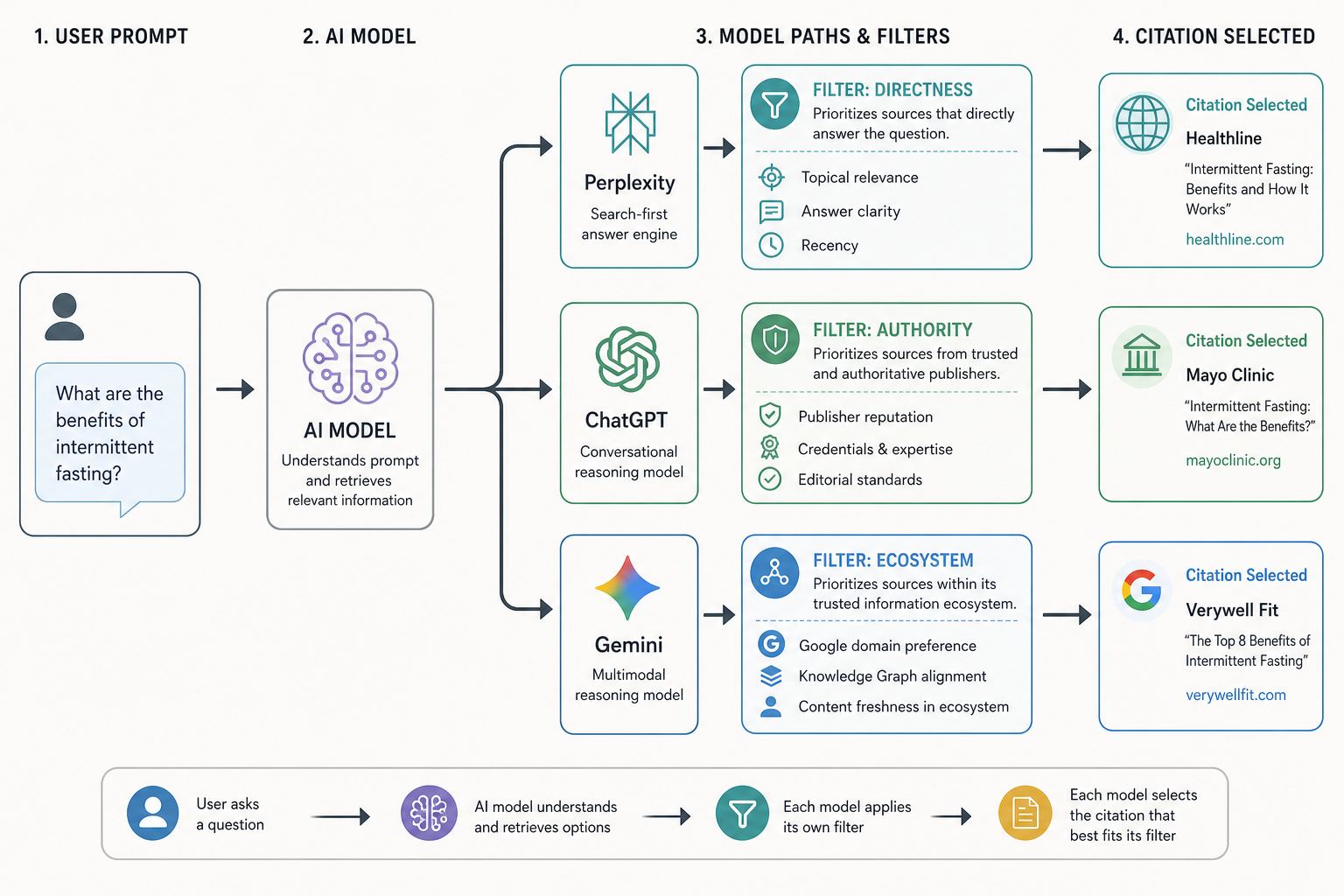
1. Perplexity: The Directness Signal

Perplexity prioritises information density. Because it functions as a 'discovery engine', it favours sources that have short, punchy, and fact-heavy paragraphs. If your content is buried under 1,000 words of 'SEO filler' before reaching the data, Perplexity's retrieval window may miss it.

  • Signal: Direct Answer Format. Does the page provide a clear definition or data point within the first two paragraphs?
  • Example: If the query is 'Cost of solar panels in Manchester 2024', Perplexity will pass over a lifestyle blog about green living in favour of a local installer's pricing table.

2. ChatGPT (Search): The Authority and Freshness Signal

Following its 2024 updates, ChatGPT's search functionality leans heavily on Bing's index but applies its own filter for 'conversational utility'. It looks for sources that can sustain a dialogue.

  • Signal: Citation Density. How many other reputable sources cite this specific data point? ChatGPT often chooses 'Original Source' content—primary research, white papers, or news breaks.
  • Signal: Intent Alignment. It looks for content that matches the likely follow-up questions of the user.

3. Google Gemini: The Ecosystem Signal

Gemini has an advantage and a bias: the Google Search index and the 'Helpful Content' framework. It prioritises the 'Double-E-E-A-T' (Experience, Expertise, Authoritativeness, Trustworthiness) criteria more strictly than its competitors.

  • Signal: Entity Connectivity. How well is the author associated with the topic in the Knowledge Graph?
  • Signal: Structured Data. Gemini relies heavily on Schema.org (especially FactCheck, Product, and Article schemas) to parse information for its 'AI Overviews'.

Concrete Signals: What the AI is Looking For

Semantic Relevance vs. Keyword Matching

Traditional SEO focuses on keywords. AI engines focus on 'embeddings'. An embedding is a numerical representation of a concept. If your content uses the exact vocabulary and surrounding context that the AI associates with a 'high-quality answer', you are more likely to be selected.

Fact-Density and Verifiability

AI engines are prone to hallucinations. To mitigate this, their training rewards sources that provide verifiable facts.

  • Quantifiable Data: Use numbers, percentages, and dates.
  • Citation in Content: Outbound links to academic papers or government data signals to the AI that your content is a research-backed node in the web.

Readability and Formatting

AI crawlers 'read' differently. They look for structural markers that denote importance:

  1. Markdown-style headers: Clear H2s and H3s.
  2. Tables and Lists: AI engines find it significantly easier to extract data from a structured table than from a meandering paragraph.
  3. Short Sentences: Subject-Verb-Object structures are easier for NLP (Natural Language Processing) models to parse without losing the context.

Worked Example: Optimising for a Finance Client

Scenario: A UK-based fintech company wants to be the cited source for 'Best ISAs for young investors'.

The Traditional Approach: Create a long-form article titled 'Everything You Need to Know About ISAs' with 3,000 words of content.

The AI-Optimised Approach:

  1. Direct Summary: Include a 'Key Takeaways' box at the top with a 2024 ISA comparison table.
  2. Entity Association: Update the author bio to link to the author’s LinkedIn and previous contributions to the Financial Times or similar authoritative sites (establishing E-E-A-T).
  3. Schema Alignment: Implement FinancialProduct schema detailing interest rates and eligibility.
  4. Semantic Clustering: Ensure the content answers 'How much can I invest?' and 'What are the tax benefits?' immediately following the list of top products.

Result: Perplexity retrieves the table data for its summary. Gemini uses the schema to display the ISA in a carousel. ChatGPT cites the 'Key Takeaways' as a definitive guide.

Putting It Into Practice

To move from SEO to AI Visibility, follow these steps locally within your agency or department:

  1. The Prompt Audit: Enter your target keywords into ChatGPT, Perplexity, and Gemini. Identify which sites are currently being cited.
  2. Content Gap Analysis: Look at the 'missing' information in those citations. If the AI provides a general answer, can you provide a more specific, data-backed answer?
  3. Structural Overhaul: Take your top-performing organic pages and add a 'TL;DR' (Too Long; Didn't Read) section with high fact-density specifically for LLM retrieval.
  4. Monitor 'Citability': Use tools to track how often your brand name appears in AI responses versus your competitors. This is the new ‘Share of Voice’.

By aligning your content with the retrieval mechanisms of AI—not just the ranking factors of a search engine—you ensure your brand remains the quoted authority in a generative world.

Visual diagram

[ diagram placeholder ]

A workflow diagram showing a user prompt entering an AI model, which then splits into three paths (Perplexity, ChatGPT, Gemini), highlighting the different filters each uses (Directness, Authority, Ecosystem) to select a citation.

Exercise

Perform a 'Citation Audit' on your website. Choose a core service page, then ask Perplexity: 'What are the top benefits of [Your Service] according to reputable sources?' If your site isn't cited, identify one table or factual list you can add to the page to make the information more 'retrievable' for the next crawl.

Key takeaways

  • AI engines use Retrieval-Augmented Generation (RAG) to select sources.
  • Perplexity prioritises information density and direct text-to-query matching.
  • ChatGPT (Search) focuses on original research, news freshness, and conversational utility.
  • Google Gemini relies heavily on established E-E-A-T signals and the Knowledge Graph.
  • Fact-density (the number of verifiable facts per 100 words) is a major citation signal.
  • Structured data like Schema.org helps AI engines parse and verify content accurately.
  • Using tables and lists makes your data significantly more 'retrievable' for AI models.
  • Semantic relevance is more important than keyword density in the AI citation model.
  • Direct, simplified sentence structures (Subject-Verb-Object) increase NLP parsing accuracy.
  • AI visibility is the new 'Share of Voice', measured by citation frequency in LLM responses.

Lesson Quiz

Pass at 70%.

1. What is the primary process AI engines use to find information before generating a response?
2. Which signal does Perplexity prioritize the most?
3. How does Gemini's source selection differ from ChatGPT?
4. Why are tables and lists effective for AI visibility?
5. What is 'Fact-Density' in the context of citation analysis?
6. What is the second step in the AI's internal process after receiving a prompt?
7. Which schema type would most help Gemini verify an article's points for an AI Overview?
8. In AI visibility, what has largely replaced 'Keyword Matching'?
9. What does ChatGPT (Search) specifically look for to maintain its 'conversational' style?
10. If your brand is mentioned but not linked in an AI response, it is still considered:
Create a free account to save progress and earn a certificate.